
Opening your dashboard
Class 10 Biology Chapter 2: Structure of Chromosomes, Cell Cycle and Cell Division Solutions
48 textbook questions with step-by-step answers, free to read, for ICSE 2026-27.
Get talked through Ch 2, not just shown the answer
Reading a finished solution is not the same as being able to do it. The AI tutor takes one question at a time and works it with you, in your own words, until you can.
- Ask it out loud, in your own words
- It gives you the next step, not the answer
- Stuck on part (ii)? Start there
48 questions with solutions
1–10 marks · Mixed difficulty
- 11 mark
Question 1
Fill in the blanks :
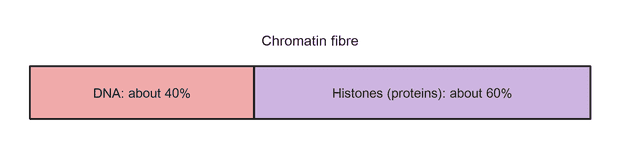
Chromatin fibre is made up of DNA and ..........
Solve with AIWritten solution
Solution:
Concept: Chromatin is the thread-like material of the nucleus; it is made of DNA together with a particular type of protein.
Step 1 — Recall what chromatin is made of.
The chromatin material is formed of two substances: DNA (deoxyribonucleic acid), which carries the genes, and histones, the proteins round which the DNA is wound.
Step 2 — Complete the sentence.
The blank needs the protein: chromatin fibre is made up of DNA and histones (histone proteins).
The histones help to coil and pack the very long DNA molecule. When the cell prepares to divide, the chromatin fibres coil and condense further to form chromosomes.
Therefore, chromatin fibre is made up of DNA and histones.
- 21 mark
Question 2
Fill in the blanks :
The two sister chromatids of a chromosome are attached to each other at ..........
Solve with AIWritten solution
Solution:
Concept: A chromosome seen at the start of cell division is already duplicated: it has two identical halves (sister chromatids) joined at one point.
Step 1 — Recall how the two chromatids are held together.
The two sister chromatids are joined at a small constricted region of the chromosome called the centromere.
Step 2 — Complete the sentence.
The blank needs that region: the two sister chromatids of a chromosome are attached to each other at the centromere.
The centromere also attaches the chromosome to a spindle fibre. In anaphase the centromere divides, and the sister chromatids are pulled to opposite poles.

Watch out: Centromere (part of a chromosome) and centrosome (a region of the cytoplasm) are different structures.
Therefore, the sister chromatids are attached at the centromere.
- 31 mark
Question 3
Fill in the blanks :
The structure of DNA was first discovered by..........
Solve with AIWritten solution
Solution:
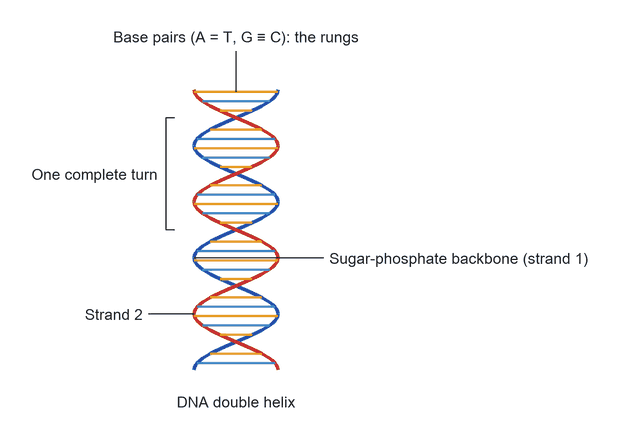
Concept: DNA is a double helix: two complementary strands wound round each other like a twisted ladder.
Step 1 — Recall who worked out the double helix.
In 1953 James Watson and Francis Crick proposed the double-stranded helical structure of DNA. They shared the Nobel Prize for it in 1962.
Step 2 — Complete the sentence.
The blank needs their names: the structure of DNA was first discovered by Watson and Crick.
Rosalind Franklin's X-ray photographs of DNA (1952) gave an important clue, but the model of the double helix was worked out by Watson and Crick.
Therefore, the structure of DNA was first discovered by Watson and Crick (1953).
- 41 mark
Question 4
Fill in the blanks :
The three components of a nucleotide are .........., .......... and .......... .
Solve with AIWritten solution
Solution:
Concept: Each DNA strand is a chain of repeating units called nucleotides, and every nucleotide has the same three parts.
Step 1 — Recall the parts of a nucleotide.
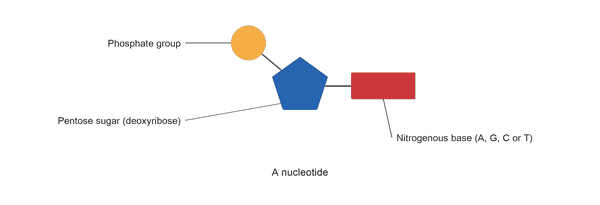
A nucleotide is built from a five-carbon (pentose) sugar, a phosphate group and a nitrogenous base.
Step 2 — Complete the sentence.
The three blanks are: pentose sugar, phosphate group and nitrogenous base.
The phosphate and the sugar alternate along the length of the strand and form its backbone. The base is joined to the sugar and points inwards; in DNA it is adenine, guanine, cytosine or thymine.
Therefore, a nucleotide is made of a pentose sugar, a phosphate group and a nitrogenous base.
- 51 mark
Question 5
Fill in the blanks :
DNA strand wound around a histone octamer forms a complex called a .......... .
Solve with AIWritten solution
Solution:
Concept: Histones are proteins that help to coil and package DNA into small structural units.
Step 1 — Recall how DNA is packed on histones.
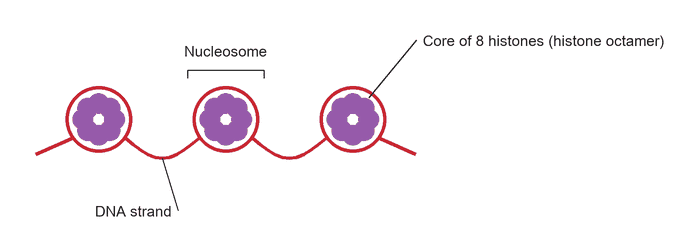
Eight histone molecules form a core called the histone octamer (octa = eight). The DNA strand winds round this core one or two times, like a rope wound round a ball.
Step 2 — Complete the sentence.
The blank needs the name of that complex: it is called a nucleosome.
Many nucleosomes lie one after another along the DNA, like beads on a string; this is the first step in packing the long DNA into a chromosome.
Watch out: Nucleosome (DNA + histone core, the unit of a chromosome) is not the same as nucleotide (the unit of DNA).
Therefore, DNA wound round a histone octamer forms a nucleosome.
- 61 mark
Question 6
Fill in the blanks :
A specific sequence of nucleotides on a chromosome constitutes a ..........
Solve with AIWritten solution
Solution:
Concept: The hereditary information is stored in the order of the nucleotides along the DNA of a chromosome.
Step 1 — Recall what a gene is.
A particular stretch of DNA, with its own sequence of nucleotides, codes for a particular protein; that protein shows up as a particular feature of the body.
Step 2 — Complete the sentence.
The blank needs that unit: a specific sequence of nucleotides on a chromosome constitutes a gene.
Genes are the units of heredity: they pass from parents to offspring and decide the characters of the offspring.
Therefore, a specific sequence of nucleotides on a chromosome is a gene.
- 71 mark
Question 7
The chromatin material is formed of
Solve with AIAnswer
(A) DNA only
- Correct
(B) DNA and Histones
(C) Histones only
(D) Nucleotides
Answer: (B) DNA and Histones
Concept: The chromatin material that makes up a chromatin fibre is formed of two substances: DNA and histone proteins.
Step 1 — List the parts of chromatin.
Chromatin contains DNA, which carries the genes, and histones, the proteins round which the DNA is coiled and packed.

Step 2 — Match with the options.
Only option (B) names both of these substances.
Why the other options are wrong:
- (A) DNA only: it leaves out the histones, which form a large share of chromatin.
- (C) Histones only: it leaves out the DNA, which carries the genes.
- (D) Nucleotides: nucleotides are only the building units of the DNA; they do not include the histone proteins.
Therefore, chromatin is formed of DNA and histones, option (B).
- 81 mark
Question 8
The term “chromosomes” literally means
Solve with AIAnswer
(A) Inherited bodies
(B) Twisted threads
- Correct
(C) Coloured bodies
(D) Shining threads
Answer: (C) Coloured bodies
Concept: The word chromosome comes from two Greek roots: chroma = colour and soma = body.
Step 1 — Split the word.
Chromo- means coloured and -some means body, so chromosome literally means coloured body.
Step 2 — See why the name fits.
When a cell prepares to divide, the chromatin condenses into thick chromosomes. These take up certain dyes strongly and look coloured under the microscope, which gave them the name.
Watch out: The question asks for the meaning of the word, not the job of chromosomes.
Why the other options are wrong:
- (A) Inherited bodies: chromosomes do carry the genes of heredity, but that is their function, not the meaning of the word.
- (B) Twisted threads: 'thread' is the meaning of mitos, the root of mitosis, not of chromosome.
- (D) Shining threads: neither root of the word means shining or thread.
Therefore, chromosome literally means coloured body, option (C).
- 91 mark
Question 9
The number of chromosomes in a certain type of cell division is halved. This kind of cell division occurs in
Solve with AIAnswer
(A) only testis
(B) only ovary
- Correct
(C) both ovary and testis
(D) all body cells
Answer: (C) both ovary and testis
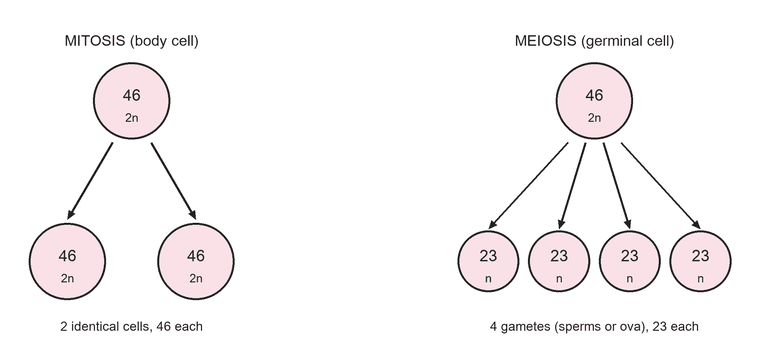
Concept: The cell division that halves the chromosome number is meiosis (reduction division); it produces the gametes (sex cells).
Step 1 — Name the division.
A division in which the chromosome number is halved (2n → n) is meiosis.
Step 2 — Find where gametes are made.
In humans, meiosis takes place in the reproductive organs: in the testis it gives sperms and in the ovary it gives eggs (ova). Each gamete gets 23 chromosomes instead of 46.
Why the other options are wrong:
- (A) only testis: meiosis also takes place in the ovary, to make the eggs.
- (B) only ovary: meiosis also takes place in the testis, to make the sperms.
- (D) all body cells: ordinary body cells divide by mitosis, which keeps the chromosome number the same.
Therefore, the halving division occurs in both the ovary and the testis, option (C).
- 101 mark
Question 10
Synthesis phase in the cell cycle is called so for the synthesis of more of
Solve with AIAnswer
(A) RNA
(B) RNA and proteins
- Correct
(C) DNA
(D) Glucose
Answer: (C) DNA
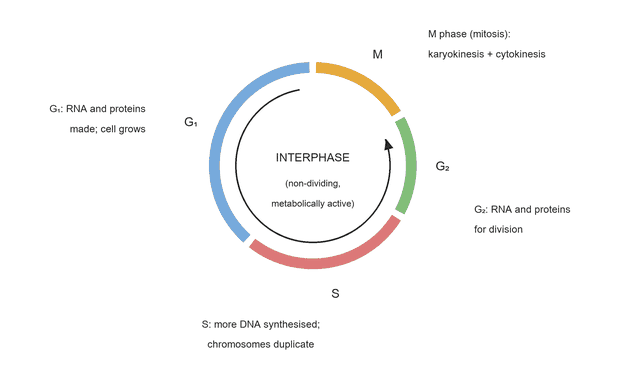
Concept: Interphase has three phases: first growth phase (), synthesis phase (S) and second growth phase (). The S phase is named after what is made in it.
Step 1 — Recall what happens in the S phase.
In the S phase the cell makes (synthesises) more DNA: every DNA molecule is copied.
Step 2 — See the result.
Because the DNA is copied, each chromosome becomes two sister chromatids joined at the centromere, ready to be shared between two daughter cells.
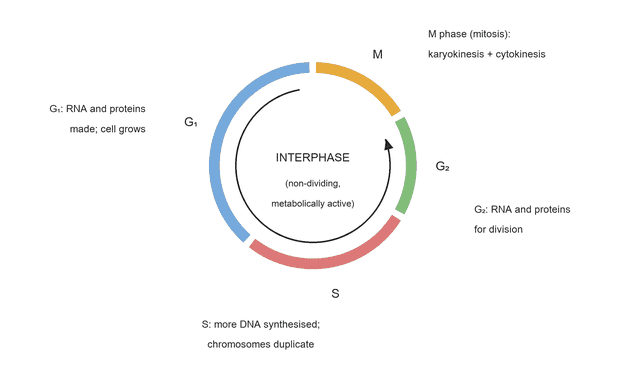
Watch out: RNA and proteins are made in the growth phases, not in the S phase.
Why the other options are wrong:
- (A) RNA: RNA is made mainly in the and phases; the S phase is not named after it.
- (B) RNA and proteins: RNA and proteins are what the cell makes in the and phases.
- (D) Glucose: glucose is made by green plants in photosynthesis; no phase of the cell cycle is named after it.
Therefore, the S phase is named for the synthesis of DNA, option (C).
- 111 mark
Question 11
In which one of the following options the stages of mitosis have been given in correct sequence ?
Solve with AIAnswer
(A) Prophase, metaphase, telophase, anaphase
- Correct
(B) Prophase, metaphase, anaphase, telophase
(C) Anaphase, telophase, prophase, metaphase
(D) Telophase, anaphase, prophase, metaphase
Answer: (B) Prophase, metaphase, anaphase, telophase
Concept: Karyokinesis (division of the nucleus) passes through four phases in a fixed order; each phase prepares for the next.
Step 1 — Prophase comes first.
In prophase (pro = first) the chromosomes become short and thick, and the nuclear membrane and nucleolus disappear.
Step 2 — Metaphase comes second.
In metaphase the chromosomes line up in one plane at the equator.
Step 3 — Anaphase comes third.
In anaphase the sister chromatids separate and are pulled to opposite poles.
Step 4 — Telophase comes last.
In telophase (telo = end) the chromosomes thin out and a nuclear membrane forms round each set.

Watch out: Use the meaning of the names: pro = first, telo = end.
Why the other options are wrong:
- (A) Prophase, metaphase, telophase, anaphase: it puts telophase before anaphase, but the chromatids must reach the poles (anaphase) before nuclei can form round them (telophase).
- (C) Anaphase, telophase, prophase, metaphase: it starts with anaphase, but chromatids cannot separate before the chromosomes condense and line up.
- (D) Telophase, anaphase, prophase, metaphase: it starts with telophase, which is the last phase of karyokinesis.
Therefore, the correct order is prophase, metaphase, anaphase, telophase, option (B).
- 121 mark
Question 12
The new cells are to be produced for all except :
Solve with AIAnswer
(A) Growth
- Correct
(B) Movement
(C) Repair
(D) Replacement
Answer: (B) Movement
Concept: New cells must be produced for four purposes: growth, replacement, repair and reproduction.
Step 1 — Check each option against the list.
Growth, repair and replacement are all on the list, so each of them needs new cells.
Step 2 — Find the one that is not.
Movement is not on the list. The body moves with the cells it already has (muscle cells contract); no new cells have to be made for it.
Why the other options are wrong:
- (A) Growth: growth needs new cells: the zygote divides again and again to build the tissues of the body.
- (C) Repair: repair needs new cells: cells divide to heal a cut in the skin or join a broken bone.
- (D) Replacement: replacement needs new cells: about 2 million red blood cells are destroyed every second and are replaced by new ones made in the bone marrow.
Therefore, movement does not need new cells, option (B).
- 131 mark
Question 13
The chromosomes are duplicated in :
Solve with AIAnswer
(A) M phase
(B) phase
- Correct
(C) S phase
(D) phase
Answer: (C) S phase
Concept: A chromosome is duplicated when its DNA is copied, and this happens in the synthesis (S) phase of interphase.
Step 1 — Find when DNA is copied.
In the S phase more DNA is made, so each chromosome makes a copy of itself.
Step 2 — See what the copy looks like.
The two copies, the sister chromatids, stay joined at the centromere. The amount of DNA doubles, but the number of chromosomes stays the same.
Watch out: The chromosomes are duplicated before division (S phase), not during it (M phase).
Why the other options are wrong:
- (A) M phase: the M phase is the dividing phase; the chromosomes are already duplicated when it starts.
- (B) phase: the phase comes before the S phase: the cell grows and makes RNA and proteins.
- (D) phase: the phase comes after the S phase: the cell makes the RNA and proteins needed for division.
Therefore, the chromosomes are duplicated in the S phase, option (C).
- 141 mark
Question 14
Triple hydrogen bonds are present between :
Solve with AIAnswer
(A) Adenine and Thymine
(B) Adenine and Cytosine
(C) Adenine and Guanine
- Correct
(D) Guanine and Cytosine
Answer: (D) Guanine and Cytosine
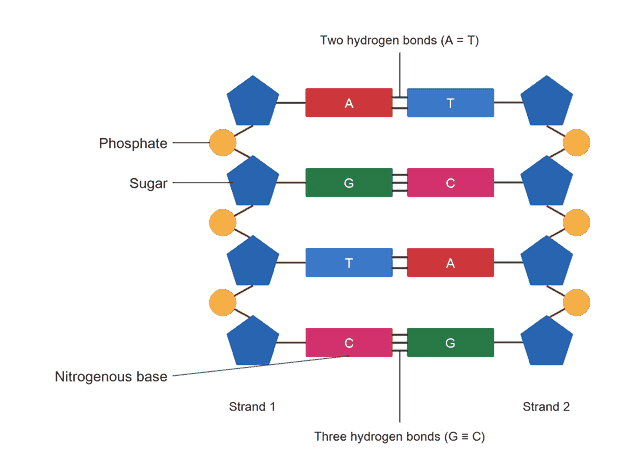
Concept: The two DNA strands are held together by hydrogen bonds between complementary bases: A pairs with T by two bonds (A = T), G pairs with C by three bonds (G ≡ C).
Step 1 — Recall the A–T pair.
Adenine always pairs with thymine, joined by two hydrogen bonds.
Step 2 — Recall the G–C pair.
Guanine always pairs with cytosine, joined by three hydrogen bonds. So the triple bonds are between guanine and cytosine.
Why the other options are wrong:
- (A) Adenine and Thymine: adenine and thymine do pair, but by only two hydrogen bonds.
- (B) Adenine and Cytosine: adenine and cytosine are not complementary, so they do not pair.
- (C) Adenine and Guanine: adenine and guanine are both purines, so they are not a complementary pair.
Therefore, triple hydrogen bonds join guanine and cytosine, option (D).
- 151 mark
Question 15
In the cells of a human male body, the number of autosomes is :
Solve with AIAnswer
(A) 23 pairs
- Correct
(B) 22 pairs
(C) 1 pair
(D) 46 pairs
Answer: (B) 22 pairs
Concept: A human body cell has 46 chromosomes in 23 pairs: 22 pairs of autosomes and 1 pair of sex chromosomes (XY in a male, XX in a female).
Step 1 — Count the pairs.
A body cell has 23 pairs of chromosomes in all.
Step 2 — Take away the sex chromosomes.
One of these pairs decides the sex: XY in a male. The rest are autosomes.
This is 44 autosomes, the same in a male and a female.

Why the other options are wrong:
- (A) 23 pairs: 23 pairs is the total, with the sex chromosomes included.
- (C) 1 pair: 1 pair is the sex chromosomes (XY in a male), not the autosomes.
- (D) 46 pairs: 46 pairs would be 92 chromosomes; 46 is the number of chromosomes, not of pairs.
Therefore, a male body cell has 22 pairs of autosomes, option (B).
- 161 mark
Question 16
The basis of genetic variation in the living organisms during meiosis occurs due to :
Solve with AIAnswer
(A) Cell division
(B) Mutation
- Correct
(C) Crossing over
(D) Karyokinesis
Answer: (C) Crossing over
Concept: Meiosis mixes the genes. In the first meiotic division the homologous chromosomes pair, and their non-sister chromatids exchange pieces; this exchange is crossing over.
Step 1 — The homologous chromosomes pair.
A maternal and a paternal chromosome of the same pair come to lie side by side.
Step 2 — Chromatids exchange pieces.
Two non-sister chromatids touch at a point called the chiasma, break there and swap portions.

Step 3 — New gene combinations result.
Each chromatid now carries a new mix of maternal and paternal genes (recombination). This is the basis of the variations seen among offspring.
Why the other options are wrong:
- (A) Cell division: 'cell division' is too general: mitosis gives identical daughter cells and no variation.
- (B) Mutation: a mutation is a sudden change in a gene; it is not a step of meiosis.
- (D) Karyokinesis: karyokinesis only means division of the nucleus; it also happens in mitosis, which gives identical cells.
Therefore, variation in meiosis is due to crossing over, option (C).
- 171 mark
Question 17
After a mitotic cell division, a human female cell will have :
Solve with AIAnswer
(A) 22 + X chromosomes
(B) 44 + XY chromosomes
- Correct
(C) 44 + XX chromosomes
(D) 22 + XX chromosomes
Answer: (C) 44 + XX chromosomes
Concept: Mitosis keeps the same chromosome number: each daughter cell gets exactly the set of chromosomes of its parent cell.
Step 1 — Write the female set.
A human female body cell has 46 chromosomes: 44 autosomes and two X chromosomes, written 44 + XX.
Step 2 — Apply mitosis.
Mitosis passes the full (diploid) set to each daughter cell, so the new cell still has 44 + XX.
Watch out: 22 + X is an egg, made by meiosis; mitosis never halves the number.
Why the other options are wrong:
- (A) 22 + X chromosomes: 22 + X is the haploid set of an egg, made by meiosis, not mitosis.
- (B) 44 + XY chromosomes: 44 + XY is the set of a male body cell.
- (D) 22 + XX chromosomes: 22 + XX adds up to only 24 chromosomes; a cell made by mitosis must have all 46.
Therefore, the female cell will have 44 + XX chromosomes, option (C).
- 181 mark
Question 18
The correct sequence of phases in interphase is :
Solve with AIAnswer
(A) , and S
(B) S, and
- Correct
(C) , S and
(D) , S and
Answer: (C) , S and
Concept: Interphase is the non-dividing phase of the cell cycle, with three phases always in the order: first growth → synthesis → second growth.
Step 1 — First growth phase.
In the cell makes RNA and proteins and grows in size.
Step 2 — Synthesis phase.
In S the DNA is copied and the chromosomes are duplicated.
Step 3 — Second growth phase.
In the cell makes the RNA and proteins needed for division; then it enters the M phase.
Why the other options are wrong:
- (A) , and S: it puts before S, but the second growth phase follows DNA synthesis.
- (B) S, and : it starts with S, but a newly formed cell first grows in .
- (D) , S and : it is the exact reverse of the correct order.
Therefore, the order is , S and , option (C).
- 191 mark
Question 19
The phase of karyokinesis which is almost the reverse of prophase is :
Solve with AIAnswer
(A) Interphase
(B) Metaphase
(C) Anaphase
- Correct
(D) Telophase
Answer: (D) Telophase
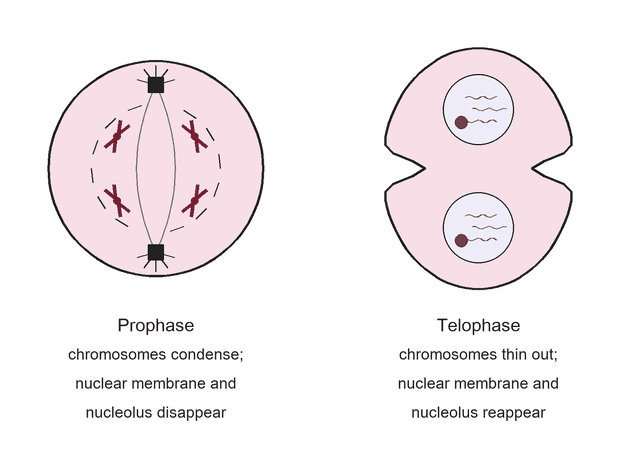
Concept: Compare the first and the last phase of karyokinesis: what happens in prophase is undone in telophase.
Step 1 — Recall prophase.
In prophase the chromosomes become short and thick, spindle fibres appear, and the nuclear membrane and nucleolus disappear.
Step 2 — Recall telophase.
In telophase the chromosomes become long and thin again (chromatin), the spindle disappears, and the nuclear membrane and nucleolus reappear.
Step 3 — Compare.
Each change of telophase is the opposite of a change of prophase, so telophase is almost the reverse of prophase.
Why the other options are wrong:
- (A) Interphase: interphase is the non-dividing phase; it is not a phase of karyokinesis at all.
- (B) Metaphase: in metaphase the chromosomes are still thick and simply line up at the equator.
- (C) Anaphase: in anaphase the chromatids move to the poles; no nucleus is re-formed yet.
Therefore, the phase almost the reverse of prophase is telophase, option (D).
- 201 mark
Question 20
The lengthwise arrangement of DNA mainly consists of a phosphate group attached with :
Solve with AIAnswer
(A) Hexose sugar
(B) Purines
- Correct
(C) Pentose sugar
(D) Pyrimidines
Answer: (C) Pentose sugar
Concept: A DNA strand is a chain of nucleotides; along its length phosphate and pentose sugar alternate, and a base is joined to each sugar on the inner side.
Step 1 — Read the strand lengthwise.
Going along a strand we meet phosphate, sugar, phosphate, sugar, and so on. This forms the side (backbone) of the DNA ladder.
Step 2 — Name the partner of phosphate.
So each phosphate group is joined to a pentose sugar; the bases point inwards and form the rungs.

Why the other options are wrong:
- (A) Hexose sugar: the sugar of DNA is a pentose (five-carbon) sugar, not a hexose (six-carbon) sugar such as glucose.
- (B) Purines: purines (adenine, guanine) are bases joined to the sugar, not to the phosphate.
- (D) Pyrimidines: pyrimidines (thymine, cytosine) are also bases joined to the sugar on the inner side.
Therefore, the phosphate is attached to pentose sugar, option (C).
- 211 mark
Question 21
The number of histone proteins associated with the DNA in a nucleosome is :
Solve with AIAnswer
(A) 6
- Correct
(B) 8
(C) 4
(D) 1
Answer: (B) 8
Concept: In a nucleosome the DNA strand winds round a core of eight histone proteins, the histone octamer (octa = eight).
Step 1 — Recall the core.
Eight histone molecules together form one core.
Step 2 — Form the nucleosome.
The DNA strand winds round this core one or two times; the core plus its DNA is one nucleosome. So 8 histones are associated with the DNA.
Why the other options are wrong:
- (A) 6: an octamer has eight histones, not six.
- (C) 4: four is only half of the eight histones of the core.
- (D) 1: a single histone cannot form the core round which the DNA winds.
Therefore, a nucleosome has 8 histones, option (B).
- 221 mark
Question 22
The pyrimidine bases of DNA are :
Solve with AIAnswer
(A) Adenine and Guanine
(B) Guanine and Cytosine
(C) Adenine and Thymine
- Correct
(D) Thymine and Cytosine
Answer: (D) Thymine and Cytosine
Concept: Nitrogenous bases are of two kinds: purines (adenine, guanine) and pyrimidines (thymine, cytosine, uracil).
Step 1 — List the bases of DNA.
DNA has four bases: adenine, guanine, thymine and cytosine (uracil occurs in RNA, not DNA).
Step 2 — Remove the purines.
Take away adenine and guanine. The two left, thymine and cytosine, are the pyrimidines of DNA.

Why the other options are wrong:
- (A) Adenine and Guanine: adenine and guanine are both purines.
- (B) Guanine and Cytosine: guanine is a purine; only cytosine is a pyrimidine.
- (C) Adenine and Thymine: adenine is a purine; only thymine is a pyrimidine.
Therefore, the pyrimidines of DNA are thymine and cytosine, option (D).
- 231 mark
Question 23
The female gamete/egg cell of a human cell will have :
Solve with AIAnswer
(A) 44 + XX chromosomes
(B) 44 + XY chromosomes
- Correct
(C) 22 + X chromosomes
(D) 22 + Y chromosomes
Answer: (C) 22 + X chromosomes
Concept: Gametes are made by meiosis, so they are haploid: they get only one chromosome of each pair.
Step 1 — Write the female body cell.
A female body cell has 22 pairs of autosomes and one pair of X chromosomes, written 44 + XX.
Step 2 — Take one of each pair.
The egg gets one of each pair: 22 autosomes and one X.
Why the other options are wrong:
- (A) 44 + XX chromosomes: 44 + XX is the diploid set of a female body cell.
- (B) 44 + XY chromosomes: 44 + XY is the diploid set of a male body cell.
- (D) 22 + Y chromosomes: 22 + Y is one kind of sperm; a female has no Y chromosome to pass on.
Therefore, the egg has 22 + X chromosomes, option (C).
- 241 mark
Question 24
The figure given alongside was shown to the students of class 10 in the laboratory under a compound microscope. They were told to observe the slide, identify the stage of mitotic cell division and mention the number of chromosomes which would be found in the daughter cells. Which of the following will be the correct response ?
 Solve with AI
Answer
(A) Anaphase, 8 Chromosomes
(B) Metaphase, 8 Chromosomes
- Correct
(C) Anaphase. 4 Chromosomes
(D) Telophase, 4 Chromosomes
Answer: (C) Anaphase. 4 Chromosomes
Concept: Name the stage from where the chromosomes are, and count the chromosomes moving to one pole to find the number in each daughter cell.
Step 1 — Identify the stage.
The chromosomes are not at the equator: two sets are being pulled apart towards opposite poles by the spindle fibres, and the cell is starting to pinch in the middle. This is anaphase.
Step 2 — Count the chromosomes.
Four daughter chromosomes are moving to each pole (8 in all). Each daughter cell receives one set, so it will have 4 chromosomes.
Step 3 — Check.
Mitosis keeps the chromosome number: the parent cell had 4 chromosomes of two chromatids each, so each daughter cell also has 4.
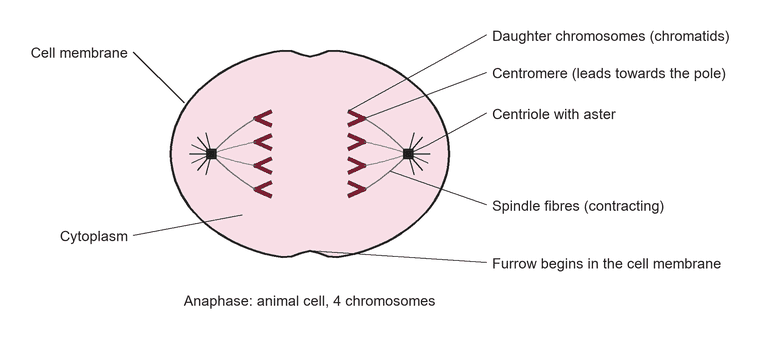
Watch out: Count only the chromosomes at one pole; the 8 seen in the cell will be shared between two cells.
Why the other options are wrong:
- (A) Anaphase, 8 Chromosomes: the stage is right, but 8 is the total at both poles; one daughter cell gets only the 4 at its pole.
- (B) Metaphase, 8 Chromosomes: in metaphase the chromosomes lie at the equator, not near the poles.
- (D) Telophase, 4 Chromosomes: in telophase the chromosomes thin out and nuclear membranes form; here the chromosomes are still distinct and on spindle fibres.
Therefore, the stage is anaphase and each daughter cell gets 4 chromosomes, option (C).
- 251 mark
Question 25
Assertion (A): Both centromere and centrosome are parts of a chromosome.
Reason (R): The centromere is the region where spindle fibres attach, while the centrosome helps in the formation of spindle fibres.
Solve with AIAnswer
(A) (1) A is True and R is False
- Correct
(B) (2) A is False and R is True
(C) (3) Both A and R are True
(D) (4) Both A and R are False
Answer: (B) (2) A is False and R is True
Concept: In an assertion–reason item, judge the Assertion (A) and the Reason (R) separately as true or false; only when both are true do we ask whether R correctly explains A.
Step 1 — Judge the Assertion.
A is false. Only the centromere is part of a chromosome: it is the constricted region where the two sister chromatids are joined. The centrosome lies outside the nucleus, in the cytoplasm of an animal cell, and contains the centrioles.
Step 2 — Judge the Reason.
R is true. The centromere is where a spindle fibre attaches to the chromosome. The centrosome splits in prophase, its centrioles move to opposite poles, and the spindle fibres form between them. Both parts of R are correct.

Step 3 — Decide the option.
A is false and R is true, so the matching option is (B) (2).
Watch out: CentroMERE is on the chromosome; centroSOME is in the cytoplasm.
Why the other options are wrong:
- (A) (1) A is True and R is False: it has the statements the wrong way round: A is the false one and R the true one.
- (C) (3) Both A and R are True: it needs A to be true, but the centrosome is not part of a chromosome.
- (D) (4) Both A and R are False: it needs R to be false, but R states the roles of both structures correctly.
Therefore, the answer is (B): A is false and R is true.
- 261 mark
Question 26
Assertion (A): The basic structural unit of DNA is nucleotide.
Reason (R): DNA is composed of repeating nucleosome which are made up of three components – pentose sugar, phosphate group and nitrogenous bases.
Solve with AIAnswer
- Correct
(A) (1) A is True and R is False
(B) (2) A is False and R is True
(C) (3) Both A and R are True
(D) (4) Both A and R are False
Answer: (A) (1) A is True and R is False
Concept: In an assertion–reason item, judge the Assertion (A) and the Reason (R) separately as true or false; only when both are true do we ask whether R correctly explains A.
Step 1 — Judge the Assertion.
A is true. Each DNA strand is a chain of repeating nucleotides, so the nucleotide is the basic structural unit of DNA.
Step 2 — Judge the Reason.
R is false. The unit made of a pentose sugar, a phosphate group and a nitrogenous base is the nucleotide, not the nucleosome. A nucleosome is DNA wound round a core of eight histones. R would be true only with the word 'nucleotides'.
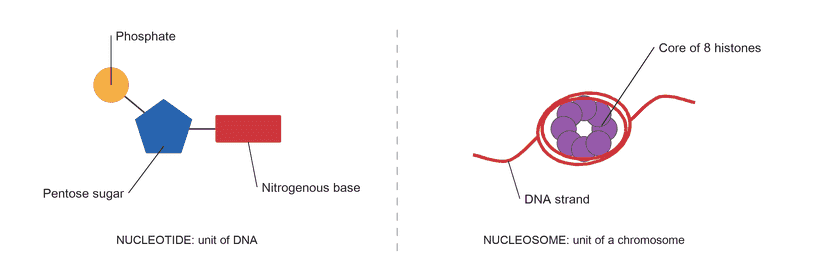
Step 3 — Decide the option.
A is true and R is false, so the matching option is (A) (1).
Watch out: NucleoTIDE = unit of DNA; nucleoSOME = DNA + histone core, unit of the chromosome.
Why the other options are wrong:
- (B) (2) A is False and R is True: it has the statements the wrong way round: A is the true one and R the false one.
- (C) (3) Both A and R are True: it needs R to be true, but R names the nucleosome where it should name the nucleotide.
- (D) (4) Both A and R are False: it needs A to be false, but A is correct.
Therefore, the answer is (A): A is true and R is false.
- 271 mark
Question 27
Assertion (A): Centrosome is the point of attachment of two chromatide of a chromosoms.
Reason (R): Centrosome initiates and regulates the process of cell division as it helps in the formation of spindle fibres.
Solve with AIAnswer
(A) (1) A is True and R is False
- Correct
(B) (2) A is False and R is True
(C) (3) Both A and R are True
(D) (4) Both A and R are False
Answer: (B) (2) A is False and R is True
Concept: In an assertion–reason item, judge the Assertion (A) and the Reason (R) separately as true or false; only when both are true do we ask whether R correctly explains A.
Step 1 — Judge the Assertion.
A is false. The two chromatids of a chromosome are joined at the centromere, not the centrosome. A uses the wrong word.
Step 2 — Judge the Reason.
R is true. The centrosome does start and regulate cell division: in prophase it splits, the centrioles move to opposite poles with their asters, and the spindle fibres form between them.
Step 3 — Decide the option.
A is false and R is true, so the matching option is (B) (2).
Why the other options are wrong:
- (A) (1) A is True and R is False: it has the statements the wrong way round: A is the false one and R the true one.
- (C) (3) Both A and R are True: it needs A to be true, but the chromatids are joined at the centromere.
- (D) (4) Both A and R are False: it needs R to be false, but R gives the correct role of the centrosome.
Therefore, the answer is (B): A is false and R is true.
- 281 mark
Question 28
Assertion (A): Meiosis is the kind of cell-division which occurs during gamete formation in the gonads.
Reason (R): During meiosis, chromosome number remains the same in parent cell and daughter cells which is very significant to maintain the identity of the organism.
Solve with AIAnswer
- Correct
(A) (1) A is True and R is False
(B) (2) A is False and R is True
(C) (3) Both A and R are True
(D) (4) Both A and R are False
Answer: (A) (1) A is True and R is False
Concept: In an assertion–reason item, judge the Assertion (A) and the Reason (R) separately as true or false; only when both are true do we ask whether R correctly explains A.
Step 1 — Judge the Assertion.
A is true. Meiosis is the cell division that makes the gametes, and it takes place in the gonads: the testis (sperms) and the ovary (eggs).
Step 2 — Judge the Reason.
R is false. In meiosis each daughter cell gets only half the chromosomes, one of each pair (2n → n): a human cell with 46 chromosomes gives gametes with 23. Keeping the number the same is a feature of mitosis, not meiosis.
Step 3 — Decide the option.
A is true and R is false, so the matching option is (A) (1).
Why the other options are wrong:
- (B) (2) A is False and R is True: it has the statements the wrong way round: A is the true one and R the false one.
- (C) (3) Both A and R are True: it needs R to be true, but meiosis halves the chromosome number.
- (D) (4) Both A and R are False: it needs A to be false, but gametes are indeed made by meiosis in the gonads.
Therefore, the answer is (A): A is true and R is false.
- 294 marks
Question 29
Name the following :
(a) The repeating components of each DNA strand lengthwise.
(b) The complex structure consisting of DNA strand and a core of histones.
(c) The type of bond which joins the complementary nitrogenous bases.
(d) The three components of a nucleotide.
Solve with AIWritten solution
Solution:
Concept: DNA is a ladder of two strands. Each strand is a chain of repeating units, and the DNA is wound round histone proteins to pack it into chromatin.
Step 1 — (a) The repeating units of a strand.
These are nucleotides: each DNA strand is a long chain of nucleotides joined one after another along its length.
Step 2 — (b) DNA strand with a core of histones.
This is a nucleosome: the DNA strand winds round a core of eight histones (the histone octamer).
Step 3 — (c) The bond between complementary bases.
This is the hydrogen bond: two hydrogen bonds join adenine to thymine (A = T) and three join guanine to cytosine (G ≡ C).
Step 4 — (d) The three parts of a nucleotide.
These are a pentose sugar, a phosphate group and a nitrogenous base. The phosphate and sugar form the side of the ladder; the base points inwards.
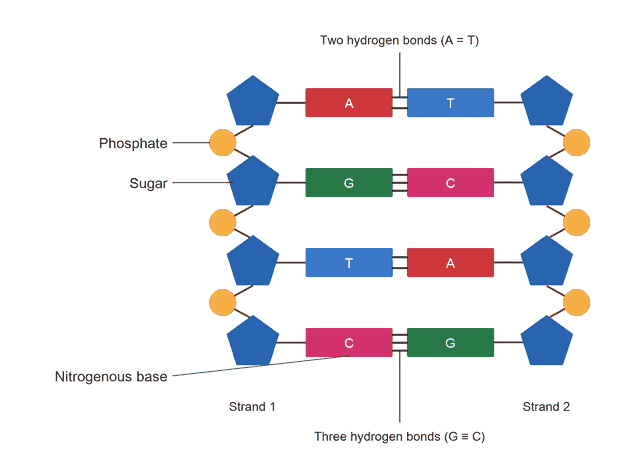
Therefore, (a) nucleotides, (b) nucleosome, (c) hydrogen bond, (d) pentose sugar, phosphate group and nitrogenous base.
- 302 marks
Question 30
Imagine one cell (A) has undergone one mitotic division and another cell (B) has completed its meiotic division. How many daughter cells would the two produce?
Cell A : ..........
Cell B : ..........
Solve with AIWritten solution
Solution:
Concept: Count the nuclear divisions: mitosis has one division, while meiosis has two divisions, one after the other.
Step 1 — Cell A: one mitotic division.
One mitotic division splits the parent cell into 2 identical daughter cells.
Step 2 — Cell B: a complete meiosis.
The first meiotic division gives two cells, and each of them divides again in the second division.
Step 3 — Compare the chromosome number.
The 2 cells from mitosis are diploid (2n) like the parent; the 4 cells from meiosis are haploid (n).
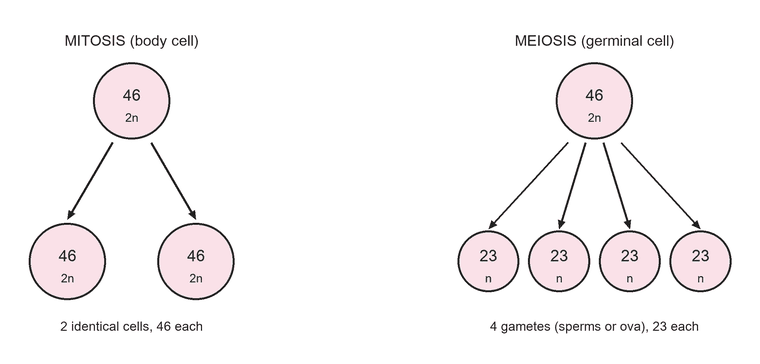
Therefore, cell A gives 2 daughter cells and cell B gives 4 daughter cells.
- 314 marks
Question 31
Match the events given in column A with the phase in mitotic cell division in Column B.
Column “A” Column “B” (a) Chromosomes get arranged in a horizontal plane at the equator. Anaphase (b) Daughter chromosomes move to the opposite poles of a spindle. Prophase (c) Chromosomes become visible as fine long threads. Telophase (d) Chromosomes lose their distinctiveness and gradually become transformed into a chromatin network. Metaphase Solve with AIWritten solution
Solution:
Concept: The four phases of karyokinesis come in the order prophase, metaphase, anaphase, telophase, and each has one event by which it is recognised.
Step 1 — (a) Chromosomes at the equator.
Lining up in one plane at the equator, each chromosome held by spindle fibres at its centromere, happens in metaphase.
Step 2 — (b) Daughter chromosomes move to the poles.
The centromere divides and the chromatids are pulled to opposite poles in anaphase.
Step 3 — (c) Chromosomes become visible as fine long threads.
The chromatin starts to condense and the chromosomes first become visible in prophase, the first phase.
Step 4 — (d) Chromosomes change back into a chromatin network.
The chromosomes lengthen, thin out and form a network again in telophase, the last phase.
Step 5 — Write the matches.
The completed matching is:
Column A (event) Column B (phase) (a) Chromosomes arranged at the equator Metaphase (b) Daughter chromosomes move to opposite poles Anaphase (c) Chromosomes visible as fine long threads Prophase (d) Chromosomes become a chromatin network Telophase 
Therefore, (a) metaphase, (b) anaphase, (c) prophase, (d) telophase.
- 326 marks
Question 32
Fill in the blanks.
(a) DNA replicates in the .......... phase of the cell cycle.
(b) Mitosis occurs in our .......... cells.
(c) Meiosis occurs only in .......... cells.
(d) Modern humans have 46 chromosomes. Their sperms and eggs will have .......... chromosomes each.
(e) During the pairing of chromosomes in meiosis, the .......... chromosomes come to lie side by side.
(f) The two non-sister chromatids of a paired chromosome are attached to each other at .......... during the process of crossing over.
Solve with AIWritten solution
Solution:
Concept: Parts (a) to (c) ask when DNA is copied and where each kind of division occurs; parts (d) to (f) are about the chromosomes in meiosis.
Step 1 — (a) When DNA replicates.
DNA is copied in the S (synthesis) phase of interphase, so the chromosomes are duplicated.
Step 2 — (b) Where mitosis occurs.
Mitosis occurs in our somatic (body) cells and gives new cells for growth, repair and replacement.
Step 3 — (c) Where meiosis occurs.
Meiosis occurs only in reproductive (germ) cells of the testis and ovary, which make the gametes.
Step 4 — (d) Chromosomes in sperms and eggs.
Meiosis halves the number, so each gamete gets 23 chromosomes.
At fertilisation 23 + 23 gives back 46.
Step 5 — (e) Which chromosomes pair.
The homologous chromosomes (one from the mother, one from the father) come to lie side by side.
Step 6 — (f) Where non-sister chromatids join.
They are attached at the chiasma, the X-shaped point where the chromatids exchange pieces during crossing over.
Therefore, (a) S, (b) somatic (body), (c) reproductive (germ), (d) 23, (e) homologous, (f) chiasma.
- 3310 marks
Question 33
Name these :
(a) Two main constituents of Chromatin
(b) Two kinds of Nucleic acids
(c) Three components of a Nucleotide
(d) Four Nitrogenous bases
(e) Two kinds of Nitrogenous bases
(f) Two components of Nucleosome
(g) Two kinds of Cell division
(h) Four main phases of Karyokinesis
(i) Two steps of the process Mitosis
(j) Two kinds of haploid cells of human body
Solve with AIWritten solution
Solution:
Concept: Each part asks for a fixed set of names; give exactly the number asked for.
Step 1 — (a) Constituents of chromatin.
DNA and histones (the proteins round which DNA is wound).
Step 2 — (b) Kinds of nucleic acids.
DNA (deoxyribonucleic acid) and RNA (ribonucleic acid).
Step 3 — (c) Components of a nucleotide.
Pentose sugar, phosphate group and nitrogenous base.
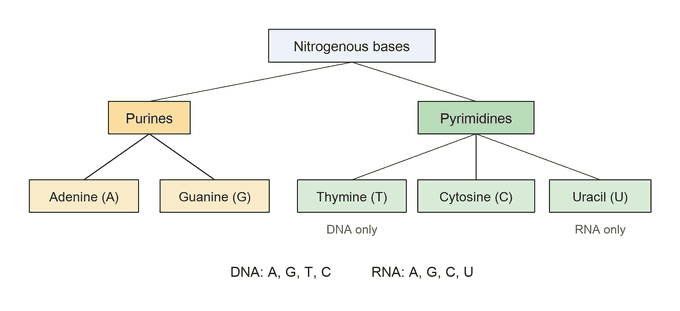
Step 4 — (d) Nitrogenous bases.
Adenine, guanine, cytosine and thymine, the four bases of DNA (RNA has uracil instead of thymine).
Step 5 — (e) Kinds of nitrogenous bases.
Purines (adenine, guanine) and pyrimidines (thymine, cytosine, uracil).
Step 6 — (f) Components of a nucleosome.
DNA and a core of histone proteins (the histone octamer).
Step 7 — (g) Kinds of cell division.
Mitosis (gives identical diploid cells) and meiosis (gives haploid gametes).
Step 8 — (h) Phases of karyokinesis.
Prophase, metaphase, anaphase and telophase, in this order.
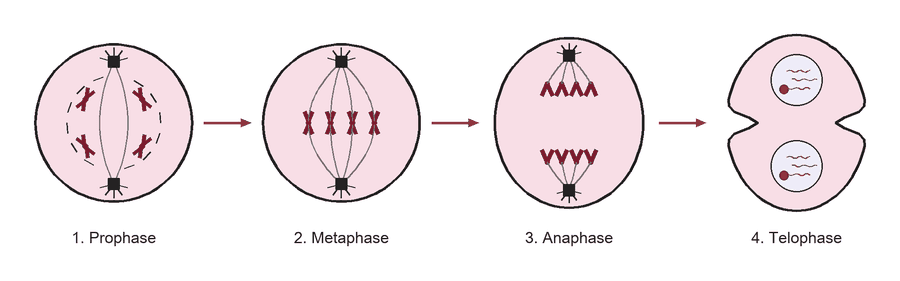
Step 9 — (i) Steps of mitosis.
Karyokinesis (division of the nucleus) followed by cytokinesis (division of the cytoplasm).
Step 10 — (j) Haploid cells of the human body.
Sperms and ova (eggs), made by meiosis, with 23 chromosomes each.
Therefore, the names are as listed in (a) to (j) above, for example (h) prophase, metaphase, anaphase and telophase, and (j) sperms and ova.
- 342 marks
Question 34
What are the rungs of the “DNA ladder” made of ?
Solve with AIWritten solution
Solution:
Concept: The two DNA strands form a ladder: the phosphate and sugar of each strand make the sides, and the rungs lie between them.
Step 1 — See what joins the strands.
A nitrogenous base is joined to each sugar and points inwards towards the other strand.
Step 2 — Form a rung.
It joins the complementary base of the other strand by hydrogen bonds; the two joined bases make one rung.
Step 3 — Recall the fixed pairing.
Adenine pairs with thymine (two hydrogen bonds) and guanine with cytosine (three hydrogen bonds).
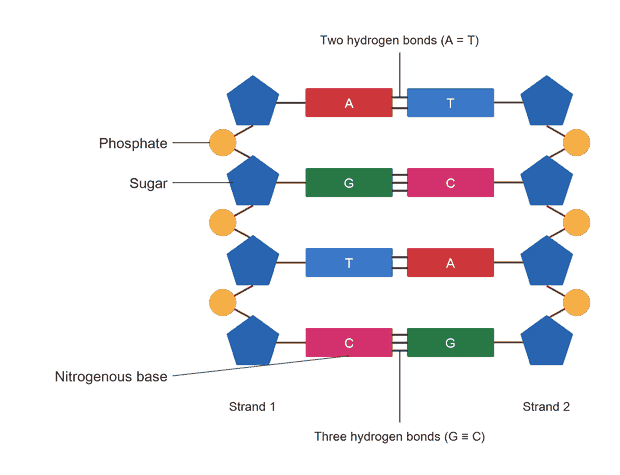
Watch out: The sides are sugar and phosphate; only the bases make the rungs.
Therefore, the rungs of the DNA ladder are pairs of complementary nitrogenous bases (A–T and G–C) joined by hydrogen bonds.
- 355 marks
Question 35
Correct the following statements for mistakes, if any.
(a) The four nitrogenous bases in the DNA are Guanine, Thiamine, Adrenaline and Cytosine.
(b) Genes are specific sequences of bases on a chromosome.
(c) A nucleotide is composed of a sulphate, a sugar (pentose) and a nitrogenous base.
(d) Nucleosomes are groups of cysteine molecules surrounded by DNA strands.
(e) If there are 46 chromosomes in a cell, there will be 23 chromatin fibres inside the nucleus during interphase.
Solve with AIWritten solution
Solution:
Concept: Each statement has wrong terms that sound like the right ones; replace only the wrong term.
Step 1 — (a) The four bases.
Thiamine is a vitamin and adrenaline is a hormone; neither is in DNA. Corrected: the four nitrogenous bases in DNA are guanine, thymine, adenine and cytosine.
Step 2 — (b) Genes.
The statement is essentially correct, since each nucleotide carries one base; the book words it as: genes are specific sequences of nucleotides on a chromosome.
Step 3 — (c) A nucleotide.
A nucleotide has no sulphate. Corrected: a nucleotide is composed of a phosphate, a sugar (pentose) and a nitrogenous base.

Step 4 — (d) Nucleosomes.
Cysteine is an amino acid. Corrected: nucleosomes are groups of histone molecules surrounded by DNA strands.
Step 5 — (e) Chromatin fibres in interphase.
Each chromosome uncoils into one long chromatin fibre, so the numbers are equal. Corrected: if there are 46 chromosomes in a cell, there will be 46 chromatin fibres in the nucleus during interphase.
Therefore, the corrected terms are: (a) thymine, adenine; (b) nucleotides (statement otherwise correct); (c) phosphate; (d) histone; (e) 46.
- 3610 marks
Question 36
Define the following terms :
(a) Chromosome
(b) Gene
(c) Cell division
(d) Chromatid
(e) Aster
Solve with AIWritten solution
Solution:
Concept: A definition says exactly what the thing is, in one or two sentences, with its key term.
Step 1 — Define chromosome.
Chromosome: a highly coiled, thread- or ribbon-like structure formed by the condensation of chromatin fibres (DNA + histones) during cell division; it carries the genes.
Chromosomes take up certain dyes strongly, hence the name (chroma = colour, soma = body).
Step 2 — Define gene.
Gene: a specific sequence of nucleotides on a chromosome that codes for a particular protein and so decides a particular character; it is the unit of heredity.
Step 3 — Define cell division.
Cell division: the process by which one parent cell divides into two (or four) daughter cells, sharing its chromosomes among them.
Mitosis gives two identical diploid cells; meiosis gives four haploid gametes.
Step 4 — Define chromatid.
Chromatid: one of the two identical halves of a duplicated chromosome, joined to its sister chromatid at the centromere.
In anaphase the sister chromatids separate, and each is then called a chromosome.
Step 5 — Define aster.
Aster: the star-like rays radiating from each centriole at the poles of a dividing animal cell.
Aster means star; plant cells form no asters.

Therefore, the five terms are defined as above: chromosome, gene, cell division, chromatid and aster.
- 376 marks
Question 37
Give reason :
(a) Gametes must be produced by meiosis for sexual reproduction.
(b) Why is meiosis referred to as ‘reductional division’?
(c) The children of the same parents, howsoever similar, are different from each other in certain aspects.
Solve with AIWritten solution
Solution:
Concept: Meiosis does two things: it halves the chromosome number, and it mixes the genes.
Step 1 — (a) Why gametes must be made by meiosis.
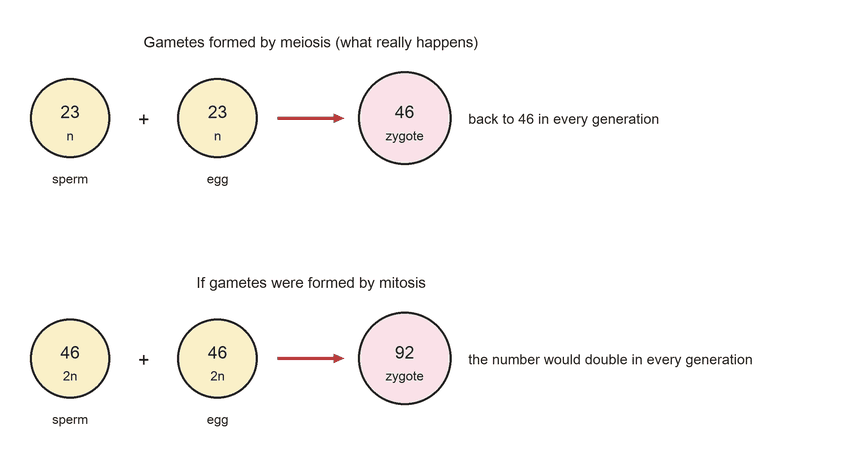
Meiosis gives haploid (n) gametes, each with half the number of chromosomes.
When a sperm and an egg fuse at fertilisation, the diploid (2n) number is restored in the zygote (23 + 23 = 46 in humans).
If gametes were made by mitosis, each would carry the full set, and the number would double in every generation (46 + 46 = 92).
Step 2 — (b) Why meiosis is called reductional division.
In the first meiotic division the members of each homologous pair separate.
Each daughter cell therefore receives only one chromosome of each pair, so the number is reduced to half (2n → n). Hence the name.
Step 3 — (c) Why children of the same parents differ.
In meiosis the maternal and paternal chromosomes are sorted randomly into the gametes.
In addition, crossing over swaps pieces between non-sister chromatids of homologous chromosomes.
So each gamete carries a new combination of genes; no two children (except identical twins) get the same set, and they show variations.
Therefore, meiosis keeps the chromosome number constant from generation to generation by halving it in the gametes, and it creates variation through random sorting and crossing over.
- 3810 marks
Question 38
Distinguish between the following pairs :
(a) Cytokinesis and Karyokinesis
(b) DNA and RNA
(c) Nucleosome and Nucleotide
(d) Centrosome and Centromere
(e) Haploid and Diploid
Solve with AIWritten solution
Solution:
Concept: Compare each pair point against point, on the same basis in both columns.
Step 1 — Cytokinesis and karyokinesis.
Compare what is divided and when:
Basis Cytokinesis Karyokinesis What divides The cytoplasm. The nucleus. When After karyokinesis, by a furrow (animal) or cell plate (plant). First, in four phases: prophase, metaphase, anaphase, telophase. Step 2 — DNA and RNA.
Compare their sugar, bases and strands:
Basis DNA RNA Full form and sugar Deoxyribonucleic acid; sugar deoxyribose. Ribonucleic acid; sugar ribose. Bases A, G, C and thymine. A, G, C and uracil. Strands Usually double-stranded (double helix). Usually single-stranded. Step 3 — Nucleosome and nucleotide.
Compare what each is made of and what it builds:
Basis Nucleosome Nucleotide Made of DNA wound round a core of eight histones. Pentose sugar, phosphate and a nitrogenous base. Unit of A chromosome (chromatin). A nucleic acid (DNA or RNA). 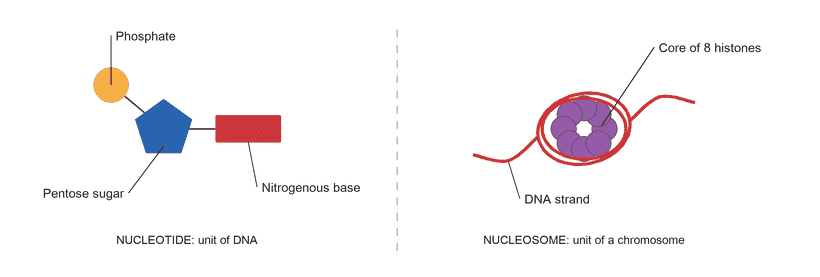
Step 4 — Centrosome and centromere.
Compare where each is and what it does:
Basis Centrosome Centromere Where In the cytoplasm near the nucleus; has centrioles; animal cells only. On the chromosome: the constricted region joining the sister chromatids. Role Forms the spindle (with asters) and starts cell division. The point where spindle fibres attach. Step 5 — Haploid and diploid.
Compare the number of chromosome sets:
Basis Haploid Diploid Sets One set: one of each pair (n). Two sets: in pairs (2n). Found in Gametes; 23 in humans. Body cells and the zygote; 46 in humans. 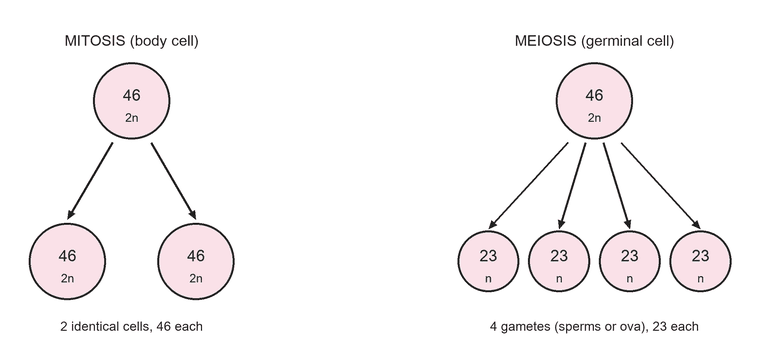
Watch out: The words in each pair differ by a few letters: nucleoTIDE belongs to DNA and nucleoSOME to the chromosome; centroMERE is on the chromosome and centroSOME is in the cytoplasm.
Therefore, the pairs differ as tabulated, the key point of each being: cytoplasm vs nucleus; deoxyribose and thymine vs ribose and uracil; chromosome unit vs DNA unit; spindle former vs spindle attachment; n vs 2n.
- 392 marks
Question 39
Write full form of the following abbreviations :
(a) DNA
(b) RNA
Solve with AIWritten solution
Solution:
Concept: DNA and RNA are the two nucleic acids, and each is named after its sugar.
Step 1 — (a) DNA.
DNA stands for Deoxyribonucleic acid, because its sugar is deoxyribose.
Step 2 — (b) RNA.
RNA stands for Ribonucleic acid, because its sugar is ribose.
Therefore, DNA = deoxyribonucleic acid and RNA = ribonucleic acid.
- 405 marks
Question 40
Given below are the sets of four terms. Choose the odd one and write the category of the remaining terms :
(a) Adenine, Guanine, Adrenaline, Thymine
(b) Pentose sugar, Histones, Phosphate group, Nitrogenous bases
(c) Metaphase, Anaphase, Interphase, Telophase
(d) phase, M phase, phase, S phase
(e) Chromoplast, Chromosome, Chloroplast, Leucoplast
Solve with AIWritten solution
Solution:
Concept: Find the group that three of the four terms share; the term left out is the odd one.
Step 1 — (a) Adenine, Guanine, Adrenaline, Thymine.
Adenine, guanine and thymine are nitrogenous bases of DNA. Adrenaline is a hormone that only sounds like adenine, so adrenaline is the odd one.
Step 2 — (b) Pentose sugar, Histones, Phosphate group, Nitrogenous bases.
Sugar, phosphate and base are the components of a nucleotide. Histones are the proteins round which DNA is wound, so histones is the odd one.
Step 3 — (c) Metaphase, Anaphase, Interphase, Telophase.
Metaphase, anaphase and telophase are phases of karyokinesis (mitosis). Interphase is the non-dividing phase, so interphase is the odd one.
Step 4 — (d) G1 phase, M phase, G2 phase, S phase.
, S and are the phases of interphase. The M phase is the dividing phase, so M phase is the odd one.
Step 5 — (e) Chromoplast, Chromosome, Chloroplast, Leucoplast.
Chromoplast, chloroplast and leucoplast are plastids of plant cells. A chromosome is a structure of the nucleus, so chromosome is the odd one.
Therefore, the odd ones are (a) adrenaline (rest: bases of DNA), (b) histones (rest: parts of a nucleotide), (c) interphase (rest: phases of karyokinesis), (d) M phase (rest: phases of interphase), (e) chromosome (rest: plastids).
- 414 marks
Question 41
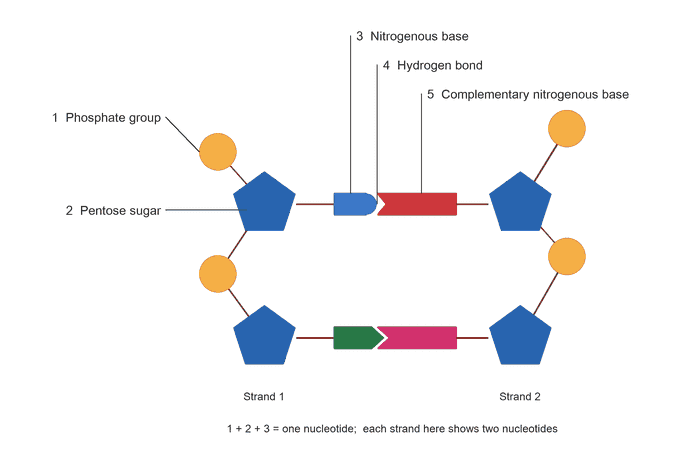
Given below is a schematic diagram of a portion of DNA.

(a) How many strands are shown in the diagram?
(b) How many nucleotides have been shown in each strand?
(c) Name the parts numbered 1, 2, 3, 4 and 5 respectively.
(d) Name the DNA unit constituted by the parts 1, 2 and 3 collectively.
Solve with AIWritten solution
Solution:
Concept: Each DNA strand is a chain of nucleotides (phosphate + pentose sugar + nitrogenous base); the bases of the two strands join by hydrogen bonds and form the rungs.
Step 1 — (a) Count the strands.
There are two chains of phosphate and sugar, one on each side, joined through their bases in the middle. So two strands are shown.
Step 2 — (b) Count the nucleotides in each strand.
Each strand shows two sugars, each with its own phosphate and base. One sugar + one phosphate + one base is one nucleotide, so there are two nucleotides in each strand.
Step 3 — (c) Name parts 1 to 5.
1 is the round part of the backbone: phosphate group. 2 is the five-sided part next to it: pentose (deoxyribose) sugar. 3 is joined to the sugar and points inwards: nitrogenous base. 4 is the join between the two bases: hydrogen bond. 5 is the base from the other strand: complementary nitrogenous base.
Step 4 — (d) Name the unit made by 1, 2 and 3.
Phosphate, sugar and base together make one nucleotide, the repeating unit of a DNA strand.
Watch out: Part 5 is also a nitrogenous base; it belongs to the opposite strand.
Therefore, (a) two strands; (b) two nucleotides each; (c) 1 phosphate group, 2 pentose sugar, 3 nitrogenous base, 4 hydrogen bond, 5 complementary nitrogenous base; (d) a nucleotide.
- 421 mark
Question 42
The three sketches given below (A, B and C) are intended to represent the replication of DNA. What should be their correct sequence starting with the first and ending with the last ? ..........
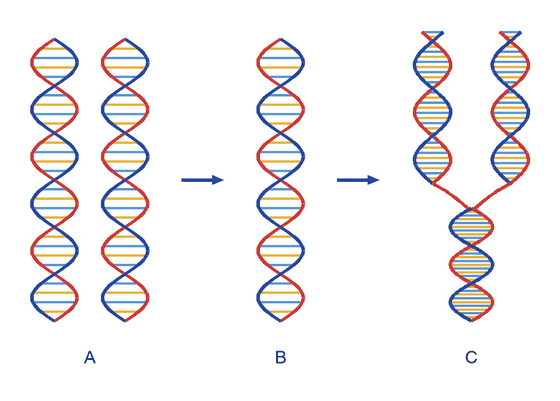 Solve with AI
Written solution
Solution:
Concept: Replication starts with one DNA double helix and ends with two; in between, the helix opens at one end and a new strand forms against each old strand.
Step 1 — Find the first sketch.
B shows a single, complete double helix: the original DNA before replication.
Step 2 — Find the middle sketch.
C shows the helix opened at one end, with the two strands apart and a new strand forming against each old one.
Step 3 — Find the last sketch.
A shows two complete double helices; each contains one old strand and one new strand.
This copying happens in the S phase, so each daughter cell can receive a copy.

Therefore, the correct sequence is B → C → A.
- 436 marks
Question 43
The diagram alongside represents a stage during cell division. Study the same and then answer the questions that follow :
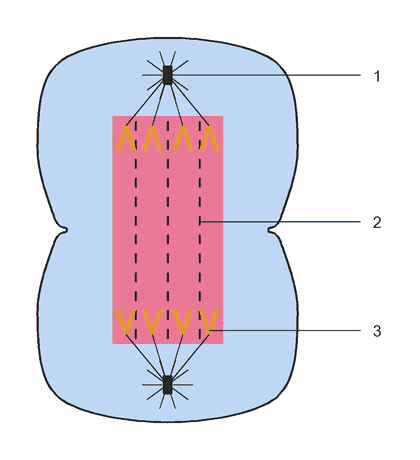
(a) Name the parts labelled 1, 2 and 3.
(b) Identify the above stage and give a reason to support your answer.
(c) Mention the type of cells in our body where this type of cell division occurs.
(d) Name the stage prior to this stage and draw a diagram to represent the same.
Solve with AIWritten solution
Solution:
Concept: A stage of mitosis is recognised by where the chromosomes are. Here two sets of daughter chromosomes lie near opposite poles and the cell membrane has begun to furrow.
Step 1 — (a) Name parts 1, 2 and 3.
1 is the dark body at a pole with rays round it: the centriole (with aster). 2 is a fibre running between the poles: a spindle fibre. 3 is one of the V-shaped bodies near a pole: a daughter chromosome (chromatid).
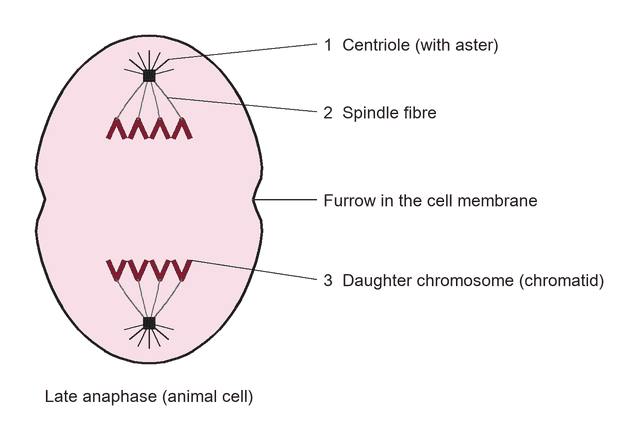
Step 2 — (b) Identify the stage.
This is anaphase (late anaphase) of mitosis.
Reason: the sister chromatids have separated and the daughter chromosomes are being pulled to opposite poles by the spindle fibres, and a furrow has begun in the cell membrane.
Step 3 — (c) Where this division occurs.
Mitosis occurs in somatic (body) cells, for example in the skin, the bone marrow and growing tissues. It gives new cells for growth, repair and replacement.
Step 4 — (d) The stage before this one.
The stage before anaphase is metaphase: the chromosomes lie in one plane at the equator, each joined to spindle fibres at its centromere.
To draw it, show a round cell with a centriole and aster at each pole, spindle fibres from the poles to the centromeres, and the same four duplicated chromosomes (two chromatids each) in a row at the equator; no nuclear membrane or nucleolus.

Therefore, (a) 1 centriole with aster, 2 spindle fibre, 3 daughter chromosome; (b) anaphase, as the chromatids are moving to opposite poles; (c) somatic cells; (d) metaphase, drawn as shown.
- 442 marks
Question 44
Draw a labelled diagram to show the metaphase stage of mitosis in an animal cell having “6” chromosomes.
Solve with AIWritten solution
Solution:
Concept: At metaphase all the duplicated chromosomes lie in one plane at the equator, each joined to spindle fibres at its centromere, with a centriole and aster at each pole.
Step 1 — Draw the cell.
Draw a round outline for the cell membrane; an animal cell has no cell wall.
Step 2 — Draw the poles.
Mark a centriole with its star-like aster at each pole, opposite each other.
Step 3 — Draw the spindle.
Draw spindle fibres from each pole towards the equator; together they make the spindle.
Step 4 — Draw the six chromosomes.
Draw six chromosomes in a row at the equator, each as two chromatids joined at the centromere, with spindle fibres from both poles ending at the centromere.
Step 5 — Leave out the nucleus.
Do not draw a nuclear membrane or nucleolus: both disappeared in prophase.
Label: centriole (with aster), spindle, spindle fibres, chromosome at equator, centromere, cytoplasm, cell membrane.
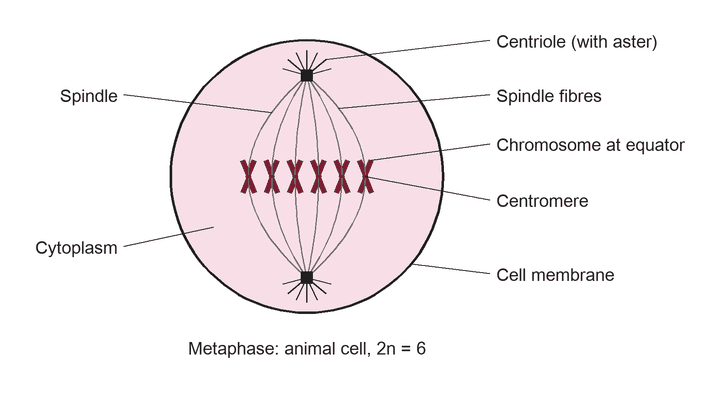
Step 6 — Check the count.
Six chromosomes of two chromatids each give 12 chromatids; in anaphase 6 go to each pole, so each daughter cell again has 6 chromosomes.
Watch out: Draw exactly six chromosomes, and do not draw them crossing the spindle fibres; the fibres end at the centromeres.
Therefore, the labelled metaphase diagram with six chromosomes at the equator is as shown.
- 453 marks
Question 45
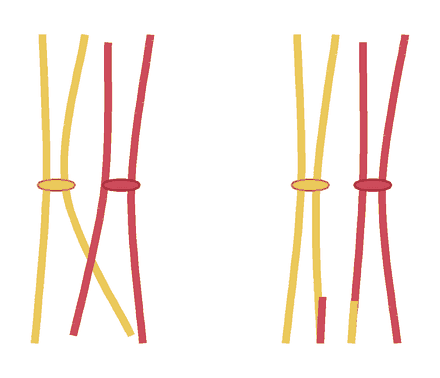
The diagram given below represents a certain phenomenon which occurs during meiosis. Name and explain the phenomenon by using the terms — homologous chromosomes, chromatids, crossing-over.
 Solve with AI
Written solution
Solution:
Concept: The diagram shows a homologous pair exchanging pieces of chromatids. Exchange of chromatid material between the members of a homologous pair during meiosis is crossing over.
Step 1 — Name the phenomenon.
The phenomenon is crossing over.
Step 2 — Homologous chromosomes pair.
In the first meiotic division the two homologous chromosomes (one from the mother, one from the father) pair up and lie side by side.
Step 3 — Four chromatids lie together.
Each chromosome is already duplicated into two sister chromatids, so the pair has four chromatids.
Step 4 — Non-sister chromatids exchange pieces.
Two non-sister chromatids touch at a point called the chiasma, break there and swap segments: this is crossing-over.
Step 5 — Read the diagram.
On the left, one chromatid of each chromosome crosses the other near the lower end (the chiasma). On the right the chromosomes have separated, and the lower tips of the two inner chromatids have changed places.
Step 6 — State the result.
The chromatids now carry new combinations of genes, which causes variations in the offspring.
Watch out: Crossing over happens between NON-sister chromatids of a homologous pair, never between sister chromatids.
Therefore, the phenomenon is crossing over: non-sister chromatids of homologous chromosomes exchange segments at the chiasma, giving new gene combinations.
- 468 marks
Question 46
Given below is a diagram representing a stage during mitotic cell division in an animal cell. Examine it carefully and answer the questions which follow.

(a) Identify the stage. Give one reason in support of your answer.
(b) Name the cell organelle that forms the ‘aster’.
(c) Name the parts labelled 1, 2 and 3.
(d) Name the stage that follows the one shown here. How is that stage identified?
(e) Mention two differences between mitosis and meiosis with regard to :
(i) The number of daughter cells produced.
(ii) The chromosome number in the daughter cells.
Solve with AIWritten solution
Solution:
Concept: Short, thick duplicated chromosomes scattered in the cell, a disappearing nuclear membrane and a spindle forming between two asters mark late prophase.
Step 1 — (a) Identify the stage.
This is prophase (late prophase).
Reason: the nuclear membrane is disappearing and spindle fibres are forming between the asters, while the duplicated chromosomes are still scattered, not lined up at the equator.
Step 2 — (b) The organelle that forms the aster.
The centrosome (its centrioles). In prophase it splits and the centrioles move to opposite poles; each centriole with its radiating rays is an aster.
Step 3 — (c) Name parts 1, 2 and 3.
1 points to the small region joining the two halves of a chromosome: centromere. 2 points to one of those halves: chromatid. 3 points to the fibres between the asters: spindle fibres.
Step 4 — (d) The stage that follows.
Metaphase follows. It is identified by the chromosomes lining up in one plane at the equator, each joined to spindle fibres at its centromere.
Step 5 — (e) Mitosis and meiosis compared.
Compare the two divisions on the two points asked:
Basis Mitosis Meiosis (i) Number of daughter cells Two Four (ii) Chromosome number in daughter cells Same as parent (diploid, 2n) Half of parent (haploid, n) Mitosis has one division and passes the full set to each cell; meiosis has two divisions and passes only one of each pair.

Therefore, (a) late prophase; (b) centrosome; (c) 1 centromere, 2 chromatid, 3 spindle fibres; (d) metaphase, chromosomes at the equator; (e) mitosis gives 2 diploid cells, meiosis 4 haploid cells.
- 474 marks
Question 47
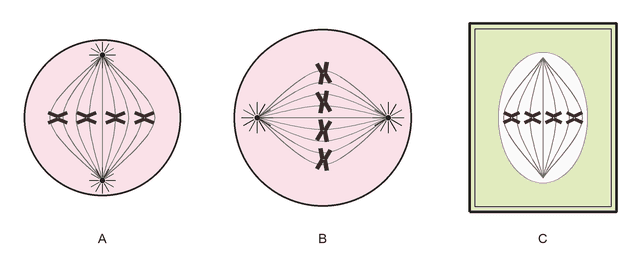
Given below are three diagrammatic sketches (A, B and C) of one and the same particular phase during mitotic type of cell division.
(a) Identify the phase ..........
(b) What is the diploid number of chromosomes shown in them ? ..........
(c) Identify whether these are animal cells or plant cells ? Give reasons.
A ..........
B ..........
C ..........
Solve with AIWritten solution
Solution:
Concept: All three sketches show the chromosomes lined up at the equator of the spindle. Centrioles with asters mark an animal cell; a cell wall and a spindle without asters mark a plant cell.
Step 1 — (a) Identify the phase.
In each sketch the chromosomes lie in one plane at the equator, midway between the poles, so the phase is metaphase. The sketches look different only because the cells face different directions.
Step 2 — (b) Count the chromosomes.
Each sketch shows four duplicated chromosomes at the equator, so the diploid number is 4 (2n = 4).
Step 3 — (c) Animal or plant cell.
A: animal cell, rounded, no cell wall, and centrioles with asters at the poles.
B: animal cell, rounded, no cell wall, and asters at both poles of the spindle.
C: plant cell, with a thick rectangular cell wall and a spindle with no centrioles or asters.
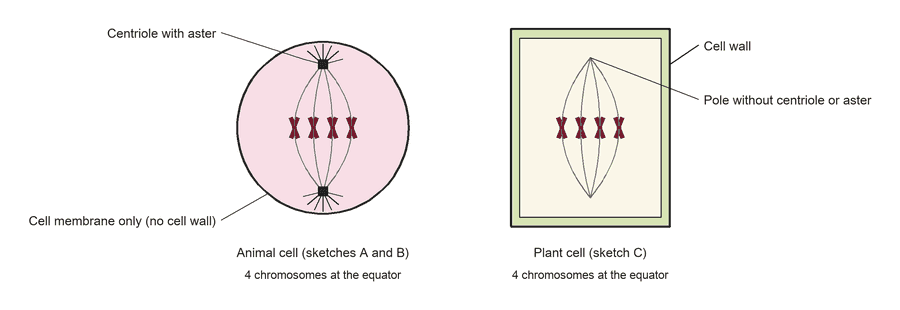
Therefore, (a) metaphase; (b) 2n = 4; (c) A and B are animal cells (asters, no cell wall) and C is a plant cell (cell wall, no asters).
- 487 marks
Question 48
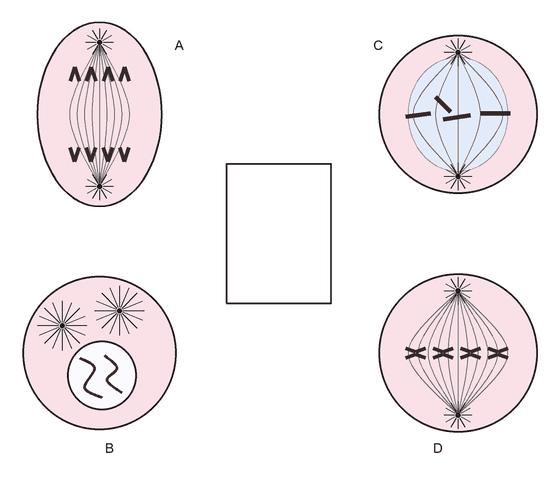
Shown below are four stages (A, B, C, D) (not in sequence) of a certain kind of cell division.
(a) Is it a plant cell or an animal cell? Give two reasons.
..........
(b) Is it undergoing mitosis or meiosis?
..........
(c) What should be the correct sequence of these four stages among themselves ? ..........
(d) Name the stage that should precede the earliest of these stages. ..........
(e) Draw the stage named above inside the blank space provided.
Solve with AIWritten solution
Solution:
Concept: Asters and rounded cells mark an animal cell; chromosomes that line up singly at the equator (no pairing) with equal numbers going to each pole mark mitosis.
Step 1 — (a) Plant or animal cell.
It is an animal cell, because (1) centrioles with asters are present at the poles, and (2) there is no cell wall: the cells are rounded and bounded only by the cell membrane.
Step 2 — (b) Mitosis or meiosis.
It is mitosis: the chromosomes do not pair; they line up singly at the equator, and equal numbers go to each pole.
Step 3 — (c) Put the stages in order.
Read each sketch:
- B: the nucleus is still whole, the chromosomes are long threads and the two asters have just begun to move apart: early prophase.
- C: the asters are at opposite poles, the spindle is forming and the chromosomes are moving to the equator: late prophase.
- D: the chromosomes lie in one plane at the equator: metaphase.
- A: two sets of daughter chromosomes are near the opposite poles: anaphase.
So the order is B → C → D → A.

Step 4 — (d) The stage before the earliest one.
The earliest stage shown is B (early prophase), and the stage before prophase is interphase.
Step 5 — (e) Draw interphase.
Draw a rounded cell with a centrosome (two centrioles) beside a whole nucleus that has a nuclear membrane, a nucleolus and a fine network of chromatin threads. Draw no separate chromosomes, because in interphase the chromatin is still long, thin threads.
Label: centrosome (centrioles), cell membrane, cytoplasm, nucleus, nuclear membrane, chromatin threads, nucleolus.

Therefore, (a) animal cell (asters; no cell wall); (b) mitosis; (c) B → C → D → A; (d) interphase; (e) interphase drawn as shown.
What Class 10 Biology Ch 2 covers
The sections of the chapter, in the order the book takes them. Every question above comes from one of these.
- 01What Are Chromosomes
- 02Discovery of Chromosomes
- 03Chromatin
- 04Structure of Chromosomes
- 05What Are Genes
- 06Need for New Cells
More ways to study this chapter
The same chapter asked three other ways. Practise it, revise it, and see what the board has set on Ch 2 before.
- Competency-Based Questions (CBQ)Case study questions: a situation, and the part of the chapter that answers it.40questionsOpen
- Previous Year QuestionsQuestions that have actually appeared in board papers, each tagged with its year.50questionsOpen
- Practice QuestionsExtra questions per chapter, for when one attempt at a method is not enough.41questionsOpen
Ch 2 in past ICSE papers
The same chapter as the board has actually asked it. These are worded differently from the textbook exercise, which is the point of reading them.
- 11 mark
Board paper question 1
Name the following:
The exchange of chromatid parts between the maternal and the paternal chromatids of a pair of homologous chromosomes during meiosis.
Solve with AIWritten solution
Solution:
Concept: In meiosis the two chromosomes of each homologous pair lie side by side. Each has two chromatids, so four chromatids lie together, and the non-sister chromatids can exchange parts.
Step 1 — Recall the event.
The exchange of chromatid parts between a maternal and a paternal chromatid of a homologous pair is called crossing over.
Step 2 — See where and why it matters.
The chromatids touch and exchange parts at an X-shaped point called the chiasma. The chromatids then carry new combinations of genes, which is one reason children of the same parents differ.
Watch out: Crossing over takes place between NON-sister chromatids (one maternal, one paternal), and only in meiosis.
Therefore, the term is crossing over.
- 21 mark
Board paper question 2
In each set of terms given below, there is an odd one and cannot be grouped in the same category to which the other three belong. Identify the odd term in each set and name the category to which the remaining three belong.
Example: Ovary, Fallopian tube, Ureter, Uterus. Odd term: Ureter Category: Parts of female reproductive system.
Thymine, Cytosine, Adenine, Pepsin.
Solve with AIWritten solution
Solution:
Concept: DNA has four nitrogenous bases: adenine (A), guanine (G), cytosine (C) and thymine (T). They pair in a fixed way across the two strands: A with T (two hydrogen bonds) and G with C (three hydrogen bonds).
Step 1 — Look at each term.
Thymine, cytosine and adenine are three of the four nitrogenous bases of DNA. Pepsin is a protein-digesting enzyme of the gastric juice.
Step 2 — Name the odd term and the category.
Pepsin is not a part of DNA, so it is the odd term; the other three are nitrogenous bases (the fourth base, guanine, is not in the list).
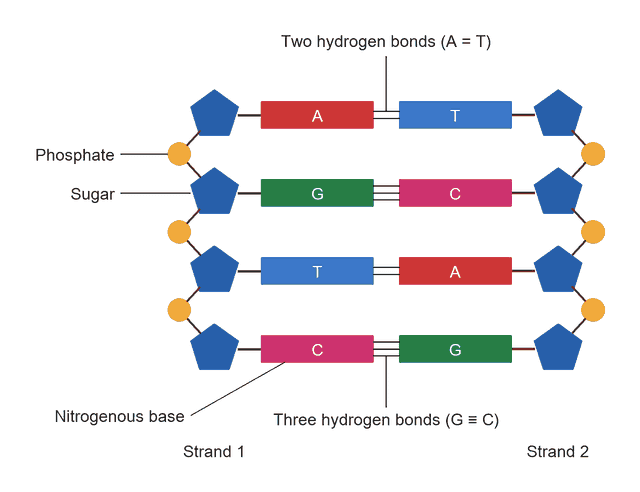
Therefore, the odd term is Pepsin, and the category of the other three is Nitrogenous bases of DNA.
- 31 mark
Board paper question 3
State the exact location of the following structures:
Centromere
Solve with AIWritten solution
Solution:
Concept: After the S phase every chromosome is duplicated: it consists of two identical sister chromatids joined at a constricted region, the centromere.
Step 1 — Recall what the centromere is.
The centromere is a small constricted region of a chromosome.
Step 2 — State its exact location.
It lies on the chromosome, at the point where the two sister chromatids are joined to each other. During cell division the spindle fibre attaches to the chromosome there.
Watch out: Centromere (the joining point of the chromatids) is different from centrosome and centriole (in the cytoplasm).
Therefore, the centromere is located on the chromosome, at the constricted region where its two sister chromatids are joined.
- 41 mark
Board paper question 4
Differentiate between the following pairs on the basis of what is mentioned within brackets:
Human skin cell and Human ovum (number of chromosomes)
Solve with AIWritten solution
Solution:
Concept: Body (somatic) cells are diploid (2n): 46 chromosomes in 23 pairs in man. Mitosis keeps the number the same. Meiosis halves it, so the gametes (sperms and ova) are haploid (n): 23 in man. Fertilisation restores 46.
Step 1 — Skin cell.
A human skin cell is a body cell formed by mitosis, so it is diploid: it has 46 chromosomes (23 pairs).
Step 2 — Ovum.
An ovum is a gamete formed by meiosis, so it is haploid: it has 23 chromosomes, one from each pair.
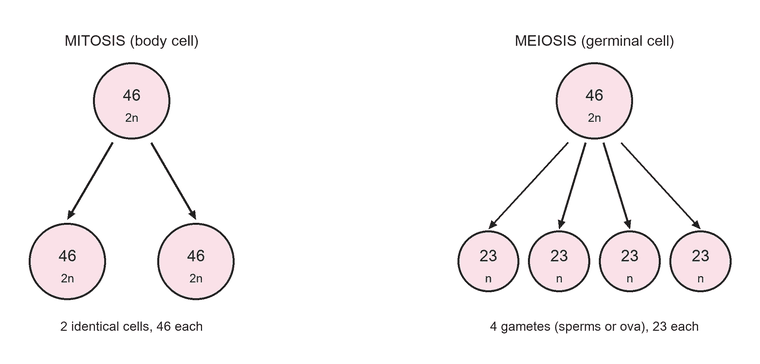
Step 3 — Set the difference side by side.
We compare the two on the basis asked, the number of chromosomes.
Human skin cell Human ovum 46 chromosomes (diploid, 2n) 23 chromosomes (haploid, n) Therefore, a human skin cell has 46 chromosomes (2n), while a human ovum has 23 chromosomes (n).
- 51 mark
Board paper question 5
Give the Biological / technical term for the following:
The repeating components of each DNA strand lengthwise.
Solve with AIWritten solution
Solution:
Concept: DNA is a double helix of two strands. Each strand is a chain of nucleotides, and each nucleotide has a phosphate group, a pentose sugar (deoxyribose) and a nitrogenous base. The bases of the two strands pair by hydrogen bonds: adenine (A) with thymine (T) and guanine (G) with cytosine (C).
Step 1 — Recall the repeating unit.
Each strand of DNA is a long chain of repeating units called nucleotides, joined end to end along its length.
Step 2 — See how they build the strand.
The sugar and phosphate of successive nucleotides form the backbone of the strand, and the base of each nucleotide points inwards to pair with a base of the other strand.
Watch out: A nucleosome (DNA + histone core) is a unit of the chromosome, not of the DNA strand.
Therefore, the term is nucleotides.
- 65 marks
Board paper question 6
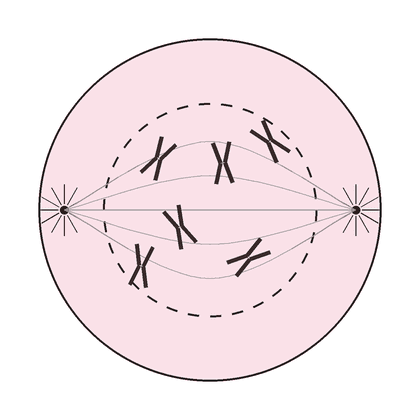
The given diagram shows a stage during mitotic division in an animal cell:
(i) Identify the stage. Give a reason to support your answer.
(ii) Draw a neat labelled diagram of the cell as it would appear in the next stage. Name the stage.
(iii) In what two ways is mitotic division in an animal cell different from the mitotic division in a plant cell?
(iv) Name the type of cell division that occurs during:
A. Growth of a shoot
B. Formation of pollen grains
Solve with AIWritten solution
Solution:
Concept: Each stage of mitosis is recognised by where the chromosomes are and what is happening to the nuclear membrane, the centrioles and the spindle. in an animal cell the centrioles move to the poles and form asters, and the cytoplasm divides by a furrow; a plant cell (of a flowering plant) has no centrioles or asters, and its cytoplasm divides by a cell plate.
Step 1 — Part (i): identify the stage.
The stage is late prophase. Each chromosome is short and thick and shows two chromatids; the chromosomes are scattered, not yet lined up at the equator; the nuclear membrane is breaking down (drawn dotted); and the centrioles with their asters have reached opposite poles, with spindle fibres forming between them.
Step 2 — Part (ii): draw the next stage.
The next stage is metaphase. The cell in the question has six chromosomes, so the drawing shows six, lined up in one plane at the equator, each attached to a spindle fibre at its centromere.
Step 3 — Part (iii): two differences between animal and plant mitosis.
The two cells differ in how the spindle forms and in how the cytoplasm divides.
Animal cell Plant cell Centrioles form asters at the poles, which help to form the spindle. No centrioles and no asters; the spindle forms without them. Cytokinesis by furrowing: a furrow in the cell membrane deepens from outside inwards. Cytokinesis by a cell plate, laid down at the centre and growing outwards to the wall. 
Step 4 — Part (iv): type of division.
Growth of a shoot needs new body cells with the same chromosome number, so it is by mitosis. Pollen grains are formed in the anthers from pollen mother cells and carry half the chromosome number, so they are formed by meiosis.
Watch out: In metaphase draw the SAME number of chromosomes as in the question (six here), each with two chromatids.
Therefore, (i) late prophase; (ii) metaphase, drawn with 6 chromosomes at the equator; (iii) asters formed only in the animal cell, and cytokinesis by furrowing in the animal cell but by a cell plate in the plant cell; (iv) A. mitosis, B. meiosis.
All 50 board paper questions for this chapter, solved the same way.
Class 10 Biology Ch 2 questions students ask
How many questions are there in Class 10 Biology Ch 2?
48 questions. Every one is solved step by step on this page.
Are these Class 10 Biology solutions free?
Yes. Every question and its full working is free to read, with no account needed.
Can I download the Class 10 Biology Ch 2 solutions as a PDF?
There is no PDF to download. Every solution is on this page instead, which means it is searchable, always the current syllabus, and readable on a phone. Use your browser's print option if you want it on paper.