Solution:
Concept: Short, thick duplicated chromosomes scattered in the cell, a disappearing nuclear membrane and a spindle forming between two asters mark late prophase.
Step 1 — (a) Identify the stage.
This is prophase (late prophase).
Reason: the nuclear membrane is disappearing and spindle fibres are forming between the asters, while the duplicated chromosomes are still scattered, not lined up at the equator.
Step 2 — (b) The organelle that forms the aster.
The centrosome (its centrioles). In prophase it splits and the centrioles move to opposite poles; each centriole with its radiating rays is an aster.
Step 3 — (c) Name parts 1, 2 and 3.
1 points to the small region joining the two halves of a chromosome: centromere. 2 points to one of those halves: chromatid. 3 points to the fibres between the asters: spindle fibres.
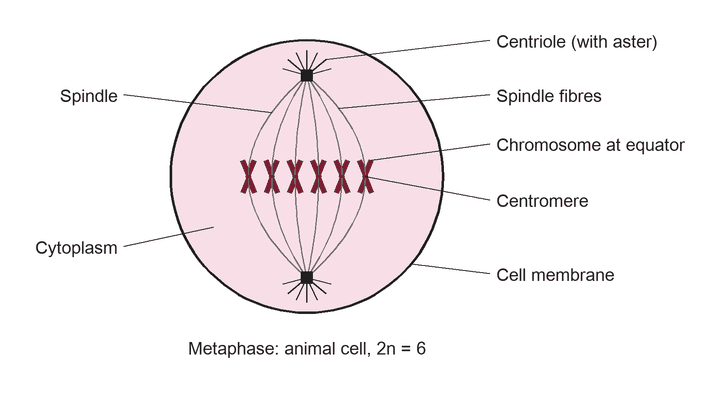
Step 4 — (d) The stage that follows.
Metaphase follows. It is identified by the chromosomes lining up in one plane at the equator, each joined to spindle fibres at its centromere.
Step 5 — (e) Mitosis and meiosis compared.
Compare the two divisions on the two points asked:
| Basis | Mitosis | Meiosis |
|---|
| (i) Number of daughter cells | Two | Four |
| (ii) Chromosome number in daughter cells | Same as parent (diploid, 2n) | Half of parent (haploid, n) |
Mitosis has one division and passes the full set to each cell; meiosis has two divisions and passes only one of each pair.

Therefore, (a) late prophase; (b) centrosome; (c) 1 centromere, 2 chromatid, 3 spindle fibres; (d) metaphase, chromosomes at the equator; (e) mitosis gives 2 diploid cells, meiosis 4 haploid cells.

