
Question 453 marksMedium
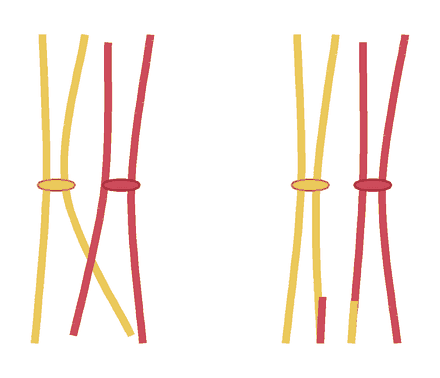
The diagram given below represents a certain phenomenon which occurs during meiosis. Name and explain the phenomenon by using the terms — homologous chromosomes, chromatids, crossing-over.
Confirming your payment
Sign up now and get 250 free tokens.
Structure of Chromosomes, Cell Cycle and Cell Division · Question 45 of 48
The diagram given below represents a certain phenomenon which occurs during meiosis. Name and explain the phenomenon by using the terms — homologous chromosomes, chromatids, crossing-over.
Solution:
Concept: The diagram shows a homologous pair exchanging pieces of chromatids. Exchange of chromatid material between the members of a homologous pair during meiosis is crossing over.
Step 1 — Name the phenomenon.
The phenomenon is crossing over.
Step 2 — Homologous chromosomes pair.
In the first meiotic division the two homologous chromosomes (one from the mother, one from the father) pair up and lie side by side.
Step 3 — Four chromatids lie together.
Each chromosome is already duplicated into two sister chromatids, so the pair has four chromatids.
Step 4 — Non-sister chromatids exchange pieces.
Two non-sister chromatids touch at a point called the chiasma, break there and swap segments: this is crossing-over.

Step 5 — Read the diagram.
On the left, one chromatid of each chromosome crosses the other near the lower end (the chiasma). On the right the chromosomes have separated, and the lower tips of the two inner chromatids have changed places.
Step 6 — State the result.
The chromatids now carry new combinations of genes, which causes variations in the offspring.
Watch out: Crossing over happens between NON-sister chromatids of a homologous pair, never between sister chromatids.
Therefore, the phenomenon is crossing over: non-sister chromatids of homologous chromosomes exchange segments at the chiasma, giving new gene combinations.