
Opening your dashboard
Class 10 Biology Chapter 2 Structure of Chromosomes, Cell Cycle and Cell Division: Competency-Based Questions (CBQ)
40 questions on Chapter 2, each worked through on its own page with the AI tutor. Class 10 Biology, ICSE 2026-27.
40 questions
1–5 marks · Mixed difficulty
- 11 mark
Question 1
Cognitive domain: Application
Mr. Bose, a healthy adult, donated a unit of blood at a blood donation camp. A few weeks later, a test showed that the number of his red blood cells was back to normal. How were the lost red blood cells made up ?
- 21 mark
Question 2
Cognitive domain: Analysis
The graph shows how the DNA content of a cell changes during one cell cycle. At the end of interval Z the cell has divided, and the graph then follows one of the two daughter cells.
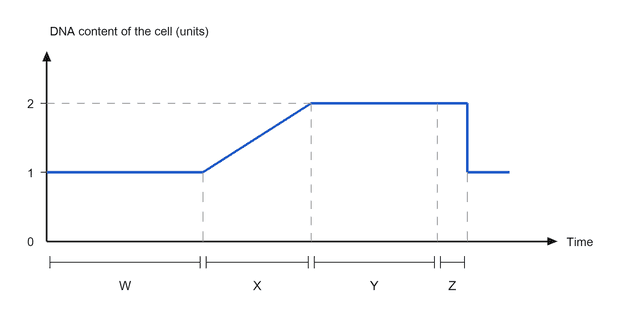
During which interval are the chromosomes being duplicated ?
- 31 mark
Question 3
Cognitive domain: Application
A scientist adds a chemical to dividing animal cells. The chemical allows the spindle fibres to form and to attach to the centromeres, but it stops the spindle fibres from contracting. What would be seen in these cells ?
- 41 mark
Question 4
Cognitive domain: Analysis
A laboratory reported the percentage of the four nitrogenous bases in four samples of double-stranded DNA. One of the reports was copied wrongly.
Sample Adenine Thymine Guanine Cytosine P 30 30 20 20 Q 22 22 28 28 R 27 27 23 23 S 18 32 18 32 Which report must be wrong ?
- 51 mark
Question 5
Cognitive domain: Understanding
Assertion (A): Two sisters born to the same parents, however similar, differ from each other in certain respects.
Reason (R): In meiosis, chromosome duplication is followed by only a single nuclear division.
- 61 mark
Question 6
Cognitive domain: Understanding
Assertion (A): In a slide of a growing root tip, a cell in anaphase is recognised by its chromatids lying in two groups that are moving towards opposite poles.
Reason (R): In anaphase, the centromere of each chromosome splits and the spindle fibres shorten.
- 71 mark
Question 7
Cognitive domain: Application
A single human chromosome may have about a million nucleosomes. Asha wants to estimate the number of histone proteins that form the cores of all these nucleosomes.
Her answer should be about ______ million histone proteins.
- 81 mark
Question 8
Cognitive domain: Application
A human zygote divides again and again, and at every round each of its cells divides into two. After four rounds of division the embryo has cells.
If this continues, after three more rounds the embryo would have ______ cells, and each of them would have ______ chromosomes.
- 91 mark
Question 9
Cognitive domain: Understanding
Nidhi stains one of her cheek cells, which is not dividing. She cannot count its chromosomes, because they are present as very long and thin chromatin fibres.
Even so, she can say that the nucleus of this cheek cell contains ______ chromatin fibres, whereas the nucleus of a human egg contains ______.
- 102 marks
Question 10
Cognitive domain: Evaluation
Kabir writes in a project: "Nothing happens in a cell during interphase. If a cell could skip interphase and go straight from one mitosis to the next, organisms would grow faster and remain just as healthy."
Evaluate Kabir's statement. Give two reasons for your answer.
- 112 marks
Question 11
Cognitive domain: Evaluation
Arjun's grandfather, aged 70, says: "My body stopped growing fifty years ago, so no mitosis takes place in my body now."
Is he right ? Justify your answer with two examples from your chapter.
- 122 marks
Question 12
Cognitive domain: Analysis
Each body cell of an insect has chromosomes: one pair of long chromosomes and one pair of short chromosomes. The figure shows the chromosomes that a student drew in the nuclei of three cells, P, Q and R, of this insect. (The chromosomes are shown after the division is over, each as a single rod.)
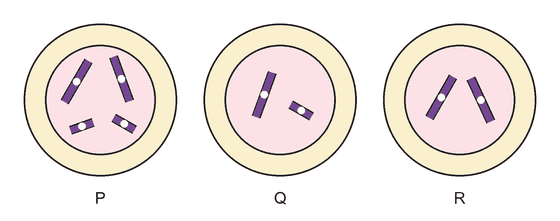
Which cell could have been formed by mitosis, and which could be a normal gamete ? Explain why the remaining cell fits neither.
- 135 marks
Question 13
Cognitive domain: Analysis
Case: A health magazine compared the body cells of three healthy members of a family: a girl of 8 years, her father of 35 years and her great-grandmother of 85 years. The table gives the estimates for X, Y and Z, in the same units of cells per day. The names have been hidden.
Person New cells produced per day Cells dying per day X 60 60 Y 48 56 Z 70 55 (a) Calculate the net change in the number of cells per day for each person.
(b) Identify X, Y and Z, giving a reason for each.
(c) Name the type of cell division that produces these new body cells. How many chromosomes does each new cell have, and why ?
(d) Even in the father, all kinds of cells are not replaced equally. From your chapter, give one example of cells that are replaced very often and one example of cells that are not replaced once they are dead.
- 145 marks
Question 14
Cognitive domain: Application
Case: On a farm, a mule was born to a female horse (mare) and a male donkey. The farm's veterinary doctor explained that each body cell of a horse has chromosomes and each body cell of a donkey has chromosomes.
(a) Name the kind of cell division that formed the egg of the mare and the sperm of the donkey. How many chromosomes did each of these gametes carry ?
(b) Work out the number of chromosomes in the zygote that developed into the mule.
(c) Every body cell of the adult mule has the same number of chromosomes as that zygote. Explain how this is ensured.
(d) Mules are usually unable to produce normal gametes. Using what you know about the way chromosomes behave in meiosis, suggest a reason.
- 155 marks
Question 15
Cognitive domain: Creativity
Case: For the school science day, Class X will act out mitosis on the playground, for an animal cell that has 4 chromosomes. Students will play the parts of the cell. They may use chalk, long ropes and caps of two colours.
(a) Decide what will represent each of these: the cell membrane, the nuclear membrane, a duplicated chromosome with its centromere, the centrioles and the spindle fibres. State how many students are needed to show the chromosomes.
(b) Describe what the students should do to show prophase, metaphase, anaphase and telophase, in the correct order.
(c) How should the class show cytokinesis for this animal cell ? What change would they make to show cytokinesis of a plant cell instead ?
(d) At the end, how can the audience check that the two daughter cells are identical to the parent cell ?
- 161 mark
Question 16
CISCE Competency-Focused Practice Questions (2024) · Cognitive domain: Analysis
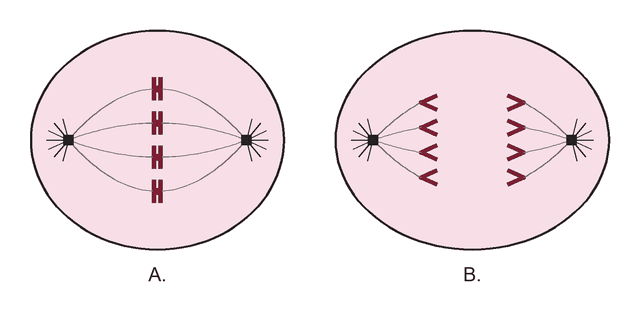
The given figures A and B show ______ and ______ stages of cell division.
- 172 marks
Question 17
CISCE Competency-Focused Practice Questions (2024) · Cognitive domain: Understanding
Name the nitrogenous base with which Guanine pairs up in the helical structure of DNA and through how many hydrogen bonds?
- 181 mark
Question 18
Cognitive domain: Analysis
Each body cell of a certain animal has chromosomes. (Hypothetical data.)
A student studies one dividing cell of this animal. At metaphase she counts ______ chromosomes and ______ chromatids in the whole cell, and at the end of anaphase, before the cell has divided into two, she counts ______ chromosomes in the whole cell.
- 191 mark
Question 19
Cognitive domain: Application
In a laboratory, an enzyme is added to the nuclei of cells that are about to divide. The enzyme breaks down only the histone proteins; it does not touch the DNA.
What is most likely to happen to the chromatin of these cells ?
- 201 mark
Question 20
Cognitive domain: Application
Human cells in a dish are treated with a chemical that stops the cleavage furrow from forming in the cell membrane. It does not stop the duplication of the chromosomes, the work of the spindle fibres or the other changes in the nucleus.
One treated cell, which has chromosomes, goes through one complete mitosis. What will be seen at the end ?
- 211 mark
Question 21
Cognitive domain: Understanding
Assertion (A): Two different genes on the same chromosome can bring about two different features of the body.
Reason (R): Each gene is a different sequence of nucleotides that encodes a particular protein.
- 221 mark
Question 22
Cognitive domain: Application
Assertion (A): A cut in the skin of a finger heals by meiosis of the cells near the cut.
Reason (R): Cells at the edge of the wound divide again and again, cover up the gap and join the broken ends.
- 231 mark
Question 23
Cognitive domain: Application
A garden pea plant has chromosomes in each body cell. In one anther of its flower, cells undergo meiosis to form pollen grains. (Hypothetical data.)
The anther will form ______ pollen grains, and each pollen grain will carry ______ chromosomes.
- 241 mark
Question 24
Cognitive domain: Analysis
A chemical that stops cells from leaving the phase is added to a culture of dividing human cells. It does not stop any of the earlier phases. After many days, every cell that had already left when the chemical was added has completed its division, and every other cell that is still in the cycle has reached the end of . A student then examines a large sample of the cells. (Hypothetical situation.)
Which of these cells would she not find in the sample ?
- 251 mark
Question 25
Cognitive domain: Analysis
Four students drew the same animal cell in late anaphase. The cell has chromosomes in its body cells, and its poles are at the top and the bottom. The figure shows the four sketches, numbered 1 to 4.
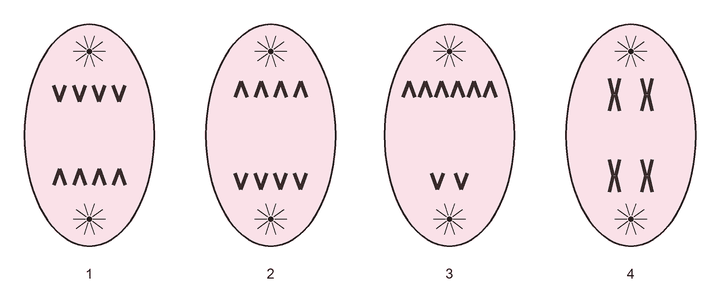
Which sketch shows late anaphase correctly ?
- 261 mark
Question 26
Cognitive domain: Analysis
Both strands of one DNA molecule in a cell are tagged with a red dye. The cell is then moved to a dish in which the dye is not available, so every new DNA strand that it makes is untagged. The cell goes through the cell cycle twice, and each time its DNA is replicated in the S phase.
After the second replication there are four copies of this DNA molecule in all. How many of the four copies contain a red strand ?
- 272 marks
Question 27
Cognitive domain: Evaluation
A student wrote this note for a science exhibition.
"Chromosomes in animals were first studied in 1882 by Rosalind Franklin, in the rapidly dividing cells of the larvae of salamander. The double-helical structure of DNA was worked out in 1953 by Walther Flemming."
The note has two mistakes. Find them and write the correct statements.
- 282 marks
Question 28
Cognitive domain: Analysis
A cell has chromosomes. Suppose that it goes into mitosis without having passed through the S phase, so that its chromosomes are not duplicated, and that its single chromosomes are shared equally between the two daughter cells. (Hypothetical situation.)
(a) How many chromosomes would each daughter cell receive ?
(b) Explain why this would be harmful to the daughter cells.
- 292 marks
Question 29
Cognitive domain: Application
A scientist measures the volume of a cell, nucleus and cytoplasm together, in a culture. A cell that has just been formed measures units. Just before it begins to divide again it measures units. (Hypothetical data.)
(a) Name the phase of the cell cycle in which most of this increase takes place, and name two substances that the cell makes in it.
(b) Suppose a cell of units divided three times in a row, with no such growth between the divisions. What would be the volume of each cell at the end ?
- 302 marks
Question 30
Cognitive domain: Application
At the start of the phase an animal cell has mitochondria and a plant leaf cell has chloroplasts. (Hypothetical data.) Each of these organelles divides once during , and after cytokinesis the organelles of each cell are shared equally between its two daughter cells.
(a) How many mitochondria will each daughter animal cell receive, and how many chloroplasts will each daughter plant cell receive ?
(b) Why is it important that these organelles divide before the cell does ?
- 312 marks
Question 31
Cognitive domain: Application
Suppose that human sperms and eggs were formed without any reduction in number, so that each sperm and each egg carried all chromosomes. (Hypothetical situation.)
(a) How many chromosomes would the zygote have in the first generation ? How many would it have in the third generation, if the same happened in every generation ?
(b) Which kind of cell division prevents this in real life, and how ?
- 322 marks
Question 32
Cognitive domain: Evaluation
Anjali wrote in her notebook:
"In mitosis the parent cell lives on beside its two daughter cells, and the daughter cells are always female cells."
Using your chapter, point out the two mistakes.
- 333 marks
Question 33
Cognitive domain: Evaluation
Neha drew an animal cell at metaphase for an animal that has chromosomes in each body cell. The labels are written by her. Her teacher said that the drawing has three mistakes.

Find the three mistakes and say how each should be corrected.
- 343 marks
Question 34
Cognitive domain: Understanding
The figure shows the cell cycle of a cell as a wheel. The arrows show the direction in which the cell goes round. In the arc marked X the cell divides. A branch marked Y leaves the wheel at the end of arc U.

(a) Name the phases U, V and W.
(b) How does a chromosome of a cell in arc W differ from a chromosome of a cell at the start of arc U, and in which arc does this change come about ?
(c) What is Y, and what happens to a cell that takes this branch ?
- 353 marks
Question 35
Cognitive domain: Evaluation
The table gives the number of chromosomes in a body cell of some organisms.
Organism Chromosomes in a body cell Fruit fly Garden pea Onion Cat Human Chimpanzee Potato Dog (a) Which two organisms have the same number of chromosomes ?
(b) How many chromosomes will a sperm of a cat have, and how many will a pollen grain of an onion have ?
(c) A student says, “The more chromosomes an organism has, the more complex it is.” Use the table to evaluate her statement.
- 363 marks
Question 36
Cognitive domain: Analysis
An Amoeba in pond water divides into two Amoebae. In a family, a baby girl is born to her parents.
(a) Name the kind of cell division by which the Amoeba reproduces. How do the chromosomes of each new Amoeba compare with those of the parent cell ?
(b) Name the kind of cell division that formed the sperm and the egg from which the baby girl developed.
(c) Explain why the two new Amoebae are alike, but the baby girl is different from both her parents in some respects.
- 373 marks
Question 37
Cognitive domain: Creativity
At the end of the phase a cell must follow one of two paths, like a train at a railway junction with a signal. Make up your own model of this junction.
(a) Say where each of the two tracks leads, and what the signal should check before it lets a cell go on.
(b) Give one kind of cell in the body for which the signal almost always sends the cell to the resting track, and one kind for which it keeps the cell going round the cycle.
(c) How should the signal be set for a growing child, a healthy adult and a very old person ? Give a reason for each.
- 385 marks
Question 38
Cognitive domain: Analysis
Case: A science club made a chart from the facts in the chapter about how long some body cells last before they are replaced. (Approximate values; take year as days.)
Cells Average life Epithelial cells lining the gut days Outer skin cells days Red blood cells days Bone cells years (a) How many times is each of the gut lining cells, the skin cells and the red blood cells replaced in one year ?
(b) Suppose a medicine stopped mitosis in the whole body for days (hypothetical situation). Assume that the cells of each kind die at an even rate through their life, and take years as days. What fraction of each kind of cell would die in these days and not be replaced ?
(c) Using your answers, say which of these tissues would show the effect of the medicine first and which last, and give a reason.
- 394 marks
Question 39
Cognitive domain: Analysis
Case: A hospital laboratory grew normal skin cells and cells taken from a tumour in two separate dishes, starting with one cell in each dish. The table gives the time that each kind of cell needs for one complete cell cycle. In both dishes every cell divides at the end of each cycle, and none of the cells dies in the first three days. (Hypothetical data.)
Cells Time for one complete cell cycle Normal skin cells hours Tumour cells hours The doctor adds that, once a wound is covered, normal skin cells stop dividing and go into the resting phase, but tumour cells do not.
(a) How many cell cycles does each kind of cell complete in hours, and how many cells are there in each dish at the end of this time ?
(b) How many times as many tumour cells as normal cells are there after hours ?
(c) Why do the tumour cells go on dividing while the normal cells stop ? Is every tumour a cancer ?
- 405 marks
Question 40
Cognitive domain: Creativity
Case: Aarav wants to find out for himself in which part of a growing onion root the new cells are formed. He has an onion bulb, a jar of water, a ruler, a fine waterproof marker pen and a hand lens. His teacher can help him with a microscope, a stain and slides.
(a) Describe how Aarav can set up the experiment and what he should mark on the root.
(b) Predict what he will see after two days, and explain it using mitosis.
(c) On a stained slide of the root tip he sees dividing cells with no asters, and a line forming across the middle of each cell. Explain how these two features show that mitosis in these cells differs from mitosis in the cells of his own skin.