Solution:
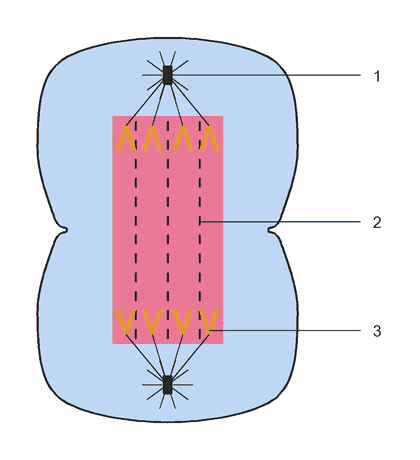
Concept: A stage of mitosis is recognised by where the chromosomes are. Here two sets of daughter chromosomes lie near opposite poles and the cell membrane has begun to furrow.
Step 1 — (a) Name parts 1, 2 and 3.
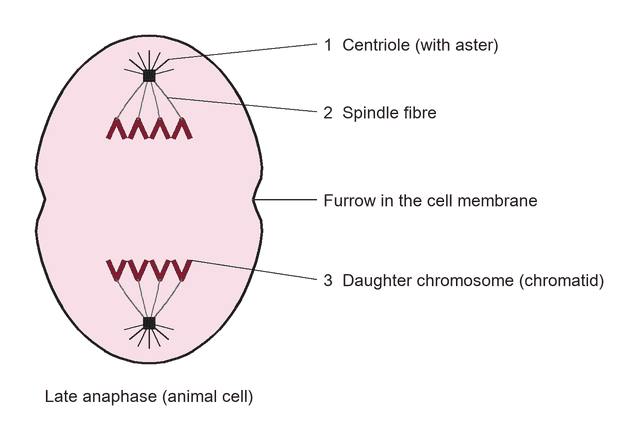
1 is the dark body at a pole with rays round it: the centriole (with aster). 2 is a fibre running between the poles: a spindle fibre. 3 is one of the V-shaped bodies near a pole: a daughter chromosome (chromatid).
Step 2 — (b) Identify the stage.
This is anaphase (late anaphase) of mitosis.
Reason: the sister chromatids have separated and the daughter chromosomes are being pulled to opposite poles by the spindle fibres, and a furrow has begun in the cell membrane.
Step 3 — (c) Where this division occurs.
Mitosis occurs in somatic (body) cells, for example in the skin, the bone marrow and growing tissues. It gives new cells for growth, repair and replacement.
Step 4 — (d) The stage before this one.
The stage before anaphase is metaphase: the chromosomes lie in one plane at the equator, each joined to spindle fibres at its centromere.
To draw it, show a round cell with a centriole and aster at each pole, spindle fibres from the poles to the centromeres, and the same four duplicated chromosomes (two chromatids each) in a row at the equator; no nuclear membrane or nucleolus.

Therefore, (a) 1 centriole with aster, 2 spindle fibre, 3 daughter chromosome; (b) anaphase, as the chromatids are moving to opposite poles; (c) somatic cells; (d) metaphase, drawn as shown.