
Question 342 marksEasy
What are the rungs of the “DNA ladder” made of ?
Confirming your payment
Sign up now and get 250 free tokens.
Structure of Chromosomes, Cell Cycle and Cell Division · Question 34 of 48
What are the rungs of the “DNA ladder” made of ?
Solution:
Concept: The two DNA strands form a ladder: the phosphate and sugar of each strand make the sides, and the rungs lie between them.
Step 1 — See what joins the strands.
A nitrogenous base is joined to each sugar and points inwards towards the other strand.
Step 2 — Form a rung.
It joins the complementary base of the other strand by hydrogen bonds; the two joined bases make one rung.
Step 3 — Recall the fixed pairing.
Adenine pairs with thymine (two hydrogen bonds) and guanine with cytosine (three hydrogen bonds).
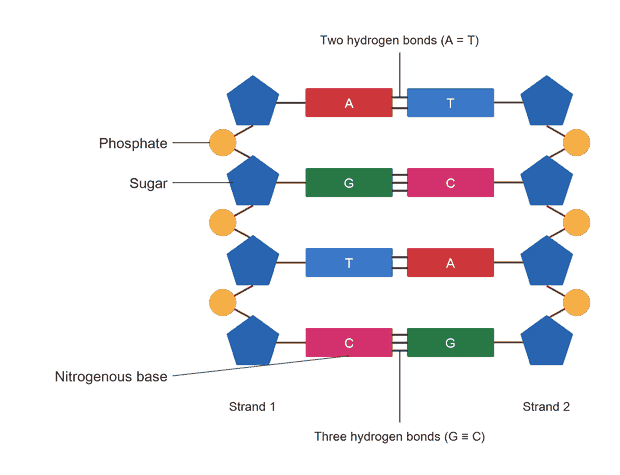
Watch out: The sides are sugar and phosphate; only the bases make the rungs.
Therefore, the rungs of the DNA ladder are pairs of complementary nitrogenous bases (A–T and G–C) joined by hydrogen bonds.