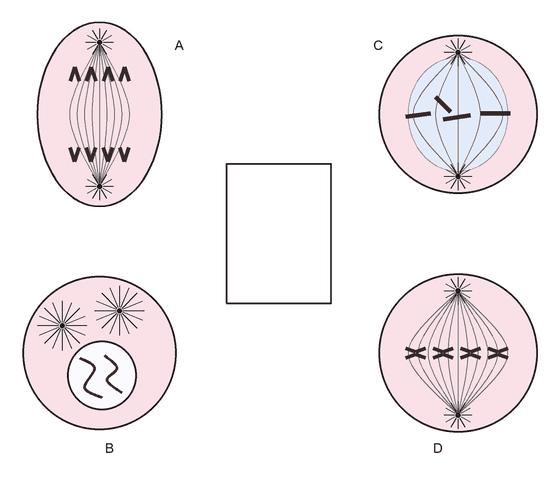
Solution:
Concept: Asters and rounded cells mark an animal cell; chromosomes that line up singly at the equator (no pairing) with equal numbers going to each pole mark mitosis.
Step 1 — (a) Plant or animal cell.
It is an animal cell, because (1) centrioles with asters are present at the poles, and (2) there is no cell wall: the cells are rounded and bounded only by the cell membrane.
Step 2 — (b) Mitosis or meiosis.
It is mitosis: the chromosomes do not pair; they line up singly at the equator, and equal numbers go to each pole.
Step 3 — (c) Put the stages in order.
Read each sketch:
- B: the nucleus is still whole, the chromosomes are long threads and the two asters have just begun to move apart: early prophase.
- C: the asters are at opposite poles, the spindle is forming and the chromosomes are moving to the equator: late prophase.
- D: the chromosomes lie in one plane at the equator: metaphase.
- A: two sets of daughter chromosomes are near the opposite poles: anaphase.
So the order is B → C → D → A.

Step 4 — (d) The stage before the earliest one.
The earliest stage shown is B (early prophase), and the stage before prophase is interphase.
Step 5 — (e) Draw interphase.
Draw a rounded cell with a centrosome (two centrioles) beside a whole nucleus that has a nuclear membrane, a nucleolus and a fine network of chromatin threads. Draw no separate chromosomes, because in interphase the chromatin is still long, thin threads.
Label: centrosome (centrioles), cell membrane, cytoplasm, nucleus, nuclear membrane, chromatin threads, nucleolus.

Therefore, (a) animal cell (asters; no cell wall); (b) mitosis; (c) B → C → D → A; (d) interphase; (e) interphase drawn as shown.