Solution:
Concept: Meiosis does two things: it halves the chromosome number, and it mixes the genes.
Step 1 — (a) Why gametes must be made by meiosis.
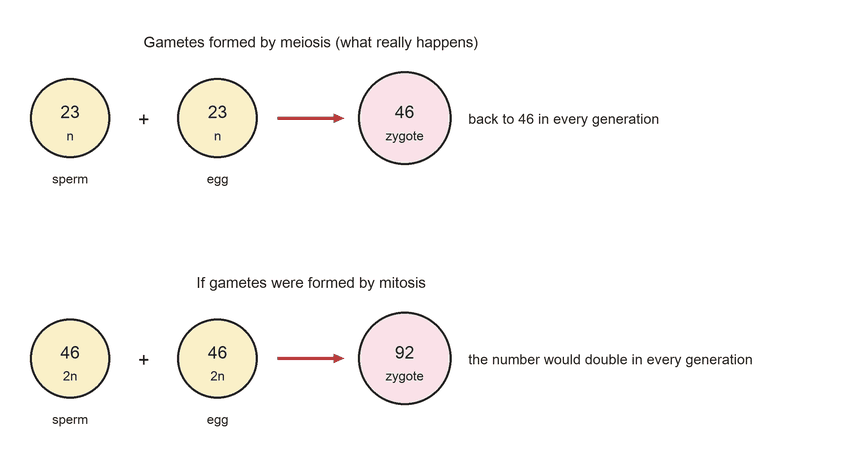
Meiosis gives haploid (n) gametes, each with half the number of chromosomes.
When a sperm and an egg fuse at fertilisation, the diploid (2n) number is restored in the zygote (23 + 23 = 46 in humans).
If gametes were made by mitosis, each would carry the full set, and the number would double in every generation (46 + 46 = 92).
Step 2 — (b) Why meiosis is called reductional division.
In the first meiotic division the members of each homologous pair separate.
Each daughter cell therefore receives only one chromosome of each pair, so the number is reduced to half (2n → n). Hence the name.
Step 3 — (c) Why children of the same parents differ.
In meiosis the maternal and paternal chromosomes are sorted randomly into the gametes.
In addition, crossing over swaps pieces between non-sister chromatids of homologous chromosomes.
So each gamete carries a new combination of genes; no two children (except identical twins) get the same set, and they show variations.

Therefore, meiosis keeps the chromosome number constant from generation to generation by halving it in the gametes, and it creates variation through random sorting and crossing over.
