
Question 3810 marksMedium
Distinguish between the following pairs :
(a) Cytokinesis and Karyokinesis
(b) DNA and RNA
(c) Nucleosome and Nucleotide
(d) Centrosome and Centromere
(e) Haploid and Diploid
Confirming your payment
Sign up now and get 250 free tokens.
Structure of Chromosomes, Cell Cycle and Cell Division · Question 38 of 48
Distinguish between the following pairs :
(a) Cytokinesis and Karyokinesis
(b) DNA and RNA
(c) Nucleosome and Nucleotide
(d) Centrosome and Centromere
(e) Haploid and Diploid
Solution:
Concept: Compare each pair point against point, on the same basis in both columns.
Step 1 — Cytokinesis and karyokinesis.
Compare what is divided and when:
| Basis | Cytokinesis | Karyokinesis |
|---|---|---|
| What divides | The cytoplasm. | The nucleus. |
| When | After karyokinesis, by a furrow (animal) or cell plate (plant). | First, in four phases: prophase, metaphase, anaphase, telophase. |
Step 2 — DNA and RNA.
Compare their sugar, bases and strands:
| Basis | DNA | RNA |
|---|---|---|
| Full form and sugar | Deoxyribonucleic acid; sugar deoxyribose. | Ribonucleic acid; sugar ribose. |
| Bases | A, G, C and thymine. | A, G, C and uracil. |
| Strands | Usually double-stranded (double helix). | Usually single-stranded. |
Step 3 — Nucleosome and nucleotide.
Compare what each is made of and what it builds:
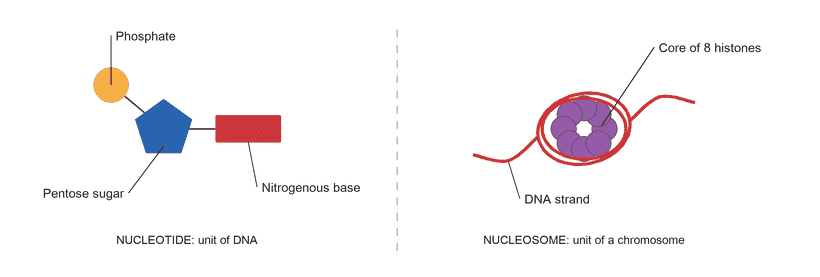
| Basis | Nucleosome | Nucleotide |
|---|---|---|
| Made of | DNA wound round a core of eight histones. | Pentose sugar, phosphate and a nitrogenous base. |
| Unit of | A chromosome (chromatin). | A nucleic acid (DNA or RNA). |
Step 4 — Centrosome and centromere.
Compare where each is and what it does:
| Basis | Centrosome | Centromere |
|---|---|---|
| Where | In the cytoplasm near the nucleus; has centrioles; animal cells only. | On the chromosome: the constricted region joining the sister chromatids. |
| Role | Forms the spindle (with asters) and starts cell division. | The point where spindle fibres attach. |

Step 5 — Haploid and diploid.
Compare the number of chromosome sets:
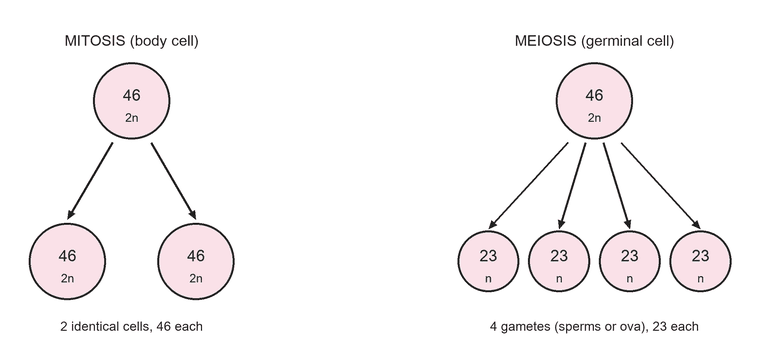
| Basis | Haploid | Diploid |
|---|---|---|
| Sets | One set: one of each pair (n). | Two sets: in pairs (2n). |
| Found in | Gametes; 23 in humans. | Body cells and the zygote; 46 in humans. |
Watch out: The words in each pair differ by a few letters: nucleoTIDE belongs to DNA and nucleoSOME to the chromosome; centroMERE is on the chromosome and centroSOME is in the cytoplasm.
Therefore, the pairs differ as tabulated, the key point of each being: cytoplasm vs nucleus; deoxyribose and thymine vs ribose and uracil; chromosome unit vs DNA unit; spindle former vs spindle attachment; n vs 2n.