
Opening your dashboard
Class 10 Biology Chapter 2 Structure of Chromosomes, Cell Cycle and Cell Division: Previous Year Questions
50 questions on Chapter 2, each solved step by step. Class 10 Biology, ICSE 2026-27.
50 questions with solutions
1–5 marks · Mixed difficulty
- 11 mark
Question 1
Name the following:
The exchange of chromatid parts between the maternal and the paternal chromatids of a pair of homologous chromosomes during meiosis.
Solve with AIWritten solution
Solution:
Concept: In meiosis the two chromosomes of each homologous pair lie side by side. Each has two chromatids, so four chromatids lie together, and the non-sister chromatids can exchange parts.
Step 1 — Recall the event.
The exchange of chromatid parts between a maternal and a paternal chromatid of a homologous pair is called crossing over.
Step 2 — See where and why it matters.
The chromatids touch and exchange parts at an X-shaped point called the chiasma. The chromatids then carry new combinations of genes, which is one reason children of the same parents differ.

Watch out: Crossing over takes place between NON-sister chromatids (one maternal, one paternal), and only in meiosis.
Therefore, the term is crossing over.
- 21 mark
Question 2
In each set of terms given below, there is an odd one and cannot be grouped in the same category to which the other three belong. Identify the odd term in each set and name the category to which the remaining three belong.
Example: Ovary, Fallopian tube, Ureter, Uterus. Odd term: Ureter Category: Parts of female reproductive system.
Thymine, Cytosine, Adenine, Pepsin.
Solve with AIWritten solution
Solution:
Concept: DNA has four nitrogenous bases: adenine (A), guanine (G), cytosine (C) and thymine (T). They pair in a fixed way across the two strands: A with T (two hydrogen bonds) and G with C (three hydrogen bonds).
Step 1 — Look at each term.
Thymine, cytosine and adenine are three of the four nitrogenous bases of DNA. Pepsin is a protein-digesting enzyme of the gastric juice.
Step 2 — Name the odd term and the category.
Pepsin is not a part of DNA, so it is the odd term; the other three are nitrogenous bases (the fourth base, guanine, is not in the list).
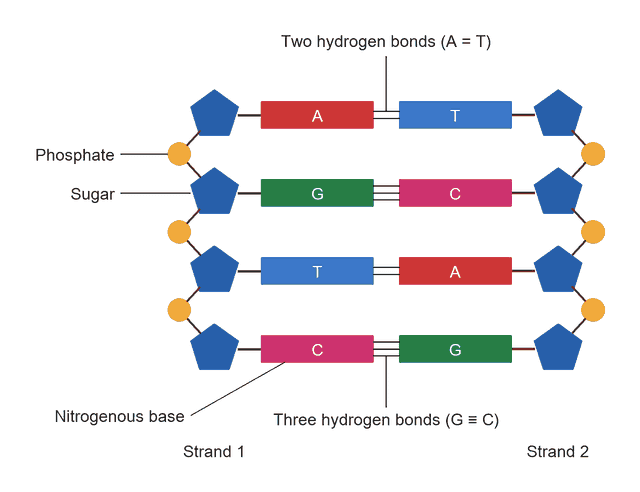
Therefore, the odd term is Pepsin, and the category of the other three is Nitrogenous bases of DNA.
- 31 mark
Question 3
State the exact location of the following structures:
Centromere
Solve with AIWritten solution
Solution:
Concept: After the S phase every chromosome is duplicated: it consists of two identical sister chromatids joined at a constricted region, the centromere.
Step 1 — Recall what the centromere is.
The centromere is a small constricted region of a chromosome.
Step 2 — State its exact location.
It lies on the chromosome, at the point where the two sister chromatids are joined to each other. During cell division the spindle fibre attaches to the chromosome there.

Watch out: Centromere (the joining point of the chromatids) is different from centrosome and centriole (in the cytoplasm).
Therefore, the centromere is located on the chromosome, at the constricted region where its two sister chromatids are joined.
- 41 mark
Question 4
Differentiate between the following pairs on the basis of what is mentioned within brackets:
Human skin cell and Human ovum (number of chromosomes)
Solve with AIWritten solution
Solution:
Concept: Body (somatic) cells are diploid (2n): 46 chromosomes in 23 pairs in man. Mitosis keeps the number the same. Meiosis halves it, so the gametes (sperms and ova) are haploid (n): 23 in man. Fertilisation restores 46.
Step 1 — Skin cell.
A human skin cell is a body cell formed by mitosis, so it is diploid: it has 46 chromosomes (23 pairs).
Step 2 — Ovum.
An ovum is a gamete formed by meiosis, so it is haploid: it has 23 chromosomes, one from each pair.
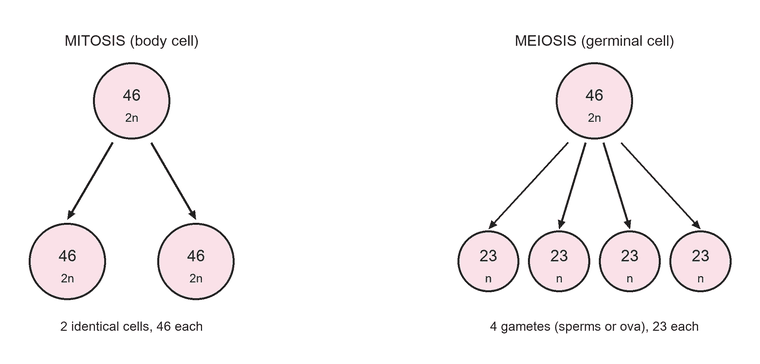
Step 3 — Set the difference side by side.
We compare the two on the basis asked, the number of chromosomes.
Human skin cell Human ovum 46 chromosomes (diploid, 2n) 23 chromosomes (haploid, n) Therefore, a human skin cell has 46 chromosomes (2n), while a human ovum has 23 chromosomes (n).
- 51 mark
Question 5
Give the Biological / technical term for the following:
The repeating components of each DNA strand lengthwise.
Solve with AIWritten solution
Solution:
Concept: DNA is a double helix of two strands. Each strand is a chain of nucleotides, and each nucleotide has a phosphate group, a pentose sugar (deoxyribose) and a nitrogenous base. The bases of the two strands pair by hydrogen bonds: adenine (A) with thymine (T) and guanine (G) with cytosine (C).
Step 1 — Recall the repeating unit.
Each strand of DNA is a long chain of repeating units called nucleotides, joined end to end along its length.
Step 2 — See how they build the strand.
The sugar and phosphate of successive nucleotides form the backbone of the strand, and the base of each nucleotide points inwards to pair with a base of the other strand.
Watch out: A nucleosome (DNA + histone core) is a unit of the chromosome, not of the DNA strand.
Therefore, the term is nucleotides.
- 65 marks
Question 6
The given diagram shows a stage during mitotic division in an animal cell:
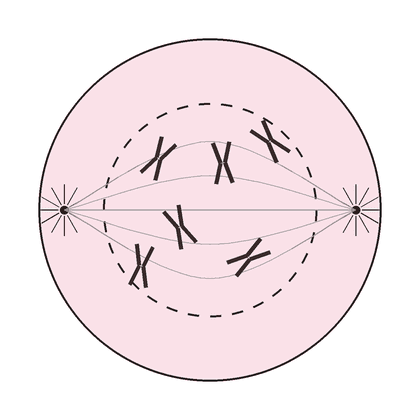
(i) Identify the stage. Give a reason to support your answer.
(ii) Draw a neat labelled diagram of the cell as it would appear in the next stage. Name the stage.
(iii) In what two ways is mitotic division in an animal cell different from the mitotic division in a plant cell?
(iv) Name the type of cell division that occurs during:
A. Growth of a shoot
B. Formation of pollen grains
Solve with AIWritten solution
Solution:
Concept: Each stage of mitosis is recognised by where the chromosomes are and what is happening to the nuclear membrane, the centrioles and the spindle. in an animal cell the centrioles move to the poles and form asters, and the cytoplasm divides by a furrow; a plant cell (of a flowering plant) has no centrioles or asters, and its cytoplasm divides by a cell plate.
Step 1 — Part (i): identify the stage.
The stage is late prophase. Each chromosome is short and thick and shows two chromatids; the chromosomes are scattered, not yet lined up at the equator; the nuclear membrane is breaking down (drawn dotted); and the centrioles with their asters have reached opposite poles, with spindle fibres forming between them.
Step 2 — Part (ii): draw the next stage.
The next stage is metaphase. The cell in the question has six chromosomes, so the drawing shows six, lined up in one plane at the equator, each attached to a spindle fibre at its centromere.
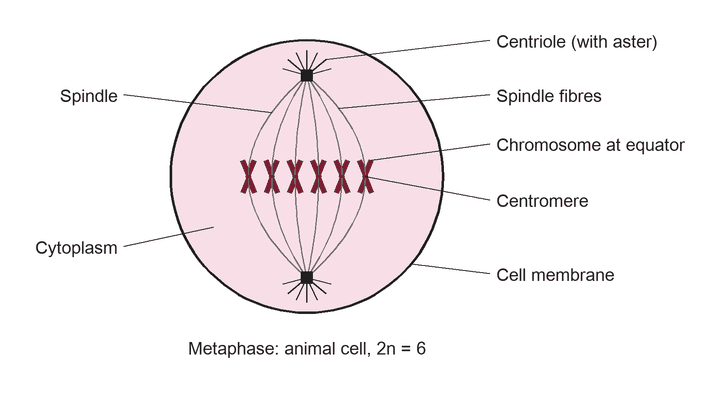
Step 3 — Part (iii): two differences between animal and plant mitosis.
The two cells differ in how the spindle forms and in how the cytoplasm divides.
Animal cell Plant cell Centrioles form asters at the poles, which help to form the spindle. No centrioles and no asters; the spindle forms without them. Cytokinesis by furrowing: a furrow in the cell membrane deepens from outside inwards. Cytokinesis by a cell plate, laid down at the centre and growing outwards to the wall. 
Step 4 — Part (iv): type of division.
Growth of a shoot needs new body cells with the same chromosome number, so it is by mitosis. Pollen grains are formed in the anthers from pollen mother cells and carry half the chromosome number, so they are formed by meiosis.
Watch out: In metaphase draw the SAME number of chromosomes as in the question (six here), each with two chromatids.
Therefore, (i) late prophase; (ii) metaphase, drawn with 6 chromosomes at the equator; (iii) asters formed only in the animal cell, and cytokinesis by furrowing in the animal cell but by a cell plate in the plant cell; (iv) A. mitosis, B. meiosis.
- 71 mark
Question 7
Choose the correct answer from the four options given below:
Synthesis phase in the cell cycle is called so, because of the synthesis of more:
Solve with AIAnswer
(A) RNA
(B) RNA and proteins
- Correct
(C) DNA
(D) Glucose
Answer: (C) DNA
Concept: The cell cycle has a non-dividing interphase (: the cell grows and makes RNA and proteins; S: DNA is synthesised and every chromosome is duplicated; : more RNA and proteins are made for division) followed by the dividing M phase: karyokinesis (prophase, metaphase, anaphase, telophase) and then cytokinesis.
Step 1 — Recall the S phase.
In the S (synthesis) phase more DNA is synthesised, and each chromosome makes a copy of itself.
Step 2 — See the result.
The two copies stay joined at the centromere as two sister chromatids. The DNA content of the cell doubles, but the number of chromosomes stays the same.
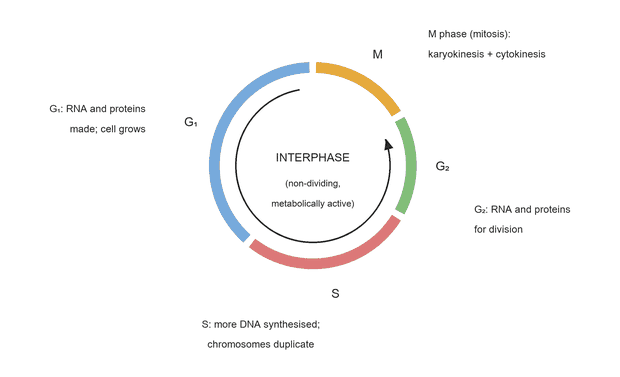
Watch out: The phase is NAMED after DNA synthesis; RNA and proteins are made all through interphase.
Why the other options are wrong:
- (A) RNA: RNA is made all through interphase, mostly in G₁ and G₂; it is not what gives the S phase its name.
- (B) RNA and proteins: RNA and proteins are the main products of the G₁ and G₂ (growth) phases.
- (D) Glucose: glucose is made by photosynthesis in green plants; it is not a step of the cell cycle.
Therefore, the S phase is named after the synthesis of more DNA, option (C).
- 81 mark
Question 8
Choose the ODD one out of the following terms given and name the CATEGORY to which the others belong:
Phosphate, RNA, Sugar, Nitrogenous base
Solve with AIWritten solution
Solution:
Concept: DNA is a double helix of two strands. Each strand is a chain of nucleotides, and each nucleotide has a phosphate group, a pentose sugar (deoxyribose) and a nitrogenous base. The bases of the two strands pair by hydrogen bonds: adenine (A) with thymine (T) and guanine (G) with cytosine (C).
Step 1 — Look at each term.
Phosphate, sugar and nitrogenous base are the three parts that join to form one nucleotide. RNA is a whole nucleic acid, a long chain of many nucleotides.
Step 2 — Name the odd term and the category.
RNA is not a part of a nucleotide, so it is the odd term.
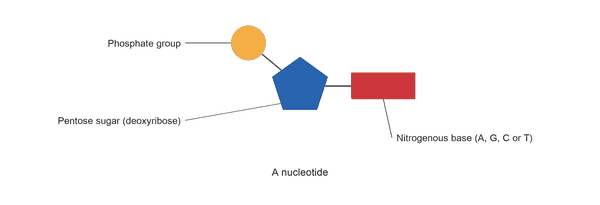
Therefore, the odd term is RNA, and the category of the other three is Components of a nucleotide.
- 91 mark
Question 9
Given below are groups of terms. In each group the first pair indicates the relationship between the two terms. Rewrite and complete the second pair on a similar basis.
Example: Oxygen : Inspiration : : Carbondioxide : Expiration
Cytoplasm : Cytokinesis : : Nucleus : ...............
Solve with AIWritten solution
Solution:
Concept: Cell division has two parts: first the nucleus divides (karyokinesis, karyon = nucleus), then the cytoplasm divides (cytokinesis, cyto = cell).
Step 1 — Find the relation in the first pair.
Cytokinesis is the division of the cytoplasm, so the first pair links a part of the cell with the name of its division.
Step 2 — Complete the second pair.
The division of the nucleus is karyokinesis: the four phases prophase, metaphase, anaphase and telophase together.
Therefore, Cytoplasm : Cytokinesis : : Nucleus : Karyokinesis.
- 101 mark
Question 10
Given below are groups of terms. In each group the first pair indicates the relationship between the two terms. Rewrite and complete the second pair on a similar basis.
Example: Oxygen : Inspiration : : Carbondioxide : Expiration
Adenine : Thymine : : Cytosine : ...............
Solve with AIWritten solution
Solution:
Concept: DNA has four nitrogenous bases: adenine (A), guanine (G), cytosine (C) and thymine (T). They pair in a fixed way across the two strands: A with T (two hydrogen bonds) and G with C (three hydrogen bonds).
Step 1 — Find the relation in the first pair.
Adenine pairs with thymine across the two strands of DNA, so the first pair is a base and its partner.
Step 2 — Complete the second pair.
Cytosine always pairs with guanine, by three hydrogen bonds.
Therefore, Adenine : Thymine : : Cytosine : Guanine.
- 111 mark
Question 11
Match the item given in Column A with the most appropriate one in Column B.
Column A Column B DNA and histones dynamic body balance Hyperglycemia Hypoglycemia Natality static body balance vehicular standards nucleosome Solve with AIWritten solution
Solution:
Concept: In a chromosome the long DNA strand is wound round cores of eight histone proteins (histone octamers). One histone core with its DNA wound round it is a nucleosome; nucleosomes lie along the DNA like beads on a string.
Step 1 — Find what DNA and histones form together.
DNA wound round a core of histones forms a nucleosome.
Step 2 — Check the other items.
None of the other items in Column B (body balance, blood sugar levels, natality, vehicular standards) has anything to do with DNA and histones.
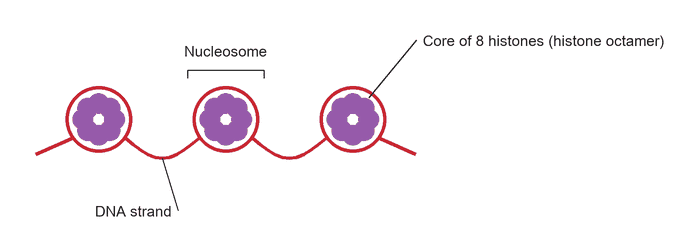
Watch out: Nucleosome (DNA + histones) is not the same as nucleotide (the unit of DNA).
Therefore, the matching pair is DNA and histones — nucleosome.
- 125 marks
Question 12
Study the diagram given below which represents a stage during the mitotic cell division and answer the questions that follow:
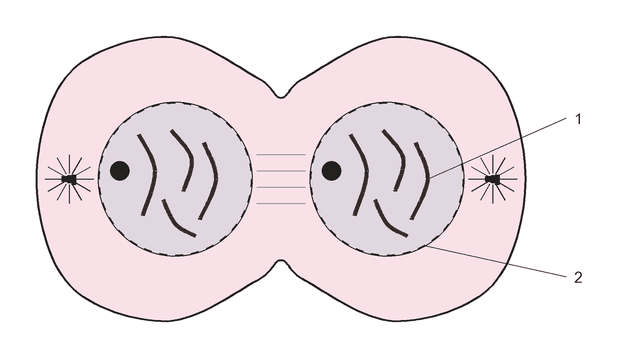
(i) Identify the stage giving suitable reasons.
(ii) Name the parts numbered 1 and 2.
(iii) What is the technical term for the division of nucleus?
(iv) Mention the stage that comes before the stage shown in the diagram. Draw a neat labelled diagram of the stage mentioned.
(v) Which is the cell division that results in half the number of chromosomes in daughter cells?
Solve with AIWritten solution
Solution:
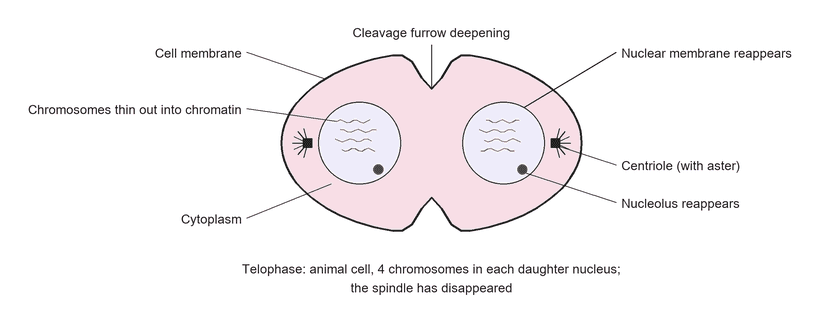
Concept: The last stage of mitosis, telophase, is almost the reverse of prophase: the two sets of daughter chromosomes reach the poles, the nuclear membrane and nucleolus re-form, the chromosomes thin out into chromatin and the cell starts to divide in the middle.
Step 1 — Part (i): identify the stage.
The stage is telophase. Two groups of daughter chromosomes have reached the opposite poles; a nuclear membrane is forming round each group and a nucleolus has reappeared in each new nucleus; the chromosomes are thinning out; only a few spindle fibres are left between the nuclei; and the cell membrane is furrowing in the middle.
Step 2 — Part (ii): name the parts.
Part 1 is a chromosome (a daughter chromosome, thinning out into a chromatin thread). Part 2 is the nuclear membrane, re-forming round the daughter nucleus.
Step 3 — Part (iii): the division of the nucleus.
The technical term for the division of the nucleus is karyokinesis.
Step 4 — Part (iv): the stage before, drawn.
The stage before telophase is anaphase. The centromere of each chromosome has split, and the sister chromatids are pulled to opposite poles by the shortening spindle fibres, centromere first.
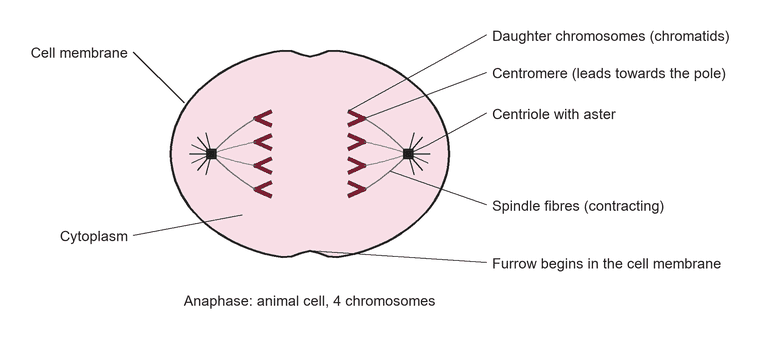
Step 5 — Part (v): the halving division.
Meiosis (reduction division) gives daughter cells with half the number of chromosomes, one of each pair (the haploid number, n).
Watch out: The dotted circle round each group is the nuclear membrane RE-forming (telophase), not breaking down (prophase); the furrow in the middle shows the stage is at the end of division.
Therefore, (i) telophase; (ii) 1 chromosome, 2 nuclear membrane; (iii) karyokinesis; (iv) anaphase (drawn); (v) meiosis.
- 131 mark
Question 13
Give appropriate biological / technical terms for the following:
A pair of corresponding chromosomes of the same size and shape, one from each parent.
Solve with AIWritten solution
Solution:
Concept: Body cells carry their chromosomes in pairs. The two chromosomes of a pair, one from the mother and one from the father, have the same size and shape and carry genes for the same characters at the same places; they are homologous chromosomes.
Step 1 — Recall the term.
A pair of corresponding chromosomes of the same size and shape, one from each parent, are homologous chromosomes.
Step 2 — Add what they share.
They carry genes for the same characters at the same positions (loci). A human body cell has 23 such pairs.

Therefore, the term is homologous chromosomes.
- 141 mark
Question 14
(a) Name the following:
The number of chromosomes present in a nerve cell of a human being.
Solve with AIWritten solution
Solution:
Concept: Body (somatic) cells are diploid (2n): 46 chromosomes in 23 pairs in man. Mitosis keeps the number the same. Meiosis halves it, so the gametes (sperms and ova) are haploid (n): 23 in man. Fertilisation restores 46.
Step 1 — Decide the type of cell.
A nerve cell is a body (somatic) cell, formed by mitosis.
Step 2 — Give its number.
So it has the full diploid number of a human cell: 46 chromosomes (23 pairs).
Watch out: Only the gametes (sperms and ova) have 23; every body cell, including a nerve cell, has 46.
Therefore, a human nerve cell has 46 chromosomes.
- 151 mark
Question 15
Correct the following statements by changing the underlined words:
Nitrogen bonds are present between the complementary nitrogenous bases of DNA.
Solve with AIWritten solution
Solution:
Concept: DNA is a double helix of two strands. Each strand is a chain of nucleotides, and each nucleotide has a phosphate group, a pentose sugar (deoxyribose) and a nitrogenous base. The bases of the two strands pair by hydrogen bonds: adenine (A) with thymine (T) and guanine (G) with cytosine (C).
Step 1 — Find what is wrong.
The two strands of DNA are not held together by 'nitrogen bonds'. The bases are joined by weak hydrogen bonds.
Step 2 — Give the numbers.
Adenine and thymine are joined by two hydrogen bonds, and guanine and cytosine by three.
Watch out: The bases are NITROGENOUS (they contain nitrogen), but the bonds between them are HYDROGEN bonds.
Therefore, the correct statement is: Hydrogen bonds are present between the complementary nitrogenous bases of DNA.
- 165 marks
Question 16
The diagram given below represents a stage during cell division. Study the same and answer the questions that follow:
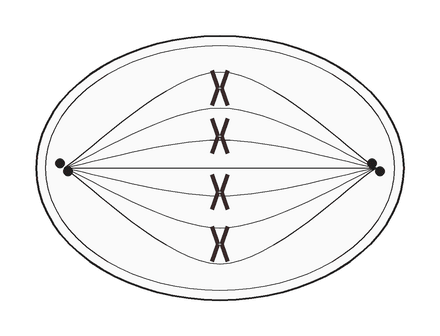
(i) Identify whether it is a plant cell or an animal cell. Give a reason in support of your answer.
(ii) Name the stage depicted in the diagram. What is the unique feature observed in this stage?
(iii) Name the type of cell division that occurs during:
(a) Replacement of old leaves by new ones.
(b) Formation of gametes.
(iv) What is the stage that comes before the stage shown in the diagram?
(v) Draw a neat, labelled diagram of the stage mentioned in (iv) above keeping the chromosome number constant.
Solve with AIWritten solution
Solution:
Concept: Centrioles (and the asters they form) are found in animal cells only; the cells of flowering plants have none. Chromosomes lined up in one plane at the equator mark metaphase.
Step 1 — Part (i): plant or animal cell.
It is an animal cell: a pair of centrioles is drawn at each pole of the spindle, and centrioles are found only in animal cells. The cell is drawn with a double outline, which could be mistaken for a cell wall, but the centrioles decide the answer.
Step 2 — Part (ii): the stage and its unique feature.
The stage is metaphase. Its unique feature is that all the duplicated chromosomes line up in one plane at the equator of the cell (the metaphase plate), each attached to a spindle fibre at its centromere.
Step 3 — Part (iii): type of division.
(a) Replacing old leaves by new ones is growth, which needs new body cells, so it is by mitosis. (b) Gametes have half the chromosome number, so they are formed by meiosis.
Step 4 — Part (iv): the stage before.
The stage that comes before metaphase is prophase.
Step 5 — Part (v): draw prophase with the same number.
The cell in the question has four chromosomes, so the prophase drawing also shows four, each as two chromatids joined at a centromere. The centrioles with their asters move to opposite poles, spindle fibres form between them, and the nuclear membrane breaks down.

Watch out: Keep the chromosome number constant: the prophase drawing must show four chromosomes, like the question's cell.
Therefore, (i) animal cell, because centrioles are present at the poles; (ii) metaphase, in which the chromosomes lie in one plane at the equator; (iii) (a) mitosis, (b) meiosis; (iv) prophase; (v) prophase drawn with four chromosomes.
- 171 mark
Question 17
Give appropriate biological or technical terms for the following:
The complex consisting of a DNA strand and a core of histones.
Solve with AIWritten solution
Solution:
Concept: In a chromosome the long DNA strand is wound round cores of eight histone proteins (histone octamers). One histone core with its DNA wound round it is a nucleosome; nucleosomes lie along the DNA like beads on a string.
Step 1 — Recall the term.
The complex of a DNA strand wound round a core of histones is a nucleosome.
Step 2 — See its role.
Nucleosomes are the first step in packing the very long DNA into a chromosome, rather like thread wound on a row of beads.
Watch out: Nucleosome (DNA + histone core) is not the same as nucleotide (the unit of DNA).
Therefore, the term is nucleosome.
- 181 mark
Question 18
Name the following:
A pair of corresponding chromosomes of the same shape and size and derived one from each parent.
Solve with AIWritten solution
Solution:
Concept: Body cells carry their chromosomes in pairs. The two chromosomes of a pair, one from the mother and one from the father, have the same size and shape and carry genes for the same characters at the same places; they are homologous chromosomes.
Step 1 — Recall the term.
A pair of corresponding chromosomes of the same shape and size, derived one from each parent, are homologous chromosomes (a homologous pair).
Step 2 — Add what they share.
They carry genes for the same traits at the same positions.
Therefore, the term is homologous chromosomes.
- 191 mark
Question 19
Expand the following biological abbreviations :
DNA
Solve with AIWritten solution
Solution:
Concept: DNA is the nucleic acid found mainly in the chromosomes; its sugar is deoxyribose, which gives it its name.
Step 1 — Expand the letters.
D stands for deoxyribo (the sugar deoxyribose), N for nucleic and A for acid.
Step 2 — Add what it is.
DNA is a double-stranded molecule (a double helix) that carries the genes.
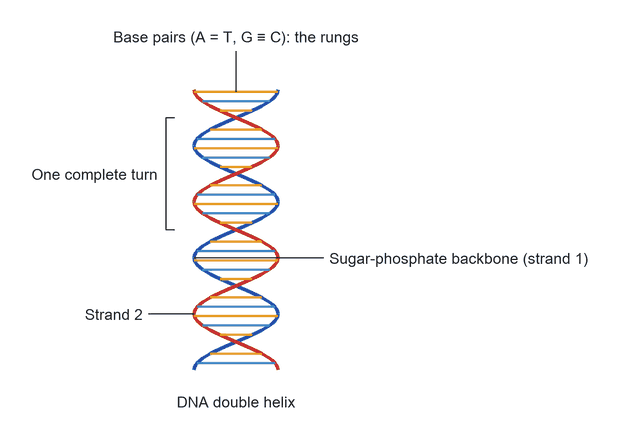
Therefore, DNA stands for Deoxyribonucleic acid.
- 205 marks
Question 20
Given below is a diagram representing a stage during the mitotic cell division. Study the diagram and answer the following questions :

(i) Identify the stage by giving a suitable reason.
(ii) Is it a plant or an animal cell? Give a reason to support your answer.
(iii) Draw a neat, labelled diagram of the stage which follows the one shown in the diagram.
(iv) How many chromosomes will each daughter cell have after the completion of the above division ?
(v) Name the four nitrogenous bases.
Solve with AIWritten solution
Solution:
Concept: Chromatids that have separated and are moving towards the two poles, centromere first, mark anaphase. in an animal cell the centrioles move to the poles and form asters, and the cytoplasm divides by a furrow; a plant cell (of a flowering plant) has no centrioles or asters, and its cytoplasm divides by a cell plate. DNA has four nitrogenous bases: adenine (A), guanine (G), cytosine (C) and thymine (T). They pair in a fixed way across the two strands: A with T (two hydrogen bonds) and G with C (three hydrogen bonds).
Step 1 — Part (i): identify the stage.
The stage is anaphase. The centromere of each chromosome has split, and the sister chromatids have separated and are moving to opposite poles. Each looks V-shaped because the spindle fibre pulls it by its centromere, so the centromere leads and the arms trail behind.
Step 2 — Part (ii): plant or animal cell.
It is an animal cell: centrioles with asters are present at the poles, and these are found only in animal cells.
Step 3 — Part (iii): draw the next stage.
The next stage is telophase. The daughter chromosomes reach the poles and thin out into chromatin, the spindle disappears, the nuclear membrane and nucleolus reappear round each set, and the cleavage furrow deepens.
Step 4 — Part (iv): chromosomes in each daughter cell.
Four chromatids are moving to each pole, eight in all. Each becomes a chromosome of a daughter nucleus, so each daughter cell gets 4 chromosomes, the same number as the parent cell had.
Step 5 — Part (v): the four nitrogenous bases.
They are adenine (A), guanine (G), cytosine (C) and thymine (T).
Watch out: Count per POLE for the daughter cells: 8 chromatids in the cell means 4 chromosomes in each daughter cell.
Therefore, (i) anaphase; (ii) animal cell, as centrioles with asters are present; (iii) telophase (drawn); (iv) 4 chromosomes; (v) adenine, guanine, cytosine and thymine.
- 211 mark
Question 21
Name the following:
(ii) The point of attachment of two chromatids.
Solve with AIWritten solution
Solution:
Concept: After the S phase every chromosome is duplicated: it consists of two identical sister chromatids joined at a constricted region, the centromere.
Step 1 — Recall the joining point.
The two sister chromatids of a duplicated chromosome are attached at the centromere.
Step 2 — See its role.
The centromere also attaches the chromosome to a spindle fibre, and it splits in anaphase so that the chromatids separate.
Watch out: Centromere (the joining point of the chromatids) is different from centrosome and centriole (in the cytoplasm).
Therefore, the point of attachment of two chromatids is the centromere.
- 221 mark
Question 22
Identify the ODD term in each set and name the CATEGORY to which the remaining three belong:
(v) Adenine, Guanine, Creatinine, Cytosine
Solve with AIWritten solution
Solution:
Concept: DNA has four nitrogenous bases: adenine (A), guanine (G), cytosine (C) and thymine (T). They pair in a fixed way across the two strands: A with T (two hydrogen bonds) and G with C (three hydrogen bonds).
Step 1 — Look at each term.
Adenine, guanine and cytosine are nitrogenous bases of DNA. Creatinine is a nitrogenous waste made in the muscles and removed in the urine.
Step 2 — Name the odd term and the category.
Creatinine is not a base of DNA, so it is the odd term.
Watch out: Creatinine also contains nitrogen, but it is a waste product, not a nitrogenous BASE of DNA.
Therefore, the odd term is Creatinine, and the category of the other three is Nitrogenous bases (of DNA).
- 231 mark
Question 23
Differentiate between the following pairs on the basis of what is mentioned in the brackets:
(v) Metaphase and Anaphase (Position of chromosomes)
Solve with AIWritten solution
Solution:
Concept: In metaphase the chromosomes gather at the middle of the cell; in anaphase the chromatids move away from the middle towards the poles.
Step 1 — Metaphase.
The duplicated chromosomes lie in one plane at the equator of the cell, each attached to a spindle fibre at its centromere.

Step 2 — Anaphase.
The centromeres split and the sister chromatids separate and move towards the opposite poles.
Step 3 — Set the difference side by side.
We compare the two on the basis asked, the position of the chromosomes.
Metaphase Anaphase Chromosomes lie at the equator of the cell. Chromatids move from the equator towards the opposite poles. Therefore, in metaphase the chromosomes lie at the equator, while in anaphase the chromatids move towards the opposite poles.
- 241 mark
Question 24
Give appropriate biological technical terms for the following:
(x) A non-dividing phase of the cell cycle where more DNA is synthesised.
Solve with AIWritten solution
Solution:
Concept: The cell cycle has a non-dividing interphase (: the cell grows and makes RNA and proteins; S: DNA is synthesised and every chromosome is duplicated; : more RNA and proteins are made for division) followed by the dividing M phase: karyokinesis (prophase, metaphase, anaphase, telophase) and then cytokinesis.
Step 1 — Find the non-dividing phase.
Interphase is the non-dividing part of the cell cycle; it has three phases, G₁, S and G₂.
Step 2 — Pick the phase that makes DNA.
More DNA is synthesised in the S phase (synthesis phase), when each chromosome makes a copy of itself and the DNA content doubles.
Therefore, the term is the S (synthesis) phase of interphase.
- 251 mark
Question 25
Haploid number of chromosomes are found in:
Solve with AIAnswer
(A) Nephrons
(B) Neurons
(C) Skin cells
- Correct
(D) Sperms
Answer: (D) Sperms
Concept: Body (somatic) cells are diploid (2n): 46 chromosomes in 23 pairs in man. Mitosis keeps the number the same. Meiosis halves it, so the gametes (sperms and ova) are haploid (n): 23 in man. Fertilisation restores 46.
Step 1 — Find the gamete.
Of the four options only sperms are gametes; they are formed in the testes by meiosis.
Step 2 — Give its number.
Meiosis halves the chromosome number, so a human sperm has 23 chromosomes (n), while a body cell has 46.
Why the other options are wrong:
- (A) Nephrons: the cells of nephrons (kidney tubules) are body cells, so they are diploid.
- (B) Neurons: neurons are nerve cells, which are body cells and diploid (46 chromosomes in man).
- (C) Skin cells: skin cells are body cells formed by mitosis, so they are diploid.
Therefore, the haploid number is found in sperms, option (D).
- 261 mark
Question 26
During the synthesis phase of the cell cycle, more of:
Solve with AIAnswer
(A) RNA is synthesised
(B) RNA and proteins are synthesised
- Correct
(C) DNA is synthesised
(D) Glucose is synthesized
Answer: (C) DNA is synthesised
Concept: The cell cycle has a non-dividing interphase (: the cell grows and makes RNA and proteins; S: DNA is synthesised and every chromosome is duplicated; : more RNA and proteins are made for division) followed by the dividing M phase: karyokinesis (prophase, metaphase, anaphase, telophase) and then cytokinesis.
Step 1 — Recall the S phase.
In the S (synthesis) phase more DNA is synthesised and each chromosome is duplicated.
Step 2 — See the result.
The two copies stay attached at the centromere as sister chromatids, ready to be shared between the two daughter cells.
Watch out: The phase is NAMED after DNA synthesis; RNA and proteins are made all through interphase.
Why the other options are wrong:
- (A) RNA is synthesised: RNA is made all through interphase, mostly in G₁ and G₂; it is not what the S phase is known for.
- (B) RNA and proteins are synthesised: RNA and proteins are the main products of the G₁ and G₂ (growth) phases.
- (D) Glucose is synthesized: glucose is made by green plants in photosynthesis, not in a phase of the cell cycle.
Therefore, in the synthesis phase more DNA is synthesised, option (C).
- 271 mark
Question 27
Name the following:
(a) The organelle that forms the aster during cell division.
Solve with AIWritten solution
Solution:
Concept: The centrosome of an animal cell, near the nucleus, contains a pair of centrioles. When the cell divides, rays radiate from each centriole; this star-like structure is the aster.
Step 1 — Recall what forms the aster.
The aster is formed by the centriole (of the centrosome).
Step 2 — See when it happens.
In prophase the centrioles move to opposite poles, and each becomes surrounded by radiating rays, the aster. The cells of flowering plants have no centrioles and form no asters.
Watch out: Centromere (the joining point of the chromatids) is different from centrosome and centriole (in the cytoplasm).
Therefore, the organelle that forms the aster is the centriole (centrosome).
- 282 marks
Question 28
Differentiate between Karyokinesis and Cytokinesis.
Solve with AIWritten solution
Solution:
Concept: Cell division has two parts: first the nucleus divides, then the cytoplasm divides.
Step 1 — Karyokinesis.
Karyokinesis is the division of the nucleus. It goes through prophase, metaphase, anaphase and telophase and gives two daughter nuclei.
Step 2 — Cytokinesis.
Cytokinesis is the division of the cytoplasm. It follows karyokinesis and gives two separate daughter cells: by a furrow in an animal cell and by a cell plate in a plant cell.
Step 3 — Set the difference side by side.
We place the two parts of division together.
Karyokinesis Cytokinesis Division of the nucleus. Division of the cytoplasm. Comes first; gives two daughter nuclei. Comes after it; gives two daughter cells. Therefore, karyokinesis is the division of the nucleus, while cytokinesis is the division of the cytoplasm that follows it.
- 291 mark
Question 29
Expand the abbreviation — DNA.
Solve with AIWritten solution
Solution:
Concept: DNA is the nucleic acid of the chromosomes; its pentose sugar is deoxyribose, which gives it its name.
Step 1 — Expand the letters.
D stands for deoxyribo (the sugar deoxyribose), N for nucleic and A for acid.
Step 2 — Add what it does.
DNA carries the genes, which are passed on from parents to offspring.
Therefore, DNA stands for Deoxyribonucleic acid.
- 302 marks
Question 30
Mention the two pairs of nitrogenous bases which pair with each other with hydrogen bonds.
Solve with AIWritten solution
Solution:
Concept: DNA has four nitrogenous bases: adenine (A), guanine (G), cytosine (C) and thymine (T). They pair in a fixed way across the two strands: A with T (two hydrogen bonds) and G with C (three hydrogen bonds).
Step 1 — First pair.
Adenine (A) pairs with thymine (T), joined by two hydrogen bonds.
Step 2 — Second pair.
Guanine (G) pairs with cytosine (C), joined by three hydrogen bonds.
Watch out: A base never pairs with its own kind (A with A) or across the pairs (A with C); the pairing is fixed.
Therefore, the two pairs are adenine with thymine and guanine with cytosine.
- 311 mark
Question 31
Duplicated chromosomes are joined at a point termed:
Solve with AIAnswer
(A) Centrosome
- Correct
(B) Centromere
(C) Centriole
(D) Chromatid
Answer: (B) Centromere
Concept: After the S phase every chromosome is duplicated: it consists of two identical sister chromatids joined at a constricted region, the centromere.
Step 1 — Name the joining point.
The two sister chromatids of a duplicated chromosome are held together at a small constricted region called the centromere.
Step 2 — See what happens to it later.
In anaphase the centromere splits and the two chromatids are pulled to opposite poles.
Watch out: Centromere (the joining point of the chromatids) is different from centrosome and centriole (in the cytoplasm).
Why the other options are wrong:
- (A) Centrosome: the centrosome is the region near the nucleus of an animal cell that contains the centrioles; it does not join chromatids.
- (C) Centriole: the centriole lies inside the centrosome and forms the aster at a pole of the dividing cell.
- (D) Chromatid: a chromatid is one of the two halves that are joined; it is not the joining point.
Therefore, duplicated chromosomes are joined at the centromere, option (B).
- 321 mark
Question 32
A male gorilla has 48 chromosomes in each of its body cells. How many chromosomes will each of the sperms have?
 Solve with AI
Answer
- Correct
(A) 24
(B) 48
(C) 12
(D) 16
Answer: (A) 24
Concept: Sperms are formed by meiosis, which halves the chromosome number: body cells are diploid (2n) and sperms are haploid (n).
Step 1 — Write the body-cell number.
The body cells of the male gorilla have the diploid number.
Step 2 — Halve it for a sperm.
Each sperm receives one chromosome of each pair, so it has half the number.
Why the other options are wrong:
- (B) 48: 48 is the number in the body cells; it would be right for mitosis, which keeps the number unchanged.
- (C) 12: 12 is 48 halved twice; meiosis halves the number only once.
- (D) 16: 16 is a third of 48; no cell division divides the chromosome number by three.
Therefore, each sperm of the gorilla has 24 chromosomes, option (A).
- 331 mark
Question 33
Match the items given in Column I with most appropriate ones in Column II and rewrite the correct matching pairs:
Column I: (c) Ova
Column II: Lack of thyroxine in children; 12 pairs; Testosterone; Diffusion of respiratory gases; Haploid cells; 31 Pairs; Diploid cells
Solve with AIWritten solution
Solution:
Concept: Body (somatic) cells are diploid (2n): 46 chromosomes in 23 pairs in man. Mitosis keeps the number the same. Meiosis halves it, so the gametes (sperms and ova) are haploid (n): 23 in man. Fertilisation restores 46.
Step 1 — Decide the type of cell.
Ova (eggs) are female gametes formed by meiosis.
Step 2 — Pick the match.
So they carry half the chromosome number: they are haploid cells. A human ovum has 23 chromosomes; the sperm's 23 restore 46 at fertilisation.
Therefore, the matching pair is Ova — Haploid cells.
- 343 marks
Question 34
The diagram given below represents a stage in mitosis.
(a) Identify the stage given above.
(b) Give one reason to support your answer in (a).
(c) Mention the number of chromosomes given in the diagram.
Solve with AIWritten solution
Solution:
Concept: V-shaped chromatids moving away from the middle towards the two poles, centromere first, show that the sister chromatids have separated: this is anaphase. Once the chromatids separate, each is counted as a chromosome.
Step 1 — Part (a): identify the stage.
The stage is anaphase.
Step 2 — Part (b): give a reason.
The sister chromatids have separated and are moving towards opposite poles, pulled by the shortening spindle fibres. Each is V-shaped because it is pulled by its centromere, which leads while the arms trail behind.
Step 3 — Part (c): count the chromosomes.
We count the V-shaped daughter chromosomes: 4 are moving to each pole, so 8 chromosomes are seen. Each was one chromatid, so the cell began the division with 4 chromosomes, and each daughter cell will get 4.
Watch out: After the centromeres split, every separated chromatid counts as one chromosome, so the diagram shows 8.
Therefore, (a) anaphase; (b) the sister chromatids have separated and are moving to opposite poles; (c) 8 chromosomes (4 moving to each pole).
- 351 mark
Question 35
A phase of cell division where the spindle fibres disappear is:
Solve with AIAnswer
- Correct
(A) Telophase
(B) Prophase
(C) Metaphase
(D) Anaphase
Answer: (A) Telophase
Concept: The spindle forms at the start of mitosis and is no longer needed once the chromatids have reached the poles.
Step 1 — Find the stage at the poles.
In telophase the two sets of daughter chromosomes have reached the opposite poles.
Step 2 — See what disappears.
The spindle fibres disappear, the nuclear membrane and nucleolus reappear, and the chromosomes thin out into chromatin threads.
Why the other options are wrong:
- (B) Prophase: prophase is when the spindle fibres APPEAR between the centrioles.
- (C) Metaphase: metaphase is when each chromosome is ATTACHED to a spindle fibre at its centromere.
- (D) Anaphase: anaphase is when the spindle fibres SHORTEN and pull the chromatids towards the poles.
Therefore, the spindle fibres disappear in telophase, option (A).
- 361 mark
Question 36
Read the explanations given below and name the structures:
Example: The tubules which produce sperms.
Answer: Seminiferous tubules
(d) The point of attachment of two chromatids of a chromosome.
Solve with AIWritten solution
Solution:
Concept: After the S phase every chromosome is duplicated: it consists of two identical sister chromatids joined at a constricted region, the centromere.
Step 1 — Recall the joining point.
The two sister chromatids of a chromosome are attached at the centromere.
Step 2 — See its role.
It attaches the chromosome to a spindle fibre during cell division, and it splits in anaphase so that the chromatids separate.
Watch out: Centromere (the joining point of the chromatids) is different from centrosome and centriole (in the cytoplasm).
Therefore, the structure is the centromere.
- 372 marks
Question 37
Mention the two pairs of nitrogenous bases that are present in a DNA strand and pair with each other by hydrogen bonds.
Solve with AIWritten solution
Solution:
Concept: DNA has four nitrogenous bases: adenine (A), guanine (G), cytosine (C) and thymine (T). They pair in a fixed way across the two strands: A with T (two hydrogen bonds) and G with C (three hydrogen bonds).
Step 1 — First pair.
Adenine (A) pairs with thymine (T), held by two hydrogen bonds.
Step 2 — Second pair.
Guanine (G) pairs with cytosine (C), held by three hydrogen bonds. These base pairs form the rungs of the DNA ladder.
Therefore, the two pairs are adenine with thymine and guanine with cytosine.
- 383 marks
Question 38
Draw a neat, labelled diagram of an animal cell showing Metaphase with four chromosomes.
Solve with AIWritten solution
Solution:
Concept: In metaphase the duplicated chromosomes line up in one plane at the equator, each attached to the spindle at its centromere. An animal cell shows centrioles with asters at the poles and has no cell wall.
Step 1 — Draw the cell and the spindle.
Draw a round cell with a cell membrane only. Put a centriole with its aster at each pole and draw the spindle fibres between them.
Step 2 — Place the chromosomes.
Draw four chromosomes in a row at the equator, each made of two chromatids joined at the centromere, with a spindle fibre ending at each centromere.
Step 3 — Label it.
Label the centriole (with aster), spindle fibres, chromosome at the equator, centromere, cell membrane and cytoplasm. There is no nuclear membrane: it disappeared in prophase.
Watch out: Draw exactly four chromosomes, and no nuclear membrane or cell wall.
Therefore, the drawing shows an animal cell in metaphase: four chromosomes at the equator on the spindle, with centrioles and asters at the poles.
- 391 mark
Question 39
What is the structure of DNA as proposed by Watson and Crick?
Solve with AIWritten solution
Solution:
Concept: Watson and Crick (1953) proposed that DNA is a double helix: two strands wound round each other, like a twisted ladder.
Step 1 — Two strands.
A DNA molecule has two complementary strands wound round each other in a double helix.
Step 2 — The sides of the ladder.
Each strand is a chain of nucleotides; the sugar (deoxyribose) and phosphate of the nucleotides form the long sides (backbone) of the ladder.
Step 3 — The rungs.
The nitrogenous bases point inwards and pair by hydrogen bonds: adenine with thymine (two bonds) and guanine with cytosine (three bonds).
Therefore, Watson and Crick proposed that DNA is a double helix of two nucleotide strands with sugar-phosphate backbones, held together by hydrogen-bonded base pairs (A–T, G–C).
- 401 mark
Question 40
The number of chromosomes in the somatic cells of a human body before mitosis and after mitosis is:
Solve with AIAnswer
(A) 23, 23
(B) 26, 46
(C) 23, 46
- Correct
(D) 46, 46
Answer: (D) 46, 46
Concept: Mitosis keeps the chromosome number the same: the daughter cells get exactly the number the parent cell had.
Step 1 — Before mitosis.
A human body (somatic) cell has 46 chromosomes.
Step 2 — After mitosis.
Each chromosome has duplicated into two chromatids, and one chromatid of each goes to each daughter cell. So each daughter cell again has 46.
Why the other options are wrong:
- (A) 23, 23: 23, 23 is the number in human sperms and eggs, not in body cells.
- (B) 26, 46: no human body cell has 26 chromosomes; a body cell has 46 before mitosis as well as after it.
- (C) 23, 46: a body cell already has 46 before mitosis, and mitosis does not change the number.
Therefore, the somatic cells have 46 chromosomes before and 46 after mitosis, option (D).
- 411 mark
Question 41
Which of the following process occurs only in meiosis and NOT in mitosis:
Solve with AIAnswer
(A) Chromosome duplication
- Correct
(B) Crossing over
(C) Cytokinesis
(D) Chromosome alignment
Answer: (B) Crossing over
Concept: Crossing over needs the two chromosomes of each homologous pair to lie side by side, which happens in meiosis and not in mitosis.
Step 1 — Recall crossing over.
In meiosis homologous chromosomes pair up, and their non-sister chromatids exchange parts at a chiasma.
Step 2 — Compare with mitosis.
In mitosis the homologous chromosomes do not pair, so there is no crossing over.
Why the other options are wrong:
- (A) Chromosome duplication: chromosome duplication takes place in the S phase of interphase before both mitosis and meiosis.
- (C) Cytokinesis: cytokinesis (division of the cytoplasm) ends both kinds of division.
- (D) Chromosome alignment: the chromosomes line up at the equator in the metaphase of mitosis as well as in meiosis.
Therefore, crossing over occurs only in meiosis, option (B).
- 423 marks
Question 42
Draw a neat labelled diagram of a nucleotide.
Solve with AIWritten solution
Solution:
Concept: A nucleotide, the repeating unit of DNA, has three parts: a phosphate group, a pentose sugar and a nitrogenous base. The sugar sits in the middle, joined to both.
Step 1 — Draw the sugar.
Draw a pentagon in the middle for the pentose sugar (deoxyribose in DNA).
Step 2 — Add the phosphate and the base.
Join a small circle (the phosphate group) to one side of the sugar, and a rectangle (the nitrogenous base) to the other side.
Step 3 — Label it.
Label the phosphate group, which links one nucleotide to the next along the strand; the pentose sugar; and the nitrogenous base (adenine, guanine, cytosine or thymine in DNA), which pairs with a base on the other strand.
Watch out: The phosphate and the base are both joined to the SUGAR, not to each other.
Therefore, the drawing shows a nucleotide: a phosphate group and a nitrogenous base, each joined to a pentose sugar.
- 431 mark
Question 43
A sequence of DNA has 300 nitrogenous base pairs, of which 75 are Guanine. What is the number of Thymine in this sequence ?
Solve with AIAnswer
(A) 150
(B) 100
(C) 50
- Correct
(D) 75
Answer: (D) 75
Concept: In DNA guanine always pairs with cytosine and adenine with thymine (Chargaff's rule: G = C and A = T).
Step 1 — Guanine and cytosine.
Guanine pairs with cytosine, so there are as many C as G.
Together they make 150 bases.
Step 2 — Adenine and thymine together.
Taking the sequence as 300 bases (the reading that gives one of the options), the rest are adenine and thymine.
Step 3 — Thymine alone.
Adenine pairs with thymine, so they are equal and share the 150 equally.
Watch out: A base PAIR has two bases; in a real double strand of 300 base pairs there are 600 bases.
Note on the printed data: read literally, 300 base pairs means 600 bases; taking away 150 G and C leaves 450 bases of A and T, that is 225 thymine, which is not an option; the printed key 75 treats the 300 as bases, so it is kept.
Why the other options are wrong:
- (A) 150: 150 is adenine and thymine together, not thymine alone.
- (B) 100: 100 does not follow from base pairing: G and C are 75 each, so the other 150 bases are shared equally by A and T.
- (C) 50: 50 also breaks the pairing rule; it would leave A and T unequal.
Therefore, the number of thymine is 75, option (D).
- 441 mark
Question 44
Which is the resting but metabolically active stage of the cell cycle?
Solve with AIWritten solution
Solution:
Concept: The cell cycle has a non-dividing interphase (: the cell grows and makes RNA and proteins; S: DNA is synthesised and every chromosome is duplicated; : more RNA and proteins are made for division) followed by the dividing M phase: karyokinesis (prophase, metaphase, anaphase, telophase) and then cytokinesis.
Step 1 — Find the non-dividing stage.
In interphase no change is seen in the chromosomes under the microscope, so it was once called the 'resting phase'.
Step 2 — See why it is metabolically active.
During interphase the cell grows (G₁), synthesises more DNA and duplicates its chromosomes (S), and makes the RNA and proteins needed for division (G₂).
Therefore, the resting but metabolically active stage is interphase.
- 453 marks
Question 45
Draw a neat, labelled diagram of an animal cell showing the Prophase stage of Mitosis with four chromosomes.
Solve with AIWritten solution
Solution:
Concept: In prophase each chromosome is already duplicated into two chromatids; the centrioles move to opposite poles with their asters, the spindle starts to form, and the nuclear membrane and nucleolus disappear.
Step 1 — Draw the cell and the poles.
Draw a round cell with a cell membrane only. Put a centriole with its aster at each pole, with spindle fibres beginning to form between them.
Step 2 — Draw the chromosomes.
Draw four chromosomes, short and thick, each made of two chromatids joined at the centromere, scattered in the old nuclear area; show the nuclear membrane as a broken (dotted) line because it is disappearing.
Step 3 — Label it.
Label the centriole with aster, spindle fibres forming, chromatids, centromere, nuclear membrane disappearing, cell membrane and cytoplasm.
Watch out: The chromosomes are NOT yet at the equator in prophase; that is metaphase.
Therefore, the drawing shows an animal cell in prophase with four duplicated chromosomes, asters at the poles, a forming spindle and a disappearing nuclear membrane.
- 462 marks
Question 46
Differentiate between Mitosis in plant cell and animal cell based on Cytokinesis.
Solve with AIWritten solution
Solution:
Concept: Cytokinesis is the division of the cytoplasm. An animal cell divides by pinching in from outside; a plant cell, with its rigid cell wall, builds a new wall from the inside.
Step 1 — Animal cell.
Cytokinesis is by furrowing: a furrow starts in the cell membrane at the middle and deepens from the outside towards the centre until the cell splits into two.
Step 2 — Plant cell.
Cytokinesis is by cell plate formation: a cell plate is laid down at the centre of the cell and grows outwards until it meets the cell wall.
Step 3 — Set the difference side by side.
We compare the two on the basis asked, cytokinesis.
Animal cell Plant cell By furrowing, from the outside inwards. By a cell plate, from the centre outwards. Therefore, an animal cell divides its cytoplasm by furrowing from outside inwards, while a plant cell does it by a cell plate growing from the centre outwards.
- 471 mark
Question 47
In a dividing cell, the nuclear membrane reappears during:
Solve with AIAnswer
(A) Prophase
(B) Metaphase
(C) Anaphase
- Correct
(D) Telophase
Answer: (D) Telophase
Concept: The nuclear membrane disappears at the start of mitosis and is formed again at the end, round each new set of chromosomes.
Step 1 — Find the stage at the poles.
In telophase the daughter chromosomes reach the two poles.
Step 2 — See what reappears.
A nuclear membrane reappears round each set and the nucleolus reappears, giving two daughter nuclei.
Why the other options are wrong:
- (A) Prophase: prophase is when the nuclear membrane DISAPPEARS.
- (B) Metaphase: metaphase has no nuclear membrane; the chromosomes lie free at the equator.
- (C) Anaphase: anaphase also has no nuclear membrane; the chromatids are still moving to the poles.
Therefore, the nuclear membrane reappears during telophase, option (D).
- 481 mark
Question 48
Choose the ODD one out from the following terms and name the category to which the others belong:
(a) Mitochondria, Nucleotide, Gene, Chromatid
Solve with AIWritten solution
Solution:
Concept: A chromosome is made of two chromatids; its DNA is a chain of nucleotides, and a gene is a particular sequence of nucleotides on it.
Step 1 — Look at each term.
Chromatid, gene and nucleotide all describe the make-up of a chromosome, from its halves down to its smallest units. Mitochondria are organelles in the cytoplasm.
Step 2 — Name the odd term and the category.
Mitochondria are not part of a chromosome, so they are the odd term.
Therefore, the odd term is Mitochondria, and the category of the other three is Structure (parts) of a chromosome.
- 492 marks
Question 49
Give one difference between the number of chromosomes passed on to each daughter cell in mitosis and meiosis.
Solve with AIWritten solution
Solution:
Concept: Body (somatic) cells are diploid (2n): 46 chromosomes in 23 pairs in man. Mitosis keeps the number the same. Meiosis halves it, so the gametes (sperms and ova) are haploid (n): 23 in man. Fertilisation restores 46.
Step 1 — Mitosis.
Each daughter cell receives the full set of chromosomes, the diploid number (2n), 46 in man.
Step 2 — Meiosis.
Each daughter cell receives half the number, one chromosome of each pair, the haploid number (n), 23 in man.
Therefore, in mitosis each daughter cell gets the same (diploid) number of chromosomes as the parent cell, while in meiosis each gets half (haploid) the number.
- 503 marks
Question 50
Draw a neat, labelled diagram to show Anaphase stage of mitosis in an animal cell having 4 chromosomes.
Solve with AIWritten solution
Solution:
Concept: In anaphase the centromere of each chromosome splits and the two sister chromatids are pulled to opposite poles. With 4 chromosomes, 4 daughter chromosomes move to each pole.
Step 1 — Draw the cell and the poles.
Draw an animal cell with a cell membrane only, a slight furrow beginning at the middle, and a centriole with its aster at each pole.
Step 2 — Draw the chromatids.
Draw eight V-shaped daughter chromosomes, 4 moving towards each pole, each with its centromere leading and joined to a shortening spindle fibre.
Step 3 — Label it.
Label the daughter chromosomes (chromatids), centromere, spindle fibres (contracting), centriole with aster, the furrow, cell membrane and cytoplasm.
Watch out: The arms of each V trail BEHIND the centromere, pointing back towards the equator.
Therefore, the drawing shows anaphase in an animal cell with 4 daughter chromosomes moving to each pole, centromere first.