Solution:
Concept: Chromatids that have separated and are moving towards the two poles, centromere first, mark anaphase. in an animal cell the centrioles move to the poles and form asters, and the cytoplasm divides by a furrow; a plant cell (of a flowering plant) has no centrioles or asters, and its cytoplasm divides by a cell plate. DNA has four nitrogenous bases: adenine (A), guanine (G), cytosine (C) and thymine (T). They pair in a fixed way across the two strands: A with T (two hydrogen bonds) and G with C (three hydrogen bonds).
Step 1 — Part (i): identify the stage.
The stage is anaphase. The centromere of each chromosome has split, and the sister chromatids have separated and are moving to opposite poles. Each looks V-shaped because the spindle fibre pulls it by its centromere, so the centromere leads and the arms trail behind.
Step 2 — Part (ii): plant or animal cell.
It is an animal cell: centrioles with asters are present at the poles, and these are found only in animal cells.
Step 3 — Part (iii): draw the next stage.
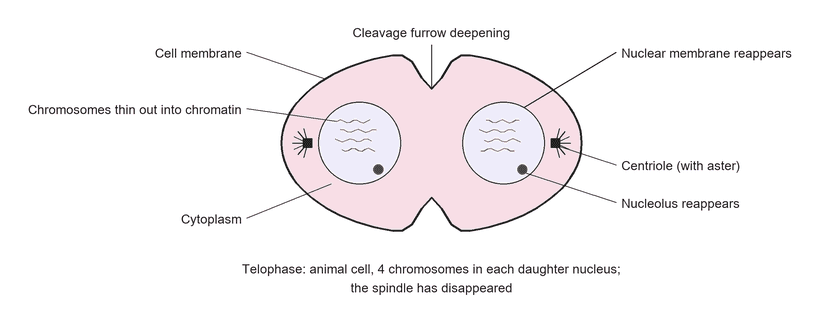
The next stage is telophase. The daughter chromosomes reach the poles and thin out into chromatin, the spindle disappears, the nuclear membrane and nucleolus reappear round each set, and the cleavage furrow deepens.
Step 4 — Part (iv): chromosomes in each daughter cell.
Four chromatids are moving to each pole, eight in all. Each becomes a chromosome of a daughter nucleus, so each daughter cell gets 4 chromosomes, the same number as the parent cell had.
Step 5 — Part (v): the four nitrogenous bases.
They are adenine (A), guanine (G), cytosine (C) and thymine (T).
Watch out: Count per POLE for the daughter cells: 8 chromatids in the cell means 4 chromosomes in each daughter cell.
Therefore, (i) anaphase; (ii) animal cell, as centrioles with asters are present; (iii) telophase (drawn); (iv) 4 chromosomes; (v) adenine, guanine, cytosine and thymine.

