Solution:
Concept: The last stage of mitosis, telophase, is almost the reverse of prophase: the two sets of daughter chromosomes reach the poles, the nuclear membrane and nucleolus re-form, the chromosomes thin out into chromatin and the cell starts to divide in the middle.
Step 1 — Part (i): identify the stage.
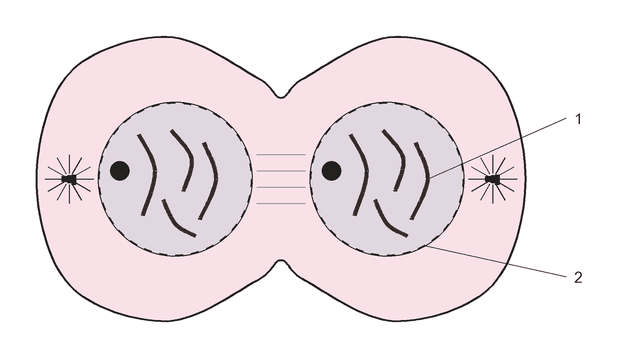
The stage is telophase. Two groups of daughter chromosomes have reached the opposite poles; a nuclear membrane is forming round each group and a nucleolus has reappeared in each new nucleus; the chromosomes are thinning out; only a few spindle fibres are left between the nuclei; and the cell membrane is furrowing in the middle.
Step 2 — Part (ii): name the parts.
Part 1 is a chromosome (a daughter chromosome, thinning out into a chromatin thread). Part 2 is the nuclear membrane, re-forming round the daughter nucleus.
Step 3 — Part (iii): the division of the nucleus.
The technical term for the division of the nucleus is karyokinesis.
Step 4 — Part (iv): the stage before, drawn.
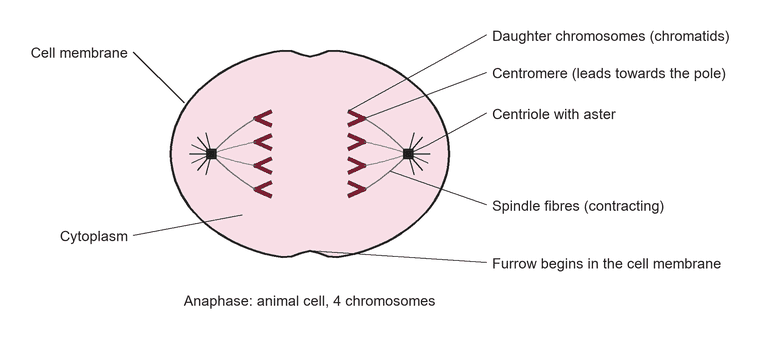
The stage before telophase is anaphase. The centromere of each chromosome has split, and the sister chromatids are pulled to opposite poles by the shortening spindle fibres, centromere first.
Step 5 — Part (v): the halving division.
Meiosis (reduction division) gives daughter cells with half the number of chromosomes, one of each pair (the haploid number, n).
Watch out: The dotted circle round each group is the nuclear membrane RE-forming (telophase), not breaking down (prophase); the furrow in the middle shows the stage is at the end of division.
Therefore, (i) telophase; (ii) 1 chromosome, 2 nuclear membrane; (iii) karyokinesis; (iv) anaphase (drawn); (v) meiosis.