
Question 492 marksAsked 2026Easy
Give one difference between the number of chromosomes passed on to each daughter cell in mitosis and meiosis.
Confirming your payment
Sign up now and get 250 free tokens.
Previous Year Questions · Question 49 of 50
Give one difference between the number of chromosomes passed on to each daughter cell in mitosis and meiosis.
Solution:
Concept: Body (somatic) cells are diploid (2n): 46 chromosomes in 23 pairs in man. Mitosis keeps the number the same. Meiosis halves it, so the gametes (sperms and ova) are haploid (n): 23 in man. Fertilisation restores 46.
Step 1 — Mitosis.
Each daughter cell receives the full set of chromosomes, the diploid number (2n), 46 in man.
Step 2 — Meiosis.
Each daughter cell receives half the number, one chromosome of each pair, the haploid number (n), 23 in man.
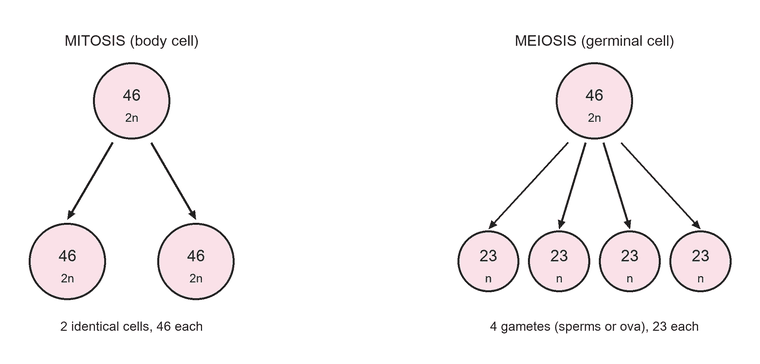
Therefore, in mitosis each daughter cell gets the same (diploid) number of chromosomes as the parent cell, while in meiosis each gets half (haploid) the number.