
Question 343 marksAsked 2024Medium
The diagram given below represents a stage in mitosis.

(a) Identify the stage given above.
(b) Give one reason to support your answer in (a).
(c) Mention the number of chromosomes given in the diagram.
Confirming your payment
Sign up now and get 250 free tokens.
Previous Year Questions · Question 34 of 50
The diagram given below represents a stage in mitosis.
(a) Identify the stage given above.
(b) Give one reason to support your answer in (a).
(c) Mention the number of chromosomes given in the diagram.
Solution:
Concept: V-shaped chromatids moving away from the middle towards the two poles, centromere first, show that the sister chromatids have separated: this is anaphase. Once the chromatids separate, each is counted as a chromosome.
Step 1 — Part (a): identify the stage.
The stage is anaphase.
Step 2 — Part (b): give a reason.
The sister chromatids have separated and are moving towards opposite poles, pulled by the shortening spindle fibres. Each is V-shaped because it is pulled by its centromere, which leads while the arms trail behind.
Step 3 — Part (c): count the chromosomes.
We count the V-shaped daughter chromosomes: 4 are moving to each pole, so 8 chromosomes are seen. Each was one chromatid, so the cell began the division with 4 chromosomes, and each daughter cell will get 4.
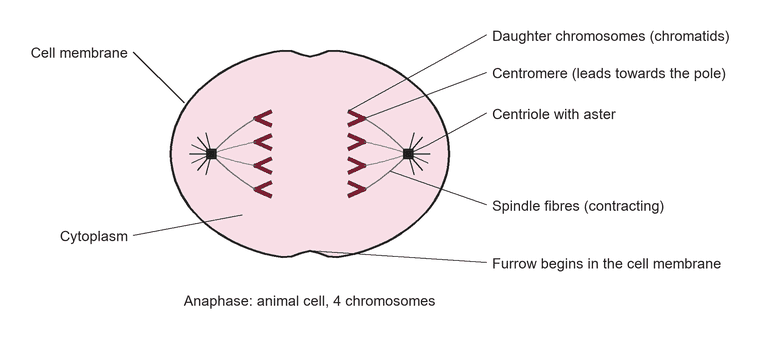
Watch out: After the centromeres split, every separated chromatid counts as one chromosome, so the diagram shows 8.
Therefore, (a) anaphase; (b) the sister chromatids have separated and are moving to opposite poles; (c) 8 chromosomes (4 moving to each pole).