Solution:
Concept: Each stage of mitosis is recognised by where the chromosomes are and what is happening to the nuclear membrane, the centrioles and the spindle. in an animal cell the centrioles move to the poles and form asters, and the cytoplasm divides by a furrow; a plant cell (of a flowering plant) has no centrioles or asters, and its cytoplasm divides by a cell plate.
Step 1 — Part (i): identify the stage.
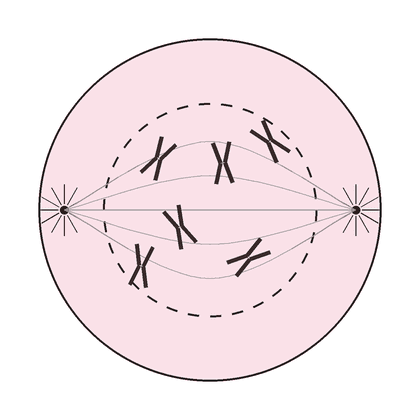
The stage is late prophase. Each chromosome is short and thick and shows two chromatids; the chromosomes are scattered, not yet lined up at the equator; the nuclear membrane is breaking down (drawn dotted); and the centrioles with their asters have reached opposite poles, with spindle fibres forming between them.
Step 2 — Part (ii): draw the next stage.
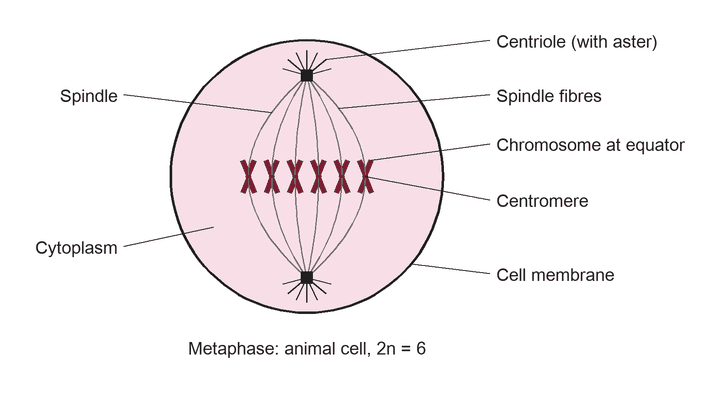
The next stage is metaphase. The cell in the question has six chromosomes, so the drawing shows six, lined up in one plane at the equator, each attached to a spindle fibre at its centromere.
Step 3 — Part (iii): two differences between animal and plant mitosis.
The two cells differ in how the spindle forms and in how the cytoplasm divides.
| Animal cell | Plant cell |
|---|
| Centrioles form asters at the poles, which help to form the spindle. | No centrioles and no asters; the spindle forms without them. |
| Cytokinesis by furrowing: a furrow in the cell membrane deepens from outside inwards. | Cytokinesis by a cell plate, laid down at the centre and growing outwards to the wall. |

Step 4 — Part (iv): type of division.
Growth of a shoot needs new body cells with the same chromosome number, so it is by mitosis. Pollen grains are formed in the anthers from pollen mother cells and carry half the chromosome number, so they are formed by meiosis.
Watch out: In metaphase draw the SAME number of chromosomes as in the question (six here), each with two chromatids.
Therefore, (i) late prophase; (ii) metaphase, drawn with 6 chromosomes at the equator; (iii) asters formed only in the animal cell, and cytokinesis by furrowing in the animal cell but by a cell plate in the plant cell; (iv) A. mitosis, B. meiosis.