Solution:
Concept: Centrioles (and the asters they form) are found in animal cells only; the cells of flowering plants have none. Chromosomes lined up in one plane at the equator mark metaphase.
Step 1 — Part (i): plant or animal cell.
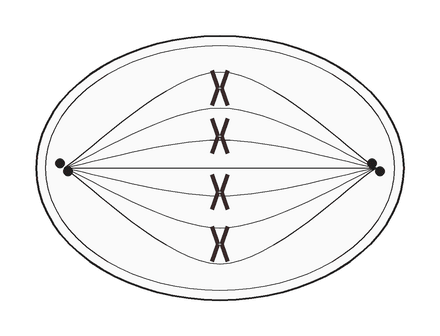
It is an animal cell: a pair of centrioles is drawn at each pole of the spindle, and centrioles are found only in animal cells. The cell is drawn with a double outline, which could be mistaken for a cell wall, but the centrioles decide the answer.
Step 2 — Part (ii): the stage and its unique feature.
The stage is metaphase. Its unique feature is that all the duplicated chromosomes line up in one plane at the equator of the cell (the metaphase plate), each attached to a spindle fibre at its centromere.
Step 3 — Part (iii): type of division.
(a) Replacing old leaves by new ones is growth, which needs new body cells, so it is by mitosis. (b) Gametes have half the chromosome number, so they are formed by meiosis.
Step 4 — Part (iv): the stage before.
The stage that comes before metaphase is prophase.
Step 5 — Part (v): draw prophase with the same number.
The cell in the question has four chromosomes, so the prophase drawing also shows four, each as two chromatids joined at a centromere. The centrioles with their asters move to opposite poles, spindle fibres form between them, and the nuclear membrane breaks down.

Watch out: Keep the chromosome number constant: the prophase drawing must show four chromosomes, like the question's cell.
Therefore, (i) animal cell, because centrioles are present at the poles; (ii) metaphase, in which the chromosomes lie in one plane at the equator; (iii) (a) mitosis, (b) meiosis; (iv) prophase; (v) prophase drawn with four chromosomes.