Solution:
Concept: Each DNA strand is a chain of nucleotides (phosphate + pentose sugar + nitrogenous base); the bases of the two strands join by hydrogen bonds and form the rungs.
Step 1 — (a) Count the strands.
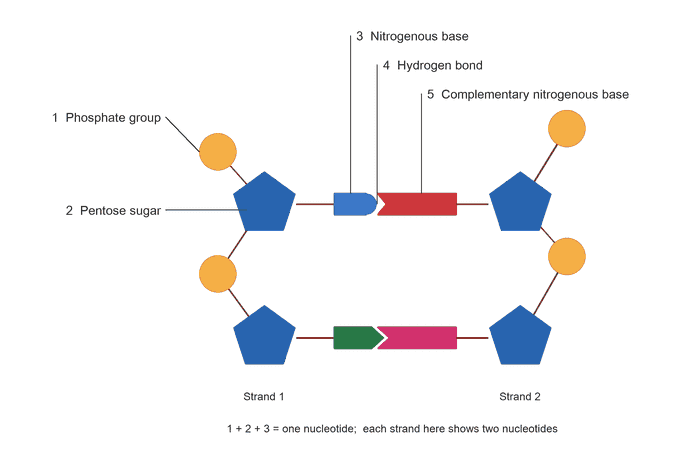
There are two chains of phosphate and sugar, one on each side, joined through their bases in the middle. So two strands are shown.
Step 2 — (b) Count the nucleotides in each strand.
Each strand shows two sugars, each with its own phosphate and base. One sugar + one phosphate + one base is one nucleotide, so there are two nucleotides in each strand.
Step 3 — (c) Name parts 1 to 5.
1 is the round part of the backbone: phosphate group. 2 is the five-sided part next to it: pentose (deoxyribose) sugar. 3 is joined to the sugar and points inwards: nitrogenous base. 4 is the join between the two bases: hydrogen bond. 5 is the base from the other strand: complementary nitrogenous base.
Step 4 — (d) Name the unit made by 1, 2 and 3.
Phosphate, sugar and base together make one nucleotide, the repeating unit of a DNA strand.
Watch out: Part 5 is also a nitrogenous base; it belongs to the opposite strand.
Therefore, (a) two strands; (b) two nucleotides each; (c) 1 phosphate group, 2 pentose sugar, 3 nitrogenous base, 4 hydrogen bond, 5 complementary nitrogenous base; (d) a nucleotide.

