Answer: (C) Anaphase. 4 Chromosomes
Concept: Name the stage from where the chromosomes are, and count the chromosomes moving to one pole to find the number in each daughter cell.
Step 1 — Identify the stage.
The chromosomes are not at the equator: two sets are being pulled apart towards opposite poles by the spindle fibres, and the cell is starting to pinch in the middle. This is anaphase.
Step 2 — Count the chromosomes.
Four daughter chromosomes are moving to each pole (8 in all). Each daughter cell receives one set, so it will have 4 chromosomes.
Step 3 — Check.
Mitosis keeps the chromosome number: the parent cell had 4 chromosomes of two chromatids each, so each daughter cell also has 4.
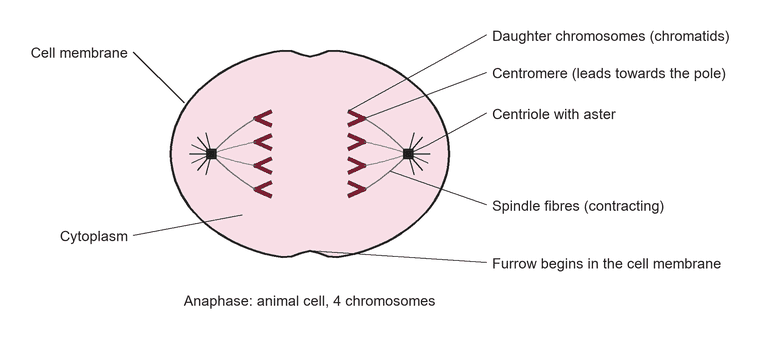
Watch out: Count only the chromosomes at one pole; the 8 seen in the cell will be shared between two cells.
Why the other options are wrong:
- (A) Anaphase, 8 Chromosomes: the stage is right, but 8 is the total at both poles; one daughter cell gets only the 4 at its pole.
- (B) Metaphase, 8 Chromosomes: in metaphase the chromosomes lie at the equator, not near the poles.
- (D) Telophase, 4 Chromosomes: in telophase the chromosomes thin out and nuclear membranes form; here the chromosomes are still distinct and on spindle fibres.
Therefore, the stage is anaphase and each daughter cell gets 4 chromosomes, option (C).

