
Opening your dashboard
Class 10 Biology Chapter 2 Structure of Chromosomes, Cell Cycle and Cell Division: Practice Questions
41 questions on Chapter 2, each worked through on its own page with the AI tutor. Class 10 Biology, ICSE 2026-27.
41 questions
1–5 marks · Mixed difficulty
- 11 mark
Question 1
Bloom's level: Remember
Cell division is described as one of the most fundamental characteristics of life because it :
- 21 mark
Question 2
Bloom's level: Remember
Walther Flemming first studied chromosomes in animals in 1882 in the rapidly dividing cells of :
- 31 mark
Question 3
Bloom's level: Remember
Chromosomes become visible as separate, thick bodies inside the nucleus :
- 41 mark
Question 4
Bloom's level: Understand
Each human cell contains about 2 metres of DNA, yet its nucleus is only about 6 across. The DNA fits mainly because it is :
- 51 mark
Question 5
Bloom's level: Apply
The bases along one strand of a short part of a gene read : A – T – G – C – C – A – T – G. The bases on the complementary strand, in the same order, will be :
- 61 mark
Question 6
Bloom's level: Apply
A cell has 8 chromosomes during its phase. At the end of the S phase, it will have :
- 71 mark
Question 7
Bloom's level: Understand
Which of the following is an example of new cells being produced for replacement?
- 81 mark
Question 8
Bloom's level: Analyse
In a dividing cell, the chromosomes are short and thick, the nuclear membrane is disappearing, and spindle fibres are forming between two centrioles that are surrounded by radiating rays. The stage and the kind of cell are :
- 91 mark
Question 9
Bloom's level: Apply
The body cells of a dog have 78 chromosomes. The number of chromosomes in its egg cell and in the zygote formed at fertilisation will be :
- 101 mark
Question 10
Bloom's level: Understand
Assertion (A): Children inherit some features, such as the shape of the nose, from their parents.
Reason (R): Genes are specific sequences of nucleotides on chromosomes; they are the units of heredity passed from parents to offspring.
- 111 mark
Question 11
Bloom's level: Evaluate
Assertion (A): Mitosis produces haploid cells for gamete formation.
Reason (R): Meiosis is a reduction division: each gamete receives only one chromosome of every pair.
- 121 mark
Question 12
Bloom's level: Analyse
Assertion (A): At the start of cell division, each chromosome consists of two sister chromatids.
Reason (R): The centromere appears as a small constricted region of the chromosome.
- 131 mark
Question 13
Bloom's level: Remember
Name the two main phases of the cell cycle and the three phases into which interphase is divided.
- 142 marks
Question 14
Bloom's level: Understand
Under a light microscope, the nucleus of an unstained, non-dividing cell does not seem to contain anything in particular. Yet in a stained, dividing cell, distinct chromosomes are seen. Explain both observations.
- 152 marks
Question 15
Bloom's level: Understand
Give two jobs that the centromere performs while a cell is dividing.
- 162 marks
Question 16
Bloom's level: Apply
A short segment of DNA has 12 adenine–thymine base pairs and 8 guanine–cytosine base pairs. (a) How many hydrogen bonds join its two strands? (b) How many nucleotides does the segment contain?
- 172 marks
Question 17
Bloom's level: Apply
About 2 million red blood cells in our body are destroyed every second and are replaced by new ones. How many new red blood cells must be formed (a) in one hour, and (b) in one day?
- 182 marks
Question 18
Bloom's level: Understand
All the body cells of a person, formed by a long chain of mitotic divisions, have the same type and number of chromosomes. Explain how mitosis ensures this.
- 192 marks
Question 19
Bloom's level: Analyse
Nerve cells of the brain, once formed in the embryo, are not replaced when they die, whereas skin cells are replaced every two weeks or so. Analyse what this means for healing after (a) a scraped knee and (b) an injury that kills some brain cells.
- 202 marks
Question 20
Bloom's level: Evaluate
Riya says, "Crossing over takes place between the two sister chromatids of a chromosome, and that is why brothers and sisters look different." Judge her statement and correct it.
- 212 marks
Question 21
Bloom's level: Apply
State whether mitosis or meiosis occurs in each case : (a) cells at the root tip of an onion, (b) cells in the anther of a flower forming pollen grains, (c) bone marrow cells forming blood cells, (d) cells in the ovary of a woman forming eggs.
- 221 mark
Question 22
Bloom's level: Understand
Why did Walther Flemming call the division he observed mitosis?
- 234 marks
Question 23
Bloom's level: Apply
Case: In a school laboratory, Aman examined a stained slide of an onion root tip. He counted 100 cells and recorded the stage of each :
Stage Number of cells Interphase 80 Prophase 10 Metaphase 4 Anaphase 3 Telophase 3 (a) In which stage were most cells? What does this tell you about the time spent in this stage?
(b) What percentage of the cells were in metaphase? Describe what Aman would see in such a cell.
(c) Onion root tip cells have 16 chromosomes. How many chromosomes will each daughter cell have after this division, and how will the cytoplasm divide?
- 244 marks
Question 24
Bloom's level: Apply
Case: Priya and her brother Kunal have the same parents, yet they look quite different. Their biology teacher says the reason lies in the way sex cells are formed.
(a) Name the kind of cell division that forms sperms and eggs, and state where it takes place in humans.
(b) Describe the two ways in which this division mixes up the genes.
(c) Consider a cell with 3 pairs of chromosomes. Counting only the different ways in which one member of each pair can go into a gamete (ignore crossing over), how many different kinds of gametes are possible? How many would be possible for a human cell with 23 pairs?
- 254 marks
Question 25
Bloom's level: Analyse
The DNA in a human cell is about 2 m long when stretched end to end, while the nucleus is only about 6 in diameter.
(a) How many times longer is the DNA than the diameter of the nucleus? (1 = m)
(b) Arrange the following in order, from the simplest to the most condensed: chromatin fibre (super-coiled), DNA double helix, chromosome, nucleosome, coiled fibre.
(c) Analyse the role played by histones in this packaging.
- 264 marks
Question 26
Bloom's level: Analyse
Case: A research laboratory grows human cells in culture. One complete cell cycle of these cells takes 24 hours: – 11 hours, S – 8 hours, – 4 hours and M-phase – 1 hour.
(a) What percentage of the cell cycle is spent in interphase? (Give your answer to one decimal place.)
(b) These cells have 46 chromosomes. How many chromosomes and how many chromatids does a cell have in ?
(c) The scientists add a drug that stops DNA synthesis. Analyse which phase is blocked, what happens to cell division, and why such drugs may be useful against tumours.
- 274 marks
Question 27
Bloom's level: Evaluate
A student made this comparison of mitosis and meiosis :
Feature Mitosis Meiosis 1. Where it occurs Body (somatic) cells Reproductive cells 2. Number of daughter cells Four Two 3. Chromosomes in each daughter cell Diploid (2n) Haploid (n) 4. Number of nuclear divisions Two One 5. When it occurs Throughout life Only in the reproductively active age (a) Identify the rows that contain errors.
(b) Correct each error.
(c) Justify, using chromosome numbers, why meiosis must give haploid cells.
- 285 marks
Question 28
Bloom's level: Create
Design a model, using simple materials such as pipe cleaners (chenille wire), beads, thread and a clip, to show the structure of a duplicated chromosome and how its DNA is packed.
(a) State what you will use for the sister chromatids, the centromere, the DNA, and the histone cores, giving a reason for each choice.
(b) Describe how you will show the stages of packing, from the DNA to the chromosome.
(c) Prepare a labelled key card for your model, giving one fact about each part.
- 295 marks
Question 29
Bloom's level: Create
Plan a classroom demonstration of crossing over using two colours of modelling clay – one colour for the chromosome from the father and one for the chromosome from the mother.
(a) Describe how you will make one homologous pair, with each chromosome already duplicated.
(b) Describe step by step how you will show pairing, the chiasma and the exchange of parts.
(c) Explain what your finished model shows about the chromatids, and how this leads to variation.
- 303 marks
Question 30
Bloom's level: Apply
The body cells of a cat have 38 chromosomes. Copy and complete the table.
Cell Number of chromosomes Number of chromatids A skin cell in phase ? ? A skin cell in phase ? ? Each daughter cell just after mitosis ? ? A sperm ? ? A zygote ? ? Give a reason for your entries for the cell and the sperm.
- 311 mark
Question 31
Which one of the following gives the approximate composition of the chromatin material ?
- 321 mark
Question 32
Which one of the following kinds of cells, once formed in the embryo, last a lifetime and are not replaced when they die ?
- 331 mark
Question 33
Assertion (A): Asters are not formed during mitosis in a plant cell.
Reason (R): A plant cell has no centrosome.
- 342 marks
Question 34
The figure shows a chromosome as it appears at the start of cell division.
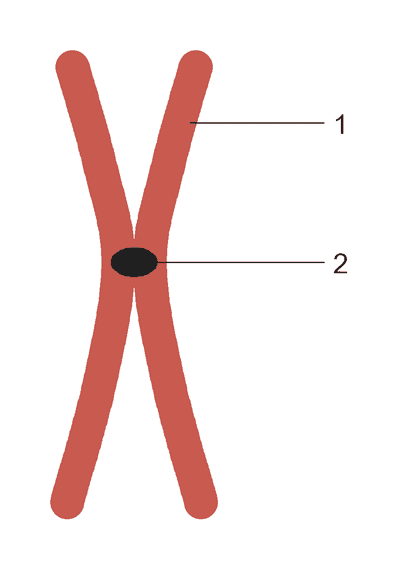
(i) What is each of the two identical lengthwise halves of this chromosome (one of them is numbered 1) called ? Write the name of the constricted region numbered 2.
(ii) In which phase of mitosis does part 1 separate from its partner ? What is each of them called after the separation ?
- 352 marks
Question 35
One nucleotide of a DNA strand contains the nitrogenous base adenine.
(i) Besides adenine, what else is this nucleotide made up of ?
(ii) With which base of the complementary strand does this adenine pair, and by how many hydrogen bonds ?
- 362 marks
Question 36
A zygote starts dividing by mitosis. Assume that every cell formed divides again each time.
(i) How many cells will the embryo have after 5 such divisions ? Show your working.
(ii) Which need for the production of new cells does this illustrate ? Name any two other needs for which new cells are produced.
- 372 marks
Question 37
(i) Name the phase of interphase in which each of the following takes place : the mitochondria of the cell divide; the chromosomes are duplicated.
(ii) Interphase was formerly called the "resting phase" of the cell. Why is this name not appropriate ?
- 384 marks
Question 38
The figure shows a stage of mitosis in an animal cell.
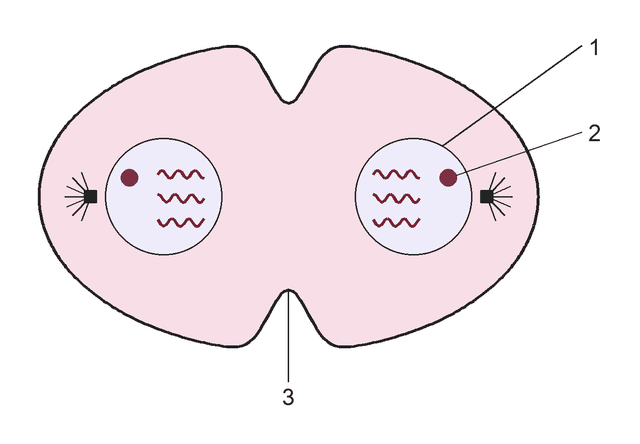
(i) Which stage of mitosis has this cell reached ? Support your answer with one feature seen in the figure.
(ii) Write the names of the covering numbered 1, the dark body numbered 2 and the constriction numbered 3.
(iii) This stage is said to be almost the reverse of prophase. Mention two changes of this stage which justify the statement.
- 394 marks
Question 39
Meiosis is the kind of cell division that produces the sex cells.
(i) Name the two parts of a flower in which meiosis takes place, and state what is produced in each.
(ii) Each body cell of a horse has 64 chromosomes. How many chromosomes will there be in a sperm of the horse, and in the zygote formed when this sperm fertilises an egg ? Show your working.
(iii) What is meant by crossing over ? State its significance.
- 403 marks
Question 40
The figure shows a small portion of a DNA molecule, drawn as a ladder. The bases of strand I are given. The four bases of strand II have been left blank and numbered 1 to 4.

(i) Write the names of the four missing bases of strand II, in the order 1 to 4.
(ii) How many hydrogen bonds in all hold the two strands together in this portion ? Show your working.
(iii) Name the two components that form each side of this ladder. Which scientists proposed the double helical structure of DNA ?
- 411 mark
Question 41
Class 10 Sample Paper 2 · Section A
Choose the odd one out:
Ovulation, Anaphase, Interphase, Telophase, Prophase