
Opening your dashboard
Class 12 Physics Chapter 2: Gauss' Theorem Solutions
60 textbook questions with step-by-step answers, free to read, for ISC 2026-27.
Get talked through Ch 2, not just shown the answer
Reading a finished solution is not the same as being able to do it. The AI tutor takes one question at a time and works it with you, in your own words, until you can.
- Ask it out loud, in your own words
- It gives you the next step, not the answer
- Stuck on part (ii)? Start there
60 questions with solutions
1–5 marks · Mixed difficulty
The first 32 solutions are on this page. This chapter is a long one, so the rest open on their own page to keep this one quick to load.
- 11 mark
Question 1
A point charge causes an electric flux of to pass through a spherical Gaussian surface of 10.0 cm radius centred on the charge. If the radius of the Gaussian surface were three times, how much flux would pass through the surface?
Solve with AIAnswer
(A)
- Correct
(B)
(C)
(D)
Answer: (B)
Key idea: By Gauss' theorem, the flux through a closed surface is . It depends only on the enclosed charge, not on the size of the surface.
Step 1 — Compare the two surfaces.
The bigger Gaussian sphere, of radius , still encloses the same point charge. So the flux through it is the same.
Step 2 — Keep the sign.
The flux is negative, so the charge is negative. It stays negative when the radius changes.
Why the other options are wrong:
- (A) is wrong: it multiplies the flux by 3 along with the radius and also drops the negative sign of the charge.
- (C) is wrong: it multiplies the flux by 3 along with the radius, but flux does not depend on the radius.
- (D) is wrong: it doubles the flux, but the enclosed charge is unchanged, so the flux cannot change.
Therefore, the flux through the larger surface is still : option (B).
- 21 mark
Question 2
Gauss' law of electrostatics would be invalid if
Solve with AIAnswer
(A) there were magnetic monopoles
(B) the speed of light was not a universal constant
- Correct
(C) the inverse square law was not exactly true
(D) the electric charge was not quantised.
Answer: (C) the inverse square law was not exactly true
Key idea: Gauss' law follows from the field of a point charge.
Step 1 — See why the inverse-square law matters.
Through a sphere centred on a point charge, the field falls as while the area grows as . The product, the flux, is then the same for every sphere and depends only on the enclosed charge.
Step 2 — See what would happen otherwise.
With any other power of , the flux would change with the size of the sphere even though the enclosed charge stays the same, so Gauss' law would fail.
Why the other options are wrong:
- (A) is wrong: magnetic monopoles would change Gauss' law for magnetism, not Gauss' law for electrostatics.
- (B) is wrong: Gauss' law of electrostatics rests on the inverse-square form of Coulomb's law; it does not depend on the speed of light.
- (D) is wrong: Gauss' law uses only the total enclosed charge, so it holds whether or not charge comes in units of .
Therefore, Gauss' law would be invalid if the inverse square law were not exactly true: option (C).
- 31 mark
Question 3
An infinitely long thin straight wire has uniform linear charge density of . Then the magnitude of the electric intensity at a point 18 cm away is
Solve with AIAnswer
- Correct
(A)
(B)
(C)
(D)
Answer: (A)
Key idea: By Gauss' theorem on a coaxial cylinder, the field of an infinite line charge is .
Step 1 — Put in the numbers.
We use and .
Step 2 — Match the option.
Written with , the value is .
Why the other options are wrong:
- (B) is wrong: it is nine times the correct value, the field at from the wire instead of .
- (C) is wrong: it is twice the correct value; it uses instead of .
- (D) is wrong: it is four times the correct value, the field at from the wire instead of .
Therefore, the field at is : option (A).
- 41 mark
Question 4
Which of the following is the correct statement of Gauss' law for electrostatics in a region of charge distribution in free space?
Solve with AIAnswer
(A)
- Correct
(B)
(C)
(D)
Answer: (B)
Key idea: Gauss' law states that the total flux through a closed surface equals the enclosed charge divided by .
Step 1 — Write Gauss' law.
For a charge enclosed in free space, the surface integral of is , which is option (B).
Step 2 — Check the units.
Flux has the unit , and has the unit , which is the same.
Why the other options are wrong:
- (A) is wrong: zero flux holds only when the enclosed charge is zero, not for a region containing charge .
- (C) is wrong: it has the wrong units; a charge in coulombs is not a flux.
- (D) is wrong: it multiplies by instead of dividing, which gives the wrong units.
Therefore, the correct statement of Gauss' law is : option (B).
- 51 mark
Question 5
Total electric flux coming out of a unit positive charge put in air is
Solve with AIAnswer
(A)
- Correct
(B)
(C)
(D)
Answer: (B)
Key idea: By Gauss' theorem, the total flux out of a charge in air (taken as free space) is .
Step 1 — Write Gauss' theorem for the charge.
The charge is a point charge in air, so all its flux leaves through any closed surface round it.
Step 2 — Put in a unit charge.
For the flux is one divided by .
Why the other options are wrong:
- (A) is wrong: this option would mean multiplying the charge by instead of dividing by it.
- (C) is wrong: this option is the flux per unit solid angle, not the total over the full steradians.
- (D) is wrong: this option is the reciprocal of the Coulomb constant ; it has the units of , not of flux.
Therefore, the total flux from a unit positive charge in air is : option (B).
- 61 mark
Question 6
A cylinder of radius and length is placed in a uniform electric field parallel to the cylinder axis. The total flux for the surface of the cylinder is given by
Solve with AIAnswer
(A)
(B)
(C)
- Correct
(D) Zero
Answer: (D) Zero
Key idea: The flux through each part of a closed surface is , counted positive where the field leaves and negative where it enters.
Step 1 — Find the flux through each flat end.
At one flat end the field enters the cylinder and at the other it leaves. Each end has area and is at right angles to the field.
Step 2 — Find the flux through the curved surface.
The field is parallel to the axis, so it runs along the curved surface and is at right angles to its normal. No flux passes through it.
Step 3 — Add the parts.
The two end fluxes are equal and opposite, and the curved surface adds nothing, so the total flux is zero. This agrees with Gauss' theorem, since the cylinder encloses no charge.
Why the other options are wrong:
- (A) is wrong: it adds the sizes of the two end fluxes instead of taking their opposite signs into account.
- (B) is wrong: this expression has the units , not the units of flux.
- (C) is wrong: this expression also has the wrong units for flux and does not even include an area.
Therefore, the total flux through the cylinder's surface is zero: option (D).
- 71 mark
Question 7
The inward and outward electric flux for a closed surface, in units of , are respectively and . Then the total charge inside the surface is
Solve with AIAnswer
(A)
(B)
(C)
- Correct
(D)
Answer: (D)
Key idea: Inward flux is counted negative and outward flux positive. By Gauss' theorem the enclosed charge is .
Step 1 — Find the net flux.
We add the inward flux with a minus sign to the outward flux.
Step 2 — Find the charge.
We multiply the net flux by .
The net flux is inward, so the charge is negative.
Why the other options are wrong:
- (A) is wrong: it has the wrong sign, as more flux goes in than out, and it leaves out the factor .
- (B) is wrong: it forgets to multiply the flux by .
- (C) is wrong: it divides by instead of multiplying.
Therefore, the total charge inside the surface is : option (D).
- 81 mark
Question 8
Gauss' law is true only if force due to a charge varies as
Solve with AIAnswer
(A)
- Correct
(B)
(C)
(D)
Answer: (B)
Key idea: Gauss' law says the flux through a closed surface depends only on the charge enclosed, not on the size of the surface.
Step 1 — Find the flux through a sphere round a point charge.
The field has the same size all over a sphere of radius centred on the charge, and the area is .
Step 2 — Find the law that makes the flux independent of r.
The flux is the same for every sphere only if cancels the , that is, only if . The force on a charge is , so the force must also vary as .
Why the other options are wrong:
- (A) is wrong: with the flux would be proportional to and would grow with the sphere.
- (C) is wrong: with the flux would be proportional to and would shrink as the sphere grows.
- (D) is wrong: with the flux would be proportional to , which also depends on the sphere's size.
Therefore, Gauss' law holds only for a force varying as : option (B).
- 91 mark
Question 9
A sphere of radius has a uniform distribution of electric charge in its volume. At a distance from its centre for , the electric intensity is proportional to
Solve with AIAnswer
(A)
(B)
- Correct
(C)
(D)
Answer: (C)
Key idea: For a uniformly charged sphere, a concentric Gaussian sphere of radius encloses only part of the charge, and by symmetry is radial and the same all over it.
Step 1 — Find the charge enclosed.
With charge density , the charge inside radius is times the volume of the Gaussian sphere.
Step 2 — Apply Gauss' theorem.
We set the flux equal to the enclosed charge divided by .
So is proportional to inside the sphere.
Why the other options are wrong:
- (A) is wrong: an inverse-square variation holds outside the sphere (), not inside it.
- (B) is wrong: a variation holds for a long line charge, not inside a sphere.
- (D) is wrong: a variation as the square of would need the enclosed charge to grow as , but it grows as .
Therefore, inside the sphere the electric intensity is proportional to : option (C).
- 101 mark
Question 10
It is not convenient to use a spherical Gaussian surface to find the electric field due to an electric dipole using Gauss' theorem because
Solve with AIAnswer
(A) Gauss' law fails in this case
- Correct
(B) This problem does not have spherical symmetry
(C) Coulomb's law is more fundamental than Gauss' law
(D) Spherical Gaussian surface will alter the dipole moment
Answer: (B) This problem does not have spherical symmetry
Key idea: Gauss' law is true for every closed surface, but it gives easily only when has the same size all over the surface and makes a fixed angle with it.
Step 1 — Look at a dipole's field on a sphere.
A dipole's field changes in size and in direction from point to point over a sphere centred on it. So cannot be taken out of the flux integral, and Gauss' law does not give directly.
Step 2 — Name the reason.
The difficulty comes from the lack of spherical symmetry in the charge arrangement, not from any failure of the law.
Why the other options are wrong:
- (A) is wrong: Gauss' law does not fail; it still gives zero total flux through a sphere round the dipole.
- (C) is wrong: in electrostatics Coulomb's law and Gauss' law are equivalent, so neither is "more fundamental"; the difficulty is only the lack of symmetry.
- (D) is wrong: a Gaussian surface is imaginary, so it cannot change any charge or the dipole moment.
Therefore, a spherical Gaussian surface is not convenient because the dipole lacks spherical symmetry: option (B).
- 111 mark
Question 11
The electric flux for Gaussian surface A (see the given figure) that enclose the charged particles in free space is (given , , )
 Solve with AI
Answer
- Correct
(A)
(B)
(C)
(D)
Answer: (A)
Key idea: By Gauss' theorem the total flux through a closed surface is the net charge it encloses divided by .
Step 1 — Add the enclosed charges with their signs.
All three charges lie inside surface A, so we add them algebraically (in nC).
In coulombs this is .
Step 2 — Divide by the permittivity of free space.
We take , so the powers of ten give .
This is option (A).
Why the other options are wrong:
- (B) is wrong: The number is right, but is the unit of (it is divided by C), not the unit of flux.
- (C) is wrong: About is the size of the flux of alone (); the flux depends on the net charge, .
- (D) is wrong: It has the same wrong number as (C) and also the unit of instead of the unit of flux.
Therefore, the flux through surface A is : option (A).
- 121 mark
Question 12
Two point charges and are kept inside a large metallic cube without touching its side. Electric flux emerging out of the cube is
Solve with AIAnswer
(A)
(B)
- Correct
(C) zero
(D)
Answer: (C) zero
Key idea: The flux out of a closed surface depends only on the algebraic sum of the charges inside it, .
Step 1 — Find the net charge inside the cube.
The cube is a closed surface and both charges are inside it, so we add them with their signs.
Step 2 — Apply Gauss' theorem.
Dividing a zero enclosed charge by gives zero net flux. Lines leave the cube near and enter near in equal amounts.
Why the other options are wrong:
- (A) is wrong: It is the flux of alone; the inside the cube cancels it.
- (B) is wrong: It is the flux of alone; the inside the cube cancels it.
- (D) is wrong: It adds the sizes of the two charges instead of their algebraic sum.
Therefore, the electric flux emerging out of the cube is zero: option (C).
- 131 mark
Question 13
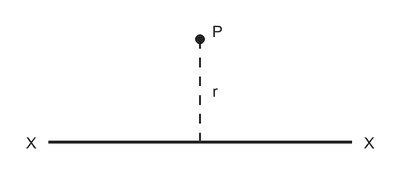
Electric field intensity at point P at a perpendicular distance from an infinitely long linear charge X-X having linear charge density is given by
 Solve with AI
Answer
(A)
- Correct
(B)
(C)
(D)
Answer: (B)
Key idea: For an infinitely long line charge the field is radial and the same at all points a distance from the line, so a coaxial cylinder is the right Gaussian surface.
Step 1 — Choose the Gaussian surface.
We draw a cylinder of radius and length with the line X-X as its axis, so that P lies on its curved surface.
Step 2 — Find the flux through the cylinder.
On the flat ends lies along the surface, so they carry no flux. On the curved surface is along the outward normal and has the same size everywhere.
Step 3 — Apply Gauss' theorem.
The cylinder encloses a length of the line, that is a charge , so we set the flux equal to .
Step 4 — Write it in the form of the options.
Multiplying top and bottom by 2 gives the form.
This is option (B).
Why the other options are wrong:
- (A) is wrong: It has ; the field of a line charge falls as , and does not even have the unit of field.
- (C) is wrong: It also falls as and loses the factor 2; that shape belongs to a point charge, not a line.
- (D) is wrong: It has the right law but is half the true value, because the factor 2 from is lost.
Therefore, , directed radially away from the line for positive : option (B).
- 141 mark
Question 14
A short electric dipole (which consists of two point charges and ) is placed at the centre O and inside a large cube ABCDEFGH of length as shown in the given figure. The electric flux emanating through the cube is
 Solve with AI
Answer
(A)
- Correct
(B) zero
(C)
(D)
Answer: (B) zero
Key idea: Gauss' theorem gives the total flux through a closed surface as the net enclosed charge divided by ; the size of the cube does not matter.
Step 1 — Find the net charge of the dipole.
A dipole is made of two equal and opposite charges, and both are inside the cube.
Step 2 — Apply Gauss' theorem to the cube.
The cube ABCDEFGH is a closed surface, so the total flux through it is the enclosed charge over .
The lines that leave near all return to inside, so as much flux enters the cube as leaves it.
Why the other options are wrong:
- (A) is wrong: has the unit of potential (charge over times a length), not of flux, and the net charge is zero anyway.
- (C) is wrong: also has the unit of potential, and the flux cannot depend on .
- (D) is wrong: has the unit of potential too; flux through a closed surface never depends on its size.
Therefore, the net electric flux through the cube is zero: option (B).
- 151 mark
Question 15
A closed surface in vacuum encloses charges and . The total electric flux emerging out of the surface is
Solve with AIAnswer
(A) zero
- Correct
(B)
(C)
(D)
Answer: (B)
Key idea: The total flux out of a closed surface is the algebraic sum of the enclosed charges divided by .
Step 1 — Add the enclosed charges with their signs.
Both charges are inside the surface, so we add them algebraically.
Step 2 — Apply Gauss' theorem.
We divide the net enclosed charge by .
Why the other options are wrong:
- (A) is wrong: The enclosed charges do not cancel; a zero flux would need them to, but and leave .
- (C) is wrong: It counts only the charge and leaves out the charge inside.
- (D) is wrong: It adds the sizes, , ignoring the negative sign of .
Therefore, the total flux emerging out of the surface is : option (B).
- 161 mark
Question 16
A sphere of radius encloses a total charge . If there is another concentric sphere of radius and there be no additional charges between and , find the ratio of electric flux through and .
Solve with AIWritten solution
Solution:
Key idea: By Gauss' theorem the flux through a closed surface depends only on the charge it encloses, not on its size.
Step 1 — Find the charge enclosed by each sphere.
Sphere encloses . Sphere encloses everything inside and the space between them, which holds no extra charge, so it also encloses .
Step 2 — Write the flux through each sphere.
Gauss' theorem gives the same expression for both surfaces.
Step 3 — Take the ratio.
Dividing the two equal fluxes gives 1.
The larger sphere has more area, but the field on it is weaker by the same factor, so the flux is the same.
Therefore, .
- 171 mark
Question 17
What is the relation between electric intensity and flux?
Solve with AIWritten solution
Solution:
Key idea: Electric flux measures how much electric field passes through a surface; it is built from and the area vector .
Step 1 — Flux through a small area.
For a small area in a field , the flux is the dot product of the two vectors, where is the angle between and the normal to the area.
Step 2 — Flux through a whole surface.
Adding up over the whole surface turns the sum into a surface integral of the electric intensity.
Step 3 — Closed surface (Gauss' theorem).
For a closed surface this integral equals the enclosed charge divided by .
Therefore, electric flux is the surface integral of the electric intensity, .
- 181 mark
Question 18
Is electric flux a scalar or vector?
Solve with AIWritten solution
Solution:
Key idea: The dot product of two vectors is a scalar: it has size and sign but no direction.
Step 1 — Write flux as a dot product.
The flux through a small area is , the dot product of the field and the area vector.
Step 2 — Decide its nature.
A dot product gives a number, and adding such numbers over a surface still gives a number. Flux can be positive (outward) or negative (inward), but it has no direction in space.
Therefore, electric flux is a scalar quantity.
- 191 mark
Question 19
What are the units of electric flux?
Solve with AIWritten solution
Solution:
Key idea: The unit of flux follows from its definition, field times area, .
Step 1 — Write the units of the factors.
Electric field is measured in and area in ; has no unit.
Step 2 — Multiply them.
The product of the two units is the unit of flux.
Step 3 — Give the equivalent form.
Since is the same as , the unit can also be written in volts.
Therefore, the unit of electric flux is , which is the same as the volt-metre (V m).
- 201 mark
Question 20
What is the S.I. unit of surface integral of electric field?
Solve with AIWritten solution
Solution:
Key idea: The surface integral of the electric field, , is the electric flux, so its unit is the unit of field times the unit of area.
Step 1 — Write the units of the factors.
The field can be measured in , and is in .
Step 2 — Multiply them.
One power of metre cancels.
Therefore, the S.I. unit of the surface integral of electric field is the volt-metre (V m), equal to .
- 211 mark
Question 21
What is the shape of Gaussian surface of a line charge?
Solve with AIWritten solution
Solution:
Key idea: A Gaussian surface is chosen to match the symmetry of the charge, so that is constant and normal on part of it and parallel to the rest.
Step 1 — Look at the field of a line charge.
The field of a long straight line charge points radially away from the line and has the same size at every point at the same distance .
Step 2 — Choose the matching surface.
A cylinder coaxial with the line has its curved surface everywhere at distance , with along its normal, while its flat ends carry no flux because lies along them.
Therefore, the Gaussian surface for a line charge is a cylinder coaxial with the line charge.
- 221 mark
Question 22
An electric dipole of dipole moment is enclosed by a closed surface. What is the net electric flux coming out of the surface?
Solve with AIWritten solution
Solution:
Key idea: By Gauss' theorem the net flux out of a closed surface depends only on the net charge inside; the dipole moment does not enter.
Step 1 — Find the net charge of the dipole.
A dipole is a pair of charges and , so its net charge is zero whatever its moment.
Step 2 — Apply Gauss' theorem.
We divide the net enclosed charge by .
The given moment is not needed.
Therefore, the net electric flux coming out of the surface is zero.
- 231 mark
Question 23
Define electric flux. Write its SI unit. A charge is enclosed by a spherical surface of radius . If the radius is reduced to half, how would the electric flux through the surface change?
Solve with AIWritten solution
Solution:
Key idea: Flux measures the field passing through a surface; for a closed surface Gauss' theorem fixes it at .
Step 1 — Define electric flux.
Electric flux through a surface is the surface integral of the electric field over it. It is proportional to the number of electric lines of force passing normally through the surface.
Step 2 — Give its SI unit.
Field () times area () gives the unit , which is the same as V m.
Step 3 — Apply Gauss' theorem to the sphere.
The flux through the closed sphere depends only on the charge enclosed.
Step 4 — Halve the radius.
The charge is still inside, so the flux is unchanged. The field on the smaller sphere is four times stronger, but its area is four times smaller.
Therefore, the flux is with SI unit , and halving the radius does not change it: it stays .
- 241 mark
Question 24
Find the number of electric lines of force that radiate outwards from charge in vacuum.
Solve with AIWritten solution
Solution:
Key idea: The number of lines of force leaving a charge is taken to be numerically equal to the electric flux it sends out, .
Step 1 — Write the flux from the charge.
By Gauss' theorem a closed surface round in vacuum has flux .
Step 2 — Put in the values.
We use and .
Therefore, about lines of force radiate outwards from a charge in vacuum.
- 251 mark
Question 25
Deduce Gauss' law from Coulomb's law.
Solve with AIWritten solution
Solution:
Key idea: Use Coulomb's law to find the field of a point charge, then work out the flux of that field through a sphere centred on the charge.
Step 1 — Field of a point charge from Coulomb's law.
The force on a test charge at distance from is , so the field (force per unit charge) is
Step 2 — Choose a sphere round the charge.
On a sphere of radius centred on , is radial, along the outward normal, and has the same size at every point.
Step 3 — Put in the field.
Substituting from Step 1, the and the cancel.
Step 4 — Extend to any surface.
The result does not depend on . Any closed surface round is crossed by the same lines of force, so it has the same flux; by superposition, for several charges inside, is their algebraic sum.
Therefore, , which is Gauss' law.
- 261 mark
Question 26
At the centre of spherical Gaussian surface a point charge is kept. How does the electric flux through the surface change when
(i) the sphere is replaced by a cylinder?
(ii) the charge is shifted to another point inside the sphere?
Solve with AIWritten solution
Solution:
Key idea: The total flux through a closed surface is ; it depends only on the charge enclosed, not on the shape of the surface or where the charge sits inside.
Step 1 — Part (i): replace the sphere by a cylinder.
The cylinder is still a closed surface that encloses the same charge , so its total flux is still . The flux does not change.
Step 2 — Part (ii): shift the charge inside the sphere.
The charge is still enclosed, so the total flux is still . The flux does not change, although the field at points on the sphere does.
Therefore, in both cases (i) and (ii) the total flux stays : there is no change.
- 271 mark
Question 27
State one essential property of a Gaussian surface.
Solve with AIWritten solution
Solution:
Key idea: A Gaussian surface is an imaginary closed surface over which Gauss' theorem is applied.
Step 1 — Recall why the surface must be closed.
Gauss' theorem links the flux to the charge enclosed, and only a closed surface encloses a definite charge, so the surface must be closed.
Step 2 — Recall where the field is obtained.
The theorem gives only at points on the surface, so it must pass through the point at which the electric intensity is to be found.
Therefore, a Gaussian surface is an imaginary closed surface that passes through the point where the electric intensity is to be found.
- 281 mark
Question 28
The unit of electrostatic field is E volt/metre. Obtain the unit of electric flux.
Solve with AIWritten solution
Solution:
Key idea: Flux is field times area, , so its unit is the unit of field times .
Step 1 — Write the units of the factors.
The field is given in volt/metre, and area is in .
Step 2 — Multiply them.
One power of metre cancels.
Therefore, the unit of electric flux is the volt-metre (V m).
- 291 mark
Question 29
State Gauss' theorem.
Solve with AIWritten solution
Solution:
Key idea: Gauss' theorem links the flux through a closed surface to the charge inside it.
Step 1 — State the theorem in words.
The total electric flux through any closed surface in vacuum is equal to times the net charge enclosed by that surface.
Step 2 — Write it as an equation.
Here is the algebraic sum of the charges inside; charges outside give no net flux.
Therefore, Gauss' theorem: for any closed surface.
- 301 mark
Question 30
A large hollow metallic sphere has a positive charge of at its centre. Find how much electric flux emanates from the sphere.
Solve with AIWritten solution
Solution:
Key idea: By Gauss' theorem the flux from a closed surface is the charge inside divided by ; the hollow metal sphere does not change the total.
Step 1 — Write Gauss' theorem.
A closed surface just outside the sphere encloses the central charge (the sphere itself, if uncharged, adds no net charge).
Step 2 — Put in the values.
We use and .
Therefore, the flux emanating from the sphere is .
- 312 marks
Question 31
What is Gaussian surface?
Solve with AIWritten solution
Solution:
Key idea: Gauss' theorem holds for every closed surface, so we may imagine any closed surface that makes the flux integral easy.
Step 1 — Define a Gaussian surface.
A Gaussian surface is an imaginary closed surface, of any shape, drawn in an electric field so that Gauss' theorem can be applied to it.
Step 2 — List its properties.
A useful Gaussian surface has these features:
- It is closed, and it passes through the point where is to be found.
- It does not pass through any discrete point charge, where the field is undefined.
- It matches the symmetry of the charge (a sphere for a point charge, a cylinder for a line charge), so that is constant and normal on its parts.
Therefore, a Gaussian surface is an imaginary closed surface, chosen to fit the symmetry of the charges, over which Gauss' theorem is applied.
- 322 marks
Question 32
An infinite line charge produces a field of at a distance 2 cm. Calculate the linear charge density.
Solve with AIWritten solution
Solution:
Key idea: For an infinite line charge Gauss' theorem gives .
Step 1 — Rearrange for .
We multiply both sides by to make the subject.
Step 2 — Put in the values.
We use , the distance 2 cm written as , and .
Watch out: Change 2 cm to 0.02 m before substituting; leaving it in cm gives an answer 100 times too large.
Therefore, the linear charge density is .
- 332 marks
Question 33
State Gauss' law in electrostatics.
- 342 marks
Question 34
State Gauss' theorem. Draw a graph showing the variation of electric field as one moves from the centre of a charged metal ball to a point on its surface and then to a far-off outside point.
- 352 marks
Question 35
Derive Coulomb's law from Gauss' law.
- 362 marks
Question 36
A point charge is placed at the centre of a cube of side . Calculate the electric flux emerging from the cube.
- 372 marks
Question 37
A charge is enclosed by a Gaussian spherical surface of radius . If the radius is doubled, calculate the net outward flux.
- 382 marks
Question 38
Using Gauss' theorem show that the electric field inside a charged metallic conductor is zero.
- 392 marks
Question 39
A Gaussian surface does not have any net charge inside it. Does it mean that the electric intensity is zero at all points on the surface?
- 402 marks
Question 40
Using Gauss theorem show that the electric intensity inside a cavity in an isolated conductor is zero.
- 412 marks
Question 41
Draw a graph to show the variation of electric field with distance from the centre of a uniformly charged sphere. Explain.
- 423 marks
Question 42
(a) Define electric flux. Give its SI unit.
(b) State and prove Gauss' law.
- 433 marks
Question 43
What is Gaussian surface? Give its properties. Derive Coulomb's law from Gauss' law.
- 443 marks
Question 44
Using Gauss' law, derive an expression for the electric intensity due to two plane parallel sheets of charge. Hence obtain an expression for electric intensity when the two sheets are charged uniformly with equal and opposite charge.
- 455 marks
Question 45
(a) State and prove Gauss' theorem.
(b) Derive an expression for the electric intensity due to a charged infinite plane sheet of charge.
- 465 marks
Question 46
(a) Applying Gauss' theorem, derive an expression for the electric intensity due to a charged sphere at a point (i) outside the sphere, (ii) on the surface of the sphere and (iii) inside the sphere.
(b) Show the variations of with distance at the points mentioned above using a graph.
- 475 marks
Question 47
Using Gauss' theorem, derive an expression for the electric intensity due to a charged infinitely long straight cylindrical rod at a point outside the cylinder.
- 485 marks
Question 48
Show that the electric intensity at any point in the space between two charged parallel metal plates is independent of the distance of the point from the plates and is equal to .
- 493 marks
Question 49
A point charge is situated at the centre of a cube of 1.5 m side. Calculate the electric flux through its surface.
- 503 marks
Question 50
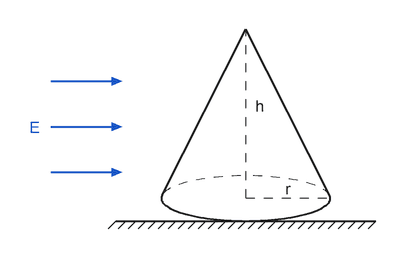
The given figure shows cone of base radius and height placed on a horizontal table. A horizontal uniform electric field penetrates the cone. Calculate the electric flux entering the cone.
- 513 marks
Question 51
At a distance from an infinite plane a point charge is placed. Calculate the electric flux through the plane due to the point charge.
- 523 marks
Question 52
At the centre of a spherical shell of radius a point charge is placed. Calculate the total electric flux through (i) the surface of the shell and (ii) any hemispherical surface of the shell.
- 533 marks
Question 53
The linear charge density of a fine wire of length 10 m is . Calculate the electric intensity due to the wire at a point distant 10 cm from the wire.
- 543 marks
Question 54
The magnitude of electric intensity just above the surface of a sheet measured from its midpoint is . Calculate the surface charge density of the sheet.
- 553 marks
Question 55
A long plane conductor is a square of side 2.00 m and has a total charge of . Calculate the surface charge density and the electric intensity at a point very close to it.
- 563 marks
Question 56
A metal sphere of diameter 20 cm is charged with . Calculate the electric intensity due to the charged sphere at a point distant (i) 5 cm from the centre of the sphere and (ii) 30 cm from the centre of the sphere.
- 574 marks
Question 57
The inner radius of a metallic spherical shell is 30 cm and outer radius is 40 cm. The net charge on the shell is . A point charge is placed at the centre of the shell. Calculate the surface charge density on (i) the inner surface and (ii) the outer surface.
- 584 marks
Question 58
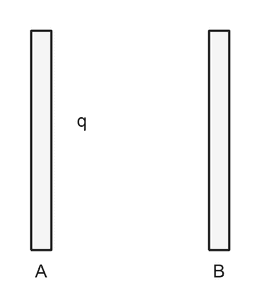
In the given figure, A and B are two conducting plates of large surface area , for each surface. They are placed parallel to each other. The plate A is given a charge and the plate B is not given any charge. Calculate (i) the surface charge density at the inner surface of the plate A (ii) the electric field at a point in between the plates.
- 593 marks
Question 59
A spherical conductor of radius 12 cm has a charge of distributed uniformly on its surface. What is the electric field (i) inside the sphere, (ii) just outside the sphere and (iii) at a point 18 cm from the centre of the sphere?
- 603 marks
Question 60
An electric dipole of dipole moment is enclosed by a closed surface. What is the net flux coming out of the surface?
What Class 12 Physics Ch 2 covers
The sections of the chapter, in the order the book takes them. Every question above comes from one of these.
- 01Area Vector and Flux of a Vector Field
- 02Electric Flux
- 03Solid Angle
- 04Gauss' Theorem
- 05Coulomb's Law from Gauss' Theorem
- 06Field due to a Line Charge
- 07Field due to Plane Sheets of Charge
More ways to study this chapter
The same chapter asked three other ways. Practise it, revise it, and see what the board has set on Ch 2 before.
- Competency-Based Questions (CBQ)Case study questions: a situation, and the part of the chapter that answers it.40questionsOpen
- Previous Year QuestionsQuestions that have actually appeared in board papers, each tagged with its year.10questionsOpen
- Practice QuestionsExtra questions per chapter, for when one attempt at a method is not enough.91questionsOpen
Ch 2 in past ISC papers
The same chapter as the board has actually asked it. These are worded differently from the textbook exercise, which is the point of reading them.
- 11 mark
Board paper question 1
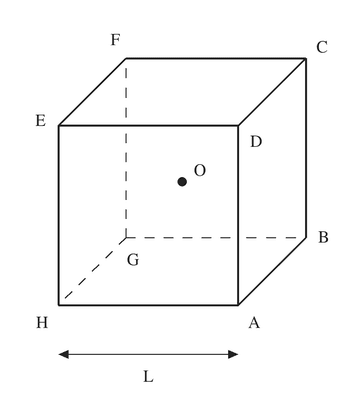
A short electric dipole (which consists of two point charges, and ) is placed at the centre O and inside a large cube (ABCDEFGH) of length L, as shown in Figure 1. The electric flux, emanating through the cube is:
 Solve with AI
Answer
(A)
- Correct
(B) zero
(C)
(D)
Answer: (B) zero
Key idea: By Gauss' theorem, the total electric flux through any closed surface is , where is the total (net) charge inside the surface. The size and shape of the surface do not matter.
Step 1 — Find the net charge inside the cube.
The whole dipole, both and , lies inside the cube, so we add the two charges.
Step 2 — Apply Gauss' theorem.
The flux through the closed surface of the cube is the net enclosed charge divided by .
Field lines do leave the cube near and enter it near , but the outward and inward fluxes are equal, so the total is zero.
Why the others are wrong:
- (A) This has the form of the potential of one charge at a distance ; flux does not depend on , and the net charge inside is zero anyway.
- (C) This also depends on the side and counts only one charge; Gauss' theorem gives a flux that is independent of the size of the surface.
- (D) This again depends on , but the flux through a closed surface depends only on the net enclosed charge, which is zero here.
Therefore, the correct option is (B): the flux is zero.
- 22 marks
Board paper question 2
(i) State Gauss' Law.
(ii) In an electric dipole, at which point is the electric potential zero?
Solve with AIWritten solution
Solution:
Key idea: (i) Gauss' law links the flux through a closed surface to the charge inside it. (ii) The potential of a dipole at a point is the sum of and ; it is zero wherever the point is equally far from both charges.
Step 1 — (i) State Gauss' law.
Gauss' law states that the total electric flux through any closed surface is equal to times the total charge enclosed by that surface.
Here is the field at the surface element , is the net charge inside the surface and is the permittivity of free space.
Step 2 — (ii) Write the potential of the dipole at a point.
Let the point be at a distance from and from . Potentials are scalars, so they simply add.
Step 3 — (ii) Find where it is zero.
The bracket is zero when equals , that is, at every point equally far from the two charges. These points form the perpendicular bisector of the dipole axis.
Therefore, (i) the total flux through a closed surface is ; (ii) the potential of a dipole is zero at every point on its equatorial line (the perpendicular bisector plane of the dipole), including its centre.
- 31 mark
Board paper question 3
Intensity of electric field at a perpendicular distance of from an infinitely long line charge having linear charge density () is . Find the value of .
Solve with AIWritten solution
Solution:
Key idea: By Gauss' theorem, an infinitely long line charge of linear charge density gives a field at a perpendicular distance . We rearrange this for .
Step 1 — Write the formula in terms of .
We write for the constant . Its value is , and is twice it, .
Step 2 — Make the subject.
We multiply both sides by and divide by .
Step 3 — Substitute the values.
Here is and is .
Therefore, .
- 41 mark
Board paper question 4
A closed surface in vacuum enclose charges and . The total electric flux emerging out of the surface is
Solve with AIAnswer
(A) Zero
- Correct
(B)
(C)
(D)
Answer: (B)
Key idea: Gauss' theorem says the total flux out of a closed surface is , where is the algebraic sum of the charges inside, signs included.
Step 1 — Add the enclosed charges with their signs.
The surface encloses and .
Step 2 — Apply Gauss' theorem.
We divide the net enclosed charge by .
Why the others are wrong:
- (A) Zero would need the enclosed charges to cancel, but and leave a net charge of .
- (C) The value counts only the charge and ignores the inside the surface.
- (D) The value adds the sizes and forgets that one charge is negative.
Therefore, the correct option is (B): the flux is .
- 51 mark
Board paper question 5
State 'Gauss' theorem
Solve with AIWritten solution
Solution:
Key idea: Gauss' theorem connects the electric flux through a closed surface with the charge enclosed by it.
Step 1 — State the theorem in words.
Gauss' theorem states that the total electric flux through any closed surface (a Gaussian surface) in vacuum is equal to times the net charge enclosed by the surface.
Step 2 — Write it as an equation.
The flux is the surface integral of the field over the closed surface, and Gauss' theorem sets it equal to the enclosed charge over .
Here is the field at the surface element , is the algebraic sum of the charges inside, and is the permittivity of free space. Charges outside the surface add nothing to the total flux.
Therefore, : the total flux through a closed surface is times the net charge it encloses.
- 61 mark
Board paper question 6
A hollow sphere of radius R has a point charge Q at its centre. Electric flux emanating from it is . If both the charge and the radius of the sphere be doubled, electric flux emanating from the sphere will:
Solve with AIAnswer
(A) Remain the same.
- Correct
(B) Become
(C) Become
(D) Become
Answer: (B) Become
Key idea: By Gauss' theorem the flux through a closed surface is . It depends only on the charge enclosed, not on the size of the surface.
Step 1 — Write the original flux.
The sphere encloses the charge , so Gauss' theorem gives:
Step 2 — Write the new flux.
The new charge is . The radius does not appear in Gauss' theorem, so it has no effect.
Why the others are wrong:
- (A) The flux would stay the same only if the charge stayed the same; doubling the charge doubles the flux.
- (C) The value comes from doubling once for the charge and again for the radius (flux taken to grow like ), but the radius has no effect on the flux.
- (D) The value comes from doubling for the charge and multiplying by four for the area (flux taken to grow like ); the field at the surface falls by the same factor of four, so the area cancels out.
Therefore, the correct option is (B): the flux becomes .
All 10 board paper questions for this chapter, solved the same way.
Class 12 Physics Ch 2 questions students ask
How many questions are there in Class 12 Physics Ch 2?
60 questions. Every one is solved step by step on this page.
Are these Class 12 Physics solutions free?
Yes. Every question and its full working is free to read, with no account needed.
Can I download the Class 12 Physics Ch 2 solutions as a PDF?
There is no PDF to download. Every solution is on this page instead, which means it is searchable, always the current syllabus, and readable on a phone. Use your browser's print option if you want it on paper.