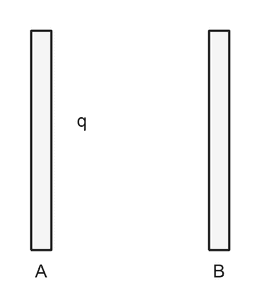
Solution:
Key idea: Each charged face of a large plate acts as a sheet whose field has size 2ε0σ on both sides. The charges on the four faces must arrange themselves so that the field is zero inside the metal of both plates. Plate B is uncharged, so its two faces carry equal and opposite induced charges.
Step 1 — Name the charges on the four faces.
From left to right, let the faces carry q1 (outer face of A), q2 (inner face of A), q3 (inner face of B) and q4 (outer face of B). The plates' totals give two equations.
q1+q2=q
q3+q4=0
Step 2 — Make the field zero inside plate B.
At a point inside B, the three faces to its left push to the right and the face q4 to its right pushes to the left, each face counted with the sign of its charge. These must cancel.
q1+q2+q3−q4=0
Using q1+q2=q and q4=−q3, this becomes q+2q3=0.
q3=−2q
q4=+2q
Step 3 — Make the field zero inside plate A.
At a point inside A, the face q1 to its left pushes right and the three faces to its right push left, each face counted with the sign of its charge. These must cancel.
q1−q2−q3−q4=0
Since q3+q4=0, this gives q1=q2, and with q1+q2=q each face of A carries half the charge.
q2=2q
Step 4 — Find the inner surface charge density of A for part (i).
The inner face carries 2q spread over the area A.
σ=2Aq
Step 5 — Find the field between the plates for part (ii).
Between the plates, A's two faces (positive, to the left) push right, B's inner face (negative, to the right) pulls right and B's outer face (positive, to the right) pushes left.
E=2ε0A1(2q+2q+2q−2q)
E=2ε0Aq
Therefore, (i) the surface charge density on the inner face of A is 2Aq; (ii) the field between the plates is 2ε0Aq, directed from A towards B.