Solution:
Key idea: By symmetry the field of a uniformly charged sphere is radial and the same at equal distances from its centre, so concentric spherical Gaussian surfaces are used.
Part (a)
Step 1 — Set up the sphere.
We take a sphere of radius R and centre O, with total charge q spread uniformly through its volume. Its charge density is ρ=q/34πR3. The points P₁ (outside), P₂ (on the surface) and P₃ (inside) lie on Gaussian spheres centred at O.

Step 2 — Point outside, P₁ (r>R).
The Gaussian sphere through P₁ encloses the whole charge q, and E is constant and along the normal on it.
E×4πr2=ε0q
E=4πε01r2q
The sphere behaves as if all its charge were at its centre.
Step 3 — Point on the surface, P₂ (r=R).
We put r=R in the outside result.
ER=4πε01R2q
Step 4 — Point inside, P₃ (r<R).
The Gaussian sphere through P₃ encloses only the charge in its own volume, a fraction r3/R3 of the total.
q′=qR3r3
Gauss' theorem on this sphere then gives
E×4πr2=ε0R3qr3
E=4πε01R3qr
So E∝r inside and E=0 at the centre.
Step 5 — Conducting sphere or thin shell.
In a conductor the free charges move until the field inside is zero, and the charge ends up on the surface. A Gaussian sphere inside then encloses no charge, so E=0 inside; results (i) and (ii) are unchanged.
Part (b)
Step 6 — Draw the graphs.
We draw the graph for the uniformly charged (non-conducting) sphere first: E rises linearly to its maximum at r=R and then falls as 1/r2:
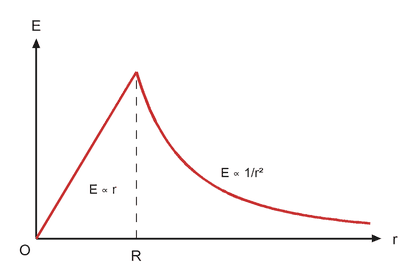
For a charged conducting sphere or shell, E is zero inside, jumps to its maximum at the surface, then falls as 1/r2:
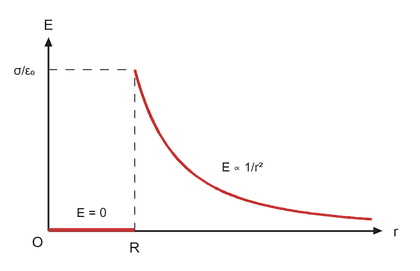
Therefore, (i) E=4πε0r2q outside, (ii) E=4πε0R2q on the surface, and (iii) E=4πε0R3qr inside a uniformly charged sphere (zero inside a conductor), as the graphs show.
