
Question 475 marksMedium
Using Gauss' theorem, derive an expression for the electric intensity due to a charged infinitely long straight cylindrical rod at a point outside the cylinder.
Confirming your payment
Sign up now and get 250 free tokens.
Gauss' Theorem · Question 47 of 60
Using Gauss' theorem, derive an expression for the electric intensity due to a charged infinitely long straight cylindrical rod at a point outside the cylinder.
Solution:
Key idea: The field of a long straight charged rod is radial and the same at equal distances from its axis, so a coaxial cylinder is the Gaussian surface.
Step 1 — Choose the Gaussian surface.
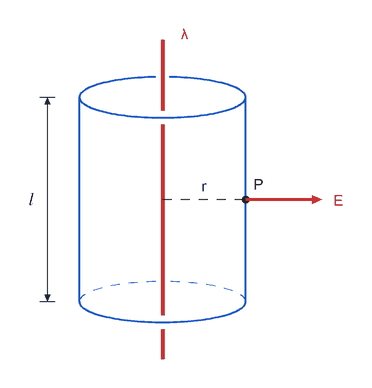
We take an infinitely long straight rod with charge per unit length. To find at P, at perpendicular distance from the axis, we draw a coaxial cylinder of radius and length through P.
Step 2 — Use symmetry.
For an infinitely long rod no point along it is special, so is radial (perpendicular to the axis) and has the same size at every point of the curved surface.
Step 3 — Find the flux.
On the flat ends lies along the surface, so they carry no flux. On the curved surface is along the outward normal.
Step 4 — Apply Gauss' theorem.
The cylinder encloses a length of the rod, that is a charge .
The field points radially outward for positive , and .
Step 5 — Rod of finite radius.
For a cylindrical rod of radius , the same working holds at any outside point (), because the charge enclosed on length is still . Outside, the rod acts like a line charge on its axis.
Therefore, at distance outside the rod, directed radially.