
Question 485 marksMedium
Show that the electric intensity at any point in the space between two charged parallel metal plates is independent of the distance of the point from the plates and is equal to .
Confirming your payment
Sign up now and get 250 free tokens.
Gauss' Theorem · Question 48 of 60
Show that the electric intensity at any point in the space between two charged parallel metal plates is independent of the distance of the point from the plates and is equal to .
Solution:
Key idea: Gauss' theorem gives the field of one sheet of charge as , independent of distance; two oppositely charged plates are two such sheets.
Step 1 — Choose a Gaussian pill-box.
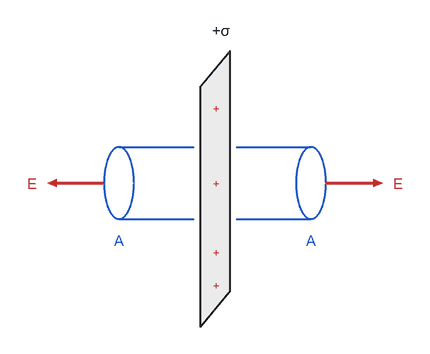
We take an infinite thin plane sheet with uniform surface charge density . We draw a closed cylinder (pill-box) that crosses the sheet at right angles, with flat ends of area on either side, at equal distances from the sheet.
Step 2 — Use symmetry.
For an infinite sheet no direction along the sheet is special, so is perpendicular to it, pointing away from it on both sides, with the same size at equal distances.
Step 3 — Find the flux through each part.
On the curved surface lies along the surface, so that part carries no flux. On each flat end is along the outward normal, so each end carries a flux .
Step 4 — Apply Gauss' theorem.
The pill-box encloses the charge of the sheet, so the flux equals .
The field points normally away from the sheet (towards it if is negative) and does not depend on the distance from the sheet.
Step 5 — Charges on two parallel metal plates.
When two parallel metal plates carry equal and opposite charges, the charges attract each other onto the facing (inner) surfaces, with densities and .
Step 6 — Sheets with and .
We place sheet 1 () on the left and sheet 2 () on the right. Each gives a field of size : away from sheet 1 and towards sheet 2. We add them in the three regions.

Step 7 — Regions outside the sheets.
In region I (left of both) sheet 1's field points left and sheet 2's field points right, with equal sizes, so they cancel. The same happens in region III (right of both). The field outside is zero.
Step 8 — Region between the sheets.
In region II both fields point from the sheet towards the sheet, so they add.
Neither term contains a distance, so this field is the same at every point between the sheets.
Therefore, the field between the plates is , from the positive to the negative plate, the same at every point and independent of the distance from the plates.