
Question 455 marksHard
(a) State and prove Gauss' theorem.
(b) Derive an expression for the electric intensity due to a charged infinite plane sheet of charge.
Confirming your payment
Sign up now and get 250 free tokens.
Gauss' Theorem · Question 45 of 60
(a) State and prove Gauss' theorem.
(b) Derive an expression for the electric intensity due to a charged infinite plane sheet of charge.
Solution:
Key idea: Gauss' theorem says the flux through a closed surface depends only on the charge inside; with a pill-box surface it gives the field of an infinite sheet.
Part (a)
Step 1 — State Gauss' theorem.
The total electric flux through any closed surface is times the net charge enclosed by that surface.
Step 2 — Set up a closed surface round a point charge.
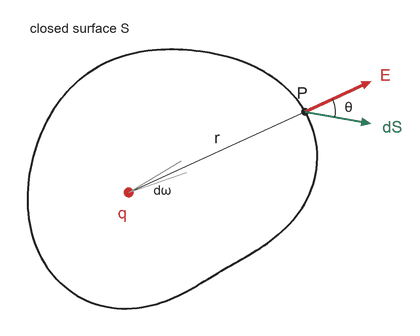
We take a point charge at O inside a closed surface S of any shape, and a small area element of S at a point P, at distance from O.
Step 3 — Flux through the small element.
By Coulomb's law the field at P points along OP and has size
If is the angle between and , the flux through the element is . Putting in :
Step 4 — Bring in the solid angle.
The quantity is the solid angle that the element subtends at O, so the flux through the element is
Step 5 — Add over the whole surface.
A closed surface subtends a total solid angle of steradian at any point inside it, so adding all the elements gives
Step 6 — Charges outside the surface.
For a charge outside S, every thin cone from the charge cuts S twice. Where the cone enters, the flux is ; where it leaves, it is . These cancel, so an outside charge gives zero net flux.
Step 7 — Several charges.
By superposition, the fluxes of charges inside S add, while outside charges give nothing.
This proves Gauss' theorem for a surface of any shape and size.
Part (b)
Step 8 — Choose a Gaussian pill-box.
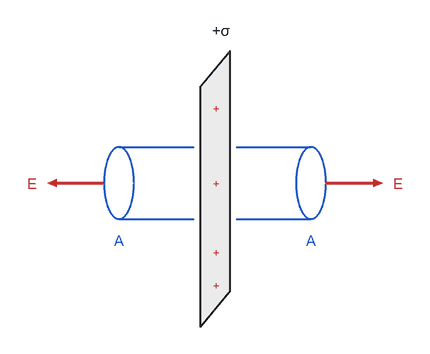
We take an infinite thin plane sheet with uniform surface charge density . We draw a closed cylinder (pill-box) that crosses the sheet at right angles, with flat ends of area on either side, at equal distances from the sheet.
Step 9 — Use symmetry.
For an infinite sheet no direction along the sheet is special, so is perpendicular to it, pointing away from it on both sides, with the same size at equal distances.
Step 10 — Find the flux through each part.
On the curved surface lies along the surface, so that part carries no flux. On each flat end is along the outward normal, so each end carries a flux .
Step 11 — Apply Gauss' theorem.
The pill-box encloses the charge of the sheet, so the flux equals .
The field points normally away from the sheet (towards it if is negative) and does not depend on the distance from the sheet.
Therefore, (a) for any closed surface, and (b) an infinite plane sheet gives , normal to the sheet and independent of distance.