
Question 433 marksMedium
What is Gaussian surface? Give its properties. Derive Coulomb's law from Gauss' law.
Confirming your payment
Sign up now and get 250 free tokens.
Gauss' Theorem · Question 43 of 60
What is Gaussian surface? Give its properties. Derive Coulomb's law from Gauss' law.
Solution:
Key idea: A Gaussian surface is an imaginary closed surface chosen to fit the symmetry of the charges; with a sphere round a point charge Gauss' law gives the Coulomb field.
Step 1 — Define a Gaussian surface.
A Gaussian surface is an imaginary closed surface drawn in an electric field, round a charge distribution, so that Gauss' theorem can be applied to it.
Step 2 — List its properties.
A Gaussian surface has these properties:
Step 3 — Choose a sphere round a point charge.
We take an isolated point charge at O and draw a spherical Gaussian surface of radius centred at O.
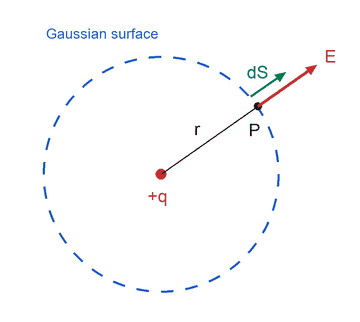
Step 4 — Use symmetry.
Every point of the sphere is the same distance from , so has the same size everywhere on it and points radially outward, along .
Step 5 — Apply Gauss' theorem.
Because is constant and along , the flux is times the area , and it equals .
Step 6 — Find the force on a second charge.
A charge placed at distance feels the force along the line joining the charges.
Therefore, along the line joining the charges, which is Coulomb's law derived from Gauss' law.