
Question 423 marksMedium
(a) Define electric flux. Give its SI unit.
(b) State and prove Gauss' law.
Confirming your payment
Sign up now and get 250 free tokens.
Gauss' Theorem · Question 42 of 60
(a) Define electric flux. Give its SI unit.
(b) State and prove Gauss' law.
Solution:
Key idea: Flux measures the field through a surface; Gauss' theorem says the flux through a closed surface depends only on the charge inside, which we prove with solid angles.
Step 1 — Part (a): define electric flux.
Electric flux through a surface is the surface integral of the electric field over it. It is proportional to the number of lines of force passing normally through the surface, and it is a scalar.
Its SI unit is , which is the same as V m.
Step 2 — Part (b): state Gauss' theorem.
The total electric flux through any closed surface is times the net charge enclosed by that surface.
Step 3 — Set up a closed surface round a point charge.
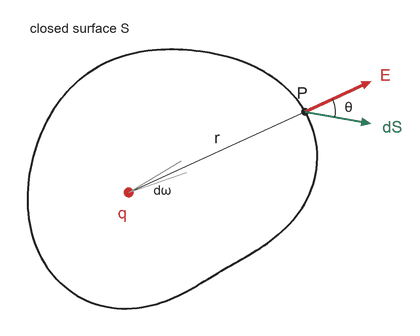
We take a point charge at O inside a closed surface S of any shape, and a small area element of S at a point P, at distance from O.
Step 4 — Flux through the small element.
By Coulomb's law the field at P points along OP and has size
If is the angle between and , the flux through the element is . Putting in :
Step 5 — Bring in the solid angle.
The quantity is the solid angle that the element subtends at O, so the flux through the element is
Step 6 — Add over the whole surface.
A closed surface subtends a total solid angle of steradian at any point inside it, so adding all the elements gives
Step 7 — Charges outside the surface.
For a charge outside S, every thin cone from the charge cuts S twice. Where the cone enters, the flux is ; where it leaves, it is . These cancel, so an outside charge gives zero net flux.
Step 8 — Several charges.
By superposition, the fluxes of charges inside S add, while outside charges give nothing.
This proves Gauss' theorem for a surface of any shape and size.
Therefore, (a) with SI unit , and (b) for any closed surface, as proved.