
Question 131 markMCQEasy
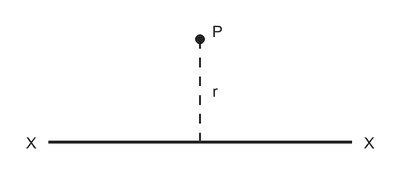
Electric field intensity at point P at a perpendicular distance from an infinitely long linear charge X-X having linear charge density is given by
Confirming your payment
Sign up now and get 250 free tokens.
Gauss' Theorem · Question 13 of 60
Electric field intensity at point P at a perpendicular distance from an infinitely long linear charge X-X having linear charge density is given by
(A)
(B)
(C)
(D)
Answer: (B)
Key idea: For an infinitely long line charge the field is radial and the same at all points a distance from the line, so a coaxial cylinder is the right Gaussian surface.
Step 1 — Choose the Gaussian surface.
We draw a cylinder of radius and length with the line X-X as its axis, so that P lies on its curved surface.
Step 2 — Find the flux through the cylinder.
On the flat ends lies along the surface, so they carry no flux. On the curved surface is along the outward normal and has the same size everywhere.
Step 3 — Apply Gauss' theorem.
The cylinder encloses a length of the line, that is a charge , so we set the flux equal to .
Step 4 — Write it in the form of the options.
Multiplying top and bottom by 2 gives the form.
This is option (B).
Why the other options are wrong:
Therefore, , directed radially away from the line for positive : option (B).