
Opening your dashboard
Class 12 Physics Chapter 2 Gauss' Theorem: Practice Questions
91 questions on Chapter 2, each worked through on its own page with the AI tutor. Class 12 Physics, ICSE 2026-27.
91 questions
1–3 marks · Mixed difficulty
- 11 mark
Question 1
A closed cube has side . The outward area vector of each of its six faces is drawn, and the six area vectors are added. The resultant vector has magnitude
- 23 marks
Question 2
Wind blows steadily at through an open rectangular window . The wind direction makes an angle of with the plane of the window. (Hypothetical data.)
(i) Find the flux of the velocity field through the window, and say what it represents.
(ii) For what angle between the wind and the plane of the window would the flux be ?
- 33 marks
Question 3
A flat triangular surface has its corners at , and , all in metres. A uniform electric field exists in the region.
(i) Find the area vector of the triangle, taking its normal on the side away from the origin. Hence find the area.
(ii) Find the electric flux through the triangle.
- 41 mark
Question 4
A flat sheet in a uniform electric field has electric flux through it. The sheet is now turned through about an axis lying in its own plane, so that its area vector is reversed. The flux through it becomes
- 51 mark
Question 5
The SI unit of electric flux, written in terms of the base units kg, m, s and A, is
- 61 mark
Question 6
A circular disc of radius is placed in a uniform electric field of . The field makes an angle of with the plane of the disc. The electric flux through the disc is about
- 72 marks
Question 7
On a fine day there is an electric field of about near the ground, directed vertically downward. A school playground is a flat horizontal rectangle . (Hypothetical data.)
(i) Taking the normal to the playground pointing upward, find the electric flux through it.
(ii) What would be the flux through a vertical wall of the same area? Give a reason.
- 83 marks
Question 8
A circular wire loop of radius rotates at revolutions per second about one of its diameters in a uniform electric field of . The axis of rotation is perpendicular to the field. At the plane of the loop is perpendicular to the field. (Hypothetical data.)
(i) Write the flux through the loop as a function of time, with numerical values.
(ii) Find the flux at .
(iii) At what earliest time is the flux zero?
- 93 marks
Question 9
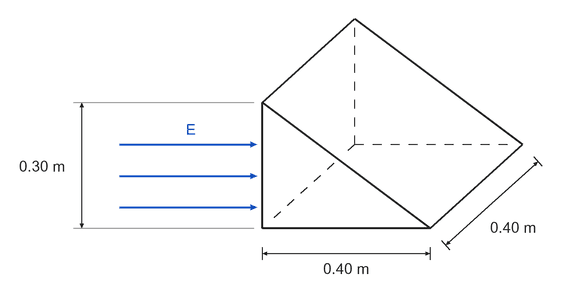
A closed wedge-shaped box (a right triangular prism) stands in a uniform horizontal electric field of along . Its faces are:
- a vertical rectangle high and wide, facing the oncoming field;
- a horizontal base long (along ) and wide;
- a sloping rectangle joining the top edge of the vertical face to the far edge of the base;
- two vertical right-triangular ends, parallel to the field.
(Hypothetical data.) Find the flux through each face and the net flux through the box.
- 101 mark
Question 10
An open hemispherical bowl of radius is placed in a uniform electric field , with the axis of the bowl parallel to . The magnitude of the electric flux through the curved surface of the bowl is
- 111 mark
Question 11
A patch of area is marked on the surface of a sphere of radius . The solid angle that the patch subtends at the centre of the sphere is
- 123 marks
Question 12
A small flat plate of area is from a point charge in air. The normal to the plate makes an angle of with the line joining the charge to the plate. (Hypothetical data.)
(i) Find the solid angle subtended by the plate at the charge.
(ii) Using this solid angle, find the electric flux through the plate.
(iii) What fraction of the total flux from the charge passes through the plate?
(Take .)
- 131 mark
Question 13
A point lies outside a closed surface of irregular shape. The total solid angle subtended by the whole closed surface at is
- 141 mark
Question 14
A point charge lies inside a closed surface , and the electric flux through is . The charge is now moved to a point just outside . The flux through becomes
- 152 marks
Question 15
A thin straight rod long carries a charge of spread uniformly along its length. An imaginary sphere of radius is centred on the midpoint of the rod. (Hypothetical data.)
(i) Find the electric flux through the sphere.
(ii) What would the flux be if the radius of the sphere were ?
(Take .)
- 163 marks
Question 16
Two imaginary concentric spheres (radius ) and (radius ) surround a group of charges. The measured electric flux is through and through . (Hypothetical data.)
(i) Find the net charge inside .
(ii) Find the net charge in the space between and .
(iii) If the charges between the spheres were moved to other places, still between and , would the flux through change? Give a reason.
(Take .)
- 173 marks
Question 17
A closed rectangular box contains a net charge of . The outward electric flux through five of its six faces is measured as , , , and , all in . (Hypothetical data.)
(i) Find the total flux through the box.
(ii) Find the flux through the sixth face, and state whether field lines go in or out through it.
(Take .)
- 183 marks
Question 18
Using the idea of solid angle, show that a point charge lying outside a closed surface produces zero net electric flux through that surface.
- 193 marks
Question 19
A region inside a storm cloud has a roughly uniform charge density . (Hypothetical data.)
(i) Find the electric flux through an imaginary cube of side lying wholly inside this region.
(ii) Find the flux through an imaginary sphere of radius , also wholly inside the region.
(iii) Does the flux through the cube depend on where the cube is placed inside the region? Give a reason.
(Take .)
- 201 mark
Question 20
An electric dipole has dipole moment and its charges are apart. A closed surface is drawn so that it encloses only the positive charge of the dipole. The electric flux through this surface is about ()
- 211 mark
Question 21
A small charged metal sphere is placed inside a closed box, and the electric flux out of the box is . Inside the box it is touched to an identical uncharged metal sphere. The second sphere is then taken out of the box. The flux out of the box is now
- 223 marks
Question 22
In a hydrogen atom the electron may be taken to move at a distance from the proton. Imagine a spherical Gaussian surface of radius centred on the proton.
(i) Find the electric flux through this surface.
(ii) Use Gauss' theorem to find the electric field at the position of the electron.
(iii) Hence find the force on the electron, with its direction.
(Take , , .)
- 231 mark
Question 23
To deduce Coulomb's law from Gauss' theorem, a spherical Gaussian surface is drawn centred on a point charge . The step is valid because, on this surface, the electric field
- 241 mark
Question 24
Using Gauss' theorem, the electric field at from a small charged bead in air is found to be . An identical bead with the same charge is placed with its centre from the first. The force between the beads is (; hypothetical data)
- 253 marks
Question 25
In an experiment to test the inverse-square law, the electric field of a small charged ball is measured in air at two distances from its centre: at and at , both directed away from the ball. ()
(a) Taking the field as radial and the same all round the ball, find the electric flux through spheres of radius and centred on it.
(b) What do your two answers show about the way the field changes with distance?
(c) Find the charge on the ball.
(Hypothetical data.)
- 261 mark
Question 26
A point charge in air sends a total flux through a sphere of radius centred on it. The magnitude of the electric field at a distance from the charge is
- 273 marks
Question 27
A point charge is at the centre of a spherical Gaussian surface of radius . Another charge is placed just outside the surface.
(a) Is the total flux through the sphere still ? Give a reason.
(b) Can we still write and get the field on the sphere as ? Explain.
- 281 mark
Question 28
The electric field at from a very long, uniformly charged straight wire is . The field at from the wire is
- 291 mark
Question 29
At a distance , the electric field of a very long straight wire with linear charge density has the same magnitude as the field of a point charge at the same distance . Then equals
- 303 marks
Question 30
Two very long, straight, parallel wires are apart in air. Wire carries and wire carries . ()
(a) Find the point between the wires, in their common plane, where the electric field is zero.
(b) Find the magnitude and direction of the field at the midpoint between the wires.
(Hypothetical data.)
- 313 marks
Question 31
At a point from a very long, uniformly charged straight wire, the electric field is and points towards the wire. (, , )
(a) Find the linear charge density of the wire, with its sign.
(b) A proton is placed from the wire. Find the force on it.
(c) Find the proton's acceleration at that instant, with its direction.
(Hypothetical data.)
- 322 marks
Question 32
(a) The field near a very large, uniformly charged plane sheet, , does not depend on the distance from the sheet. Explain this in terms of field lines.
(b) A charged square plate has sides of . Will its field be the same at and at from its centre? Give a reason.
- 333 marks
Question 33
A small ball of mass carrying a charge of hangs from a light silk thread close to a very large vertical sheet. The sheet carries a uniform charge density of . The thread settles at an angle to the vertical, as shown. (, )
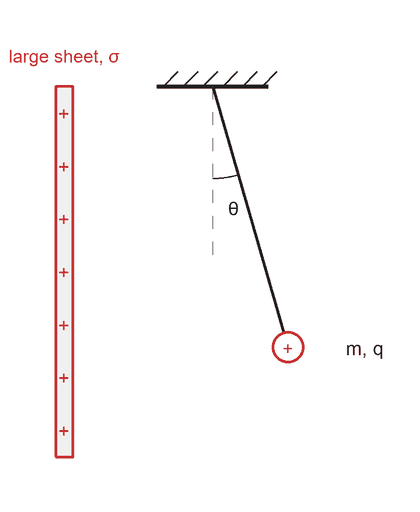
(a) Find the electric field due to the sheet at the ball.
(b) Find the angle .
(c) Find the tension in the thread.
(Hypothetical data.)
- 343 marks
Question 34
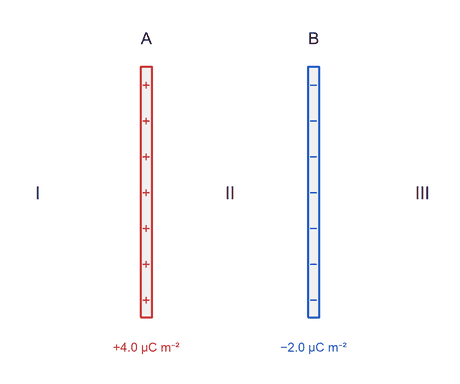
Two very large, thin, parallel sheets and carry uniform charge densities and , as shown. Find the magnitude and direction of the electric field in regions I, II and III. ()
(Hypothetical data.)
- 351 mark
Question 35
Three very large, thin, parallel sheets , and are placed in this order from left to right. They carry uniform charge densities , and respectively. The electric field at a point between and is
- 363 marks
Question 36
Two very large, thin, parallel plane sheets carry equal and opposite uniform charge densities. The field between them is . ()
(a) Find the charge density on each sheet.
(b) What is the field outside the pair of sheets?
(c) The negative sheet is taken away and the positive sheet keeps its charge. What is the field near it now?
(Hypothetical data.)
- 371 mark
Question 37
A very large thin sheet with uniform positive charge density lies in the -plane (). is the -component of the electric field. As we cross the sheet from slightly negative to slightly positive, the change in is
- 382 marks
Question 38
Just outside the surface of a charged conductor, the field is (Coulomb's theorem). Near a thin, non-conducting sheet with the same charge density , it is only . Using a small cylindrical Gaussian surface in each case, explain why the two results differ.
- 393 marks
Question 39
Air stops being an insulator (it breaks down and sparks) when the electric field in it reaches about . ()
(a) Find the largest surface charge density a conductor in air can hold.
(b) Find the largest charge a metal sphere of radius can hold in air.
(c) Find the largest charge for a metal sphere of radius , and use the result to say why charge leaks away from sharp points of a conductor.
(Hypothetical data.)
- 403 marks
Question 40
A large, uncharged metal slab is placed in a uniform electric field of , with its faces perpendicular to the field. ()
(a) What is the electric field inside the material of the slab?
(b) Find the charge density induced on each face, with its sign.
(c) Show that the field just outside each face is consistent with Coulomb's theorem.
(Hypothetical data.)
- 411 mark
Question 41
Just outside a point on the surface of a charged metal body, the electric field is , directed into the surface. The surface charge density at that point is (; hypothetical data)
- 421 mark
Question 42
A non-conducting sphere of radius has charge spread uniformly through its volume. The electric field at its surface is . The field has the value at distances from the centre of
- 433 marks
Question 43
Two thin, concentric, spherical shells have radii and . The inner shell carries and the outer shell carries , each spread uniformly. Find the magnitude and direction of the electric field at distances of (a) , (b) and (c) from the centre. ()
(Hypothetical data.)
- 441 mark
Question 44
A non-conducting sphere of radius has charge spread uniformly through its volume. The electric field at its surface is . The volume charge density is (; hypothetical data)
- 453 marks
Question 45
A thin spherical shell and a solid non-conducting sphere have the same radius and the same total charge , spread uniformly (over the surface of the shell; through the volume of the sphere). Let . Using Gauss' theorem, compare the fields of the two at distances (a) , (b) and (c) from the centre.
- 461 mark
Question 46
A charged soap bubble of radius is blown up to radius ; its charge stays the same. is a point from the centre. The electric field at
- 471 mark
Question 47
Gaussian surface should not pass through any charge. Why?
- 481 mark
Question 48
If Coulomb's law involved dependence instead of would Gauss' law be still true?
- 492 marks
Question 49
Suppose the distribution of charge is changed inside a Gaussian surface without changing the total charge. Will there be any change in the electric intensity inside or outside the Gaussian surface?
- 502 marks
Question 50
The charge enclosed by a Gaussian surface is zero. Does it mean that on its surface?
- 512 marks
Question 51
Suppose the net flux through a Gaussian surface is zero, which of the following statements are true?
(i) The net charge inside the surface is zero.
(ii) The electric field is zero everywhere.
(iii) There are no charges inside the surface.
- 522 marks
Question 52
What happens to the total flux through a spherical Gaussian surface surrounding a point charge when (i) the volume of the sphere is doubled and (ii) the charge is moved to another location inside the surface.
- 533 marks
Question 53
If the electric field is given by , calculate the electric flux through a surface of area 20 units in YZ-plane.
- 541 mark
Question 54
What is the Gaussian surface?
- 551 mark
Question 55
State Gauss' theorem in electrostatics.
- 561 mark
Question 56
A Gaussian surface is chosen to obtain an expression for the electric field at a point due to a given charge configuration. It is a closed surface. State one essential property of such a chosen Gaussian surface.
- 571 mark
Question 57
The unit of electrostatic field is volt/metre. Obtain the unit of electric flux.
- 582 marks
Question 58
A point charge of is at the centre of a cubic Gaussian surface 9.0 cm on edge. What is the net electric flux through the surface?
- 592 marks
Question 59
An infinite line charge produces a field of at a distance of 2 cm. Calculate the linear charge density.
- 602 marks
Question 60
Draw a graph showing the variation of electric field as one moves from the centre of a charged metal ball to a point on its surface and then to a far off outside point.
- 611 mark
Question 61
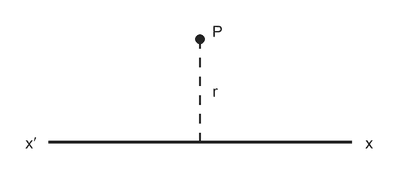
Electric field intensity at a point P at a perpendicular distance from an infinitely long line charge having linear charge density is given by
- 621 mark
Question 62
Two parallel infinite line charges with linear charge densities and are placed at a distance of in free space. What is the electric field midway between the two line charges?
- 631 mark
Question 63
A charge is located at the centre of a cube. The electric flux through any face is
- 641 mark
Question 64
In finding the electric field using Gauss law the formula is applicable. In this formula, is the permittivity of free space, is the area of the Gaussian surface and is the charge enclosed by the surface. The equation can be used in which of the following situations?
- 651 mark
Question 65
The total electric flux through a cube when a charge is placed at one corner of the cube is
- 661 mark
Question 66
Charge motion within the Gaussian surface gives changing physical quantity
- 671 mark
Question 67
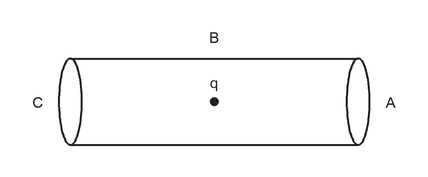
A hollow cylinder has a charge coulomb within it. If is the electric flux (in units of volt-metre) associated with the curved surface B, the flux linked with the plane surface A (in units of volt-metre) will be
- 681 mark
Question 68
Gauss law is valid for
- 691 mark
Question 69
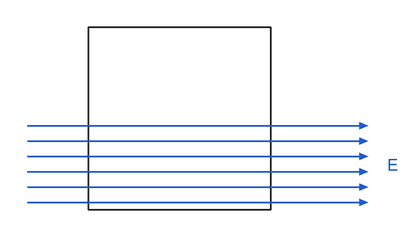
A square surface of side metre is in the plane of the paper. A uniform electric field volt/m, also in the plane of the paper, is limited only to the lower half of the square surface. The electric flux in SI unit associated with the surface is
- 701 mark
Question 70
Consider the charge configuration and spherical Gaussian surface. When calculating the flux of the electric field over the spherical surface the electric field will be due to

- 711 mark
Question 71
The given figure shows a distribution of charges. The flux of electric field due to these charges through the surface S is

- 721 mark
Question 72
Charge is enclosed by a Gaussian spherical surface of radius . If the radius is doubled, then the outward electric flux will
- 731 mark
Question 73
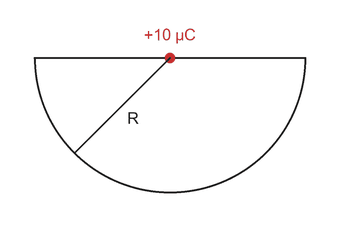
A charge is placed at the centre of a hemisphere of radius as shown in the given figure. The electric flux through the hemisphere (in MKS unit) is
- 741 mark
Question 74
The electric field in a certain region is acting radially outward and is given by . A charge contained in a sphere of radius , centred at the origin of the field will be given by
- 751 mark
Question 75
Consider an electric field where is a constant. The flux through the shaded area due to the field is

- 761 mark
Question 76
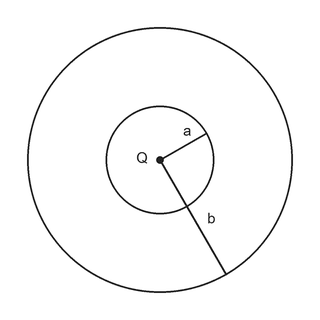
The region between two concentric spheres of radii and respectively has volume charge density where is a constant and is the distance from the centre. At the centre of the spheres, there is a point charge . The value of such that the electric field in the region between the spheres will be constant, is
- 771 mark
Question 77
Let there be a spherically symmetric charge distribution with charge density varying as up to and for where is the distance from the origin. The electric field at a distance from the origin is given by
- 781 mark
Question 78
The electric field at a distance from the centre of a charged conducting spherical shell of radius is . The electric field at a distance from the centre of the sphere is
- 791 mark
Question 79
A point charge causes an electric flux of to pass through a spherical Gaussian surface of radius centred on the charge. If the radius of the Gaussian surface were three times, how much flux would pass through the surface?
- 801 mark
Question 80
If the electric flux entering and leaving an enclosed surface respectively is and then, the electric charge inside the surface will be
- 811 mark
Question 81
The electric intensity due to an infinite cylinder of radius and having charge per unit length at a distance from its axis is
- 821 mark
Question 82
A sphere of radius has a volume density of charge , where is the distance from the centre of the sphere and is constant. The magnitude of the electric field which exists at the surface of the sphere is given by ( = permittivity of the free space)
- 831 mark
Question 83
According to Gauss' theorem, electric field of an infinitely long straight wire is proportional to
- 841 mark
Question 84
Find out the surface charge density at the intersection of point plane and x-axis in the region of uniform line charge of lying along the z-axis in free space.
- 851 mark
Question 85
An electric dipole is placed on x-axis in proximity to a line charge of linear charge density . Line charge is placed on z-axis and positive and negative charge of dipole is at a distance of and from the origin respectively. If the total force of is exerted on the dipole, find out the amount of positive or negative charge of the dipole.
- 861 mark
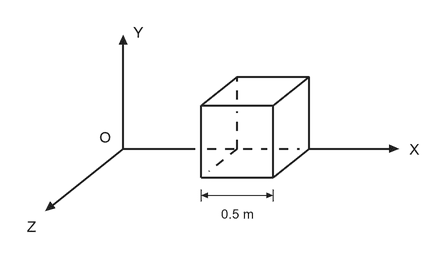
Question 86
A cube is placed inside an electric field, . The side of the cube is and is placed in the field as shown in the given figure. The charge inside the cube is
- 871 mark
Question 87
Choose the incorrect statement.
A. The electric lines of force entering into a Gaussian surface provide negative flux.
B. A charge is placed at the centre of the cube. The flux through all the faces will be the same.
C. In a uniform electric field net flux through a closed Gaussian surface containing no net charge is zero.
D. When electric field is parallel to a Gaussian surface, it provides a finite non-zero flux.
Choose the most appropriate answer from the options given below.
- 881 mark
Question 88
A charge is placed at one corner of a cube. The flux of electrostatic field through the shaded area is

- 891 mark
Question 89
Two infinitely long parallel wires having linear charge densities and respectively are placed at a distance of metres. The force per unit length on either wire will be
- 901 mark
Question 90
The electric flux emanating from a sphere of radius is . If the radius of the sphere be made four times, without changing the charge enclosed, the electric flux would
- 911 mark
Question 91
The surface charge density of a large conducting sheet is . The electric field intensity at a point just outside the sheet is