
Opening your dashboard
Class 12 Physics Chapter 2 Gauss' Theorem: Previous Year Questions
10 questions on Chapter 2, each solved step by step. Class 12 Physics, ICSE 2026-27.
10 questions with solutions
1–3 marks · Mixed difficulty
- 11 mark
Question 1
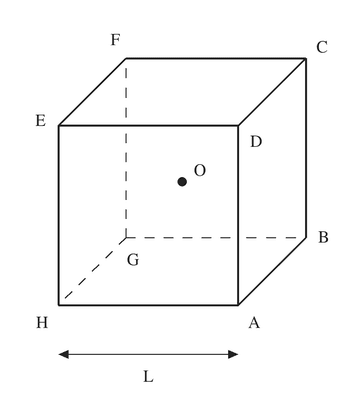
A short electric dipole (which consists of two point charges, and ) is placed at the centre O and inside a large cube (ABCDEFGH) of length L, as shown in Figure 1. The electric flux, emanating through the cube is:
 Solve with AI
Answer
(A)
- Correct
(B) zero
(C)
(D)
Answer: (B) zero
Key idea: By Gauss' theorem, the total electric flux through any closed surface is , where is the total (net) charge inside the surface. The size and shape of the surface do not matter.
Step 1 — Find the net charge inside the cube.
The whole dipole, both and , lies inside the cube, so we add the two charges.
Step 2 — Apply Gauss' theorem.
The flux through the closed surface of the cube is the net enclosed charge divided by .
Field lines do leave the cube near and enter it near , but the outward and inward fluxes are equal, so the total is zero.
Why the others are wrong:
- (A) This has the form of the potential of one charge at a distance ; flux does not depend on , and the net charge inside is zero anyway.
- (C) This also depends on the side and counts only one charge; Gauss' theorem gives a flux that is independent of the size of the surface.
- (D) This again depends on , but the flux through a closed surface depends only on the net enclosed charge, which is zero here.
Therefore, the correct option is (B): the flux is zero.
- 22 marks
Question 2
(i) State Gauss' Law.
(ii) In an electric dipole, at which point is the electric potential zero?
Solve with AIWritten solution
Solution:
Key idea: (i) Gauss' law links the flux through a closed surface to the charge inside it. (ii) The potential of a dipole at a point is the sum of and ; it is zero wherever the point is equally far from both charges.
Step 1 — (i) State Gauss' law.
Gauss' law states that the total electric flux through any closed surface is equal to times the total charge enclosed by that surface.
Here is the field at the surface element , is the net charge inside the surface and is the permittivity of free space.
Step 2 — (ii) Write the potential of the dipole at a point.
Let the point be at a distance from and from . Potentials are scalars, so they simply add.
Step 3 — (ii) Find where it is zero.
The bracket is zero when equals , that is, at every point equally far from the two charges. These points form the perpendicular bisector of the dipole axis.
Therefore, (i) the total flux through a closed surface is ; (ii) the potential of a dipole is zero at every point on its equatorial line (the perpendicular bisector plane of the dipole), including its centre.
- 31 mark
Question 3
Intensity of electric field at a perpendicular distance of from an infinitely long line charge having linear charge density () is . Find the value of .
Solve with AIWritten solution
Solution:
Key idea: By Gauss' theorem, an infinitely long line charge of linear charge density gives a field at a perpendicular distance . We rearrange this for .
Step 1 — Write the formula in terms of .
We write for the constant . Its value is , and is twice it, .
Step 2 — Make the subject.
We multiply both sides by and divide by .
Step 3 — Substitute the values.
Here is and is .
Therefore, .
- 41 mark
Question 4
A closed surface in vacuum enclose charges and . The total electric flux emerging out of the surface is
Solve with AIAnswer
(A) Zero
- Correct
(B)
(C)
(D)
Answer: (B)
Key idea: Gauss' theorem says the total flux out of a closed surface is , where is the algebraic sum of the charges inside, signs included.
Step 1 — Add the enclosed charges with their signs.
The surface encloses and .
Step 2 — Apply Gauss' theorem.
We divide the net enclosed charge by .
Why the others are wrong:
- (A) Zero would need the enclosed charges to cancel, but and leave a net charge of .
- (C) The value counts only the charge and ignores the inside the surface.
- (D) The value adds the sizes and forgets that one charge is negative.
Therefore, the correct option is (B): the flux is .
- 51 mark
Question 5
State 'Gauss' theorem
Solve with AIWritten solution
Solution:
Key idea: Gauss' theorem connects the electric flux through a closed surface with the charge enclosed by it.
Step 1 — State the theorem in words.
Gauss' theorem states that the total electric flux through any closed surface (a Gaussian surface) in vacuum is equal to times the net charge enclosed by the surface.
Step 2 — Write it as an equation.
The flux is the surface integral of the field over the closed surface, and Gauss' theorem sets it equal to the enclosed charge over .
Here is the field at the surface element , is the algebraic sum of the charges inside, and is the permittivity of free space. Charges outside the surface add nothing to the total flux.
Therefore, : the total flux through a closed surface is times the net charge it encloses.
- 61 mark
Question 6
A hollow sphere of radius R has a point charge Q at its centre. Electric flux emanating from it is . If both the charge and the radius of the sphere be doubled, electric flux emanating from the sphere will:
Solve with AIAnswer
(A) Remain the same.
- Correct
(B) Become
(C) Become
(D) Become
Answer: (B) Become
Key idea: By Gauss' theorem the flux through a closed surface is . It depends only on the charge enclosed, not on the size of the surface.
Step 1 — Write the original flux.
The sphere encloses the charge , so Gauss' theorem gives:
Step 2 — Write the new flux.
The new charge is . The radius does not appear in Gauss' theorem, so it has no effect.
Why the others are wrong:
- (A) The flux would stay the same only if the charge stayed the same; doubling the charge doubles the flux.
- (C) The value comes from doubling once for the charge and again for the radius (flux taken to grow like ), but the radius has no effect on the flux.
- (D) The value comes from doubling for the charge and multiplying by four for the area (flux taken to grow like ); the field at the surface falls by the same factor of four, so the area cancels out.
Therefore, the correct option is (B): the flux becomes .
- 72 marks
Question 7
(i) A hollow sphere of radius R has a point charge q at its centre. Electric flux emanating from the sphere is X. How will the electric flux change, if at all, when radius of the sphere is doubled?
(ii) A hollow sphere of radius R has a point charge q at its centre. Electric flux emanating from the sphere is X. How will the electric flux change, if at all, when charge q is replaced by an electric dipole?
Solve with AIWritten solution
Solution:
Key idea: Gauss' theorem gives the flux through a closed surface as . It depends only on the net charge inside, not on the size or shape of the surface.
Step 1 — Write the original flux.
The sphere encloses the charge , so:
Step 2 — (i) Double the radius.
The charge inside is still , and the radius does not appear in Gauss' theorem. The field at the surface becomes four times smaller, but the area becomes four times larger, so the flux stays the same.
Step 3 — (ii) Replace by a dipole.
A dipole is a pair of charges and , so the net charge enclosed is zero.
Therefore, (i) the flux does not change (it stays ); (ii) the flux becomes zero, because the net charge of a dipole is zero.
- 82 marks
Question 8
In case of an infinite line charge, how does intensity of electric field at a point change, if at all, when.
a. charge on it is doubled?
b. distance of the point is halved?
Solve with AIWritten solution
Solution:
Key idea: By Gauss' theorem, an infinite line charge of linear charge density gives a field at a perpendicular distance . So is directly proportional to and inversely proportional to .
Step 1 — Write the field.
We start from the field of an infinite line charge found with Gauss' theorem.
Step 2 — (a) Double the charge.
Doubling the charge on the line (same length) doubles . Since :
Step 3 — (b) Halve the distance.
We put in place of :
Watch out: For a line charge the field falls as , not as as for a point charge, so halving the distance doubles the field (it does not make it four times).
Therefore, (a) the intensity becomes double; (b) the intensity also becomes double.
- 93 marks
Question 9
An infinite plane metallic sheet having surface charge density '' is placed in vacuum. P is a point at a small distance '' to its right.
(i) Write an expression for intensity of electric field at point P.
(ii) Now, an identical charged sheet having surface charge density '' is placed parallel to the first sheet such that the point P is to its left at the same distance ''. (The point P lies between the two plates.)
(a) What is the resultant intensity of electric field at point P?
(b) What is its direction?
Solve with AIWritten solution
Solution:
Key idea: Using Gauss' theorem, a large (infinite) plane sheet of charge with surface density gives a uniform field on each side. The field points away from a positive sheet and towards a negative sheet. With two sheets we add the two fields as vectors.
Step 1 — (i) Field due to the first sheet.
For the infinite sheet with density , the field at P does not depend on the distance .
It points away from the positive sheet, that is, to the right at P.
Note: We treat the sheet as a thin sheet of charge, as the question intends. If the charge sat on only one face of a thick metal plate, the field just outside that face would be instead.
Step 2 — (ii)(a) Field due to the second sheet.
The second sheet has density and lies to the right of P. Its field has the same size and points towards it, that is, also to the right at P.
Step 3 — (ii)(a) Add the two fields.
Both fields at P point the same way, so their sizes add.
Step 4 — (ii)(b) Direction.
The resultant field is perpendicular to the sheets, directed from the positive sheet towards the negative sheet (to the right at P). Outside the pair of sheets the two fields are opposite and cancel.
Therefore, (i) , directed away from the sheet; (ii)(a) ; (ii)(b) perpendicular to the sheets, from the sheet towards the sheet.
- 102 marks
Question 10
Four-point charges , , and are kept as shown in Figure 1 below.

Calculate electric flux emanating from the closed surface S.
Solve with AIWritten solution
Solution:
Key idea: By Gauss' theorem, the flux through a closed surface is , where only the charges inside the surface are counted. Charges outside send in as much flux as they send out.
Step 1 — Pick out the charges inside S.
From the figure, and lie inside the surface S, while and lie outside it. So only and count.
Step 2 — Apply Gauss' theorem.
We take as .
Watch out: The charges and are close to S but outside it, so they add nothing to the total flux.
Therefore, the electric flux emanating from S is .