
Question 11 markMCQAsked 2015Easy
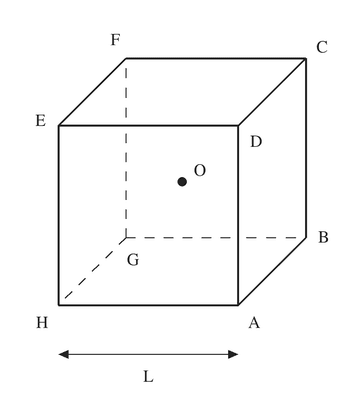
A short electric dipole (which consists of two point charges, and ) is placed at the centre O and inside a large cube (ABCDEFGH) of length L, as shown in Figure 1. The electric flux, emanating through the cube is:
Confirming your payment
Sign up now and get 250 free tokens.
Previous Year Questions · Question 1 of 10
A short electric dipole (which consists of two point charges, and ) is placed at the centre O and inside a large cube (ABCDEFGH) of length L, as shown in Figure 1. The electric flux, emanating through the cube is:
(A)
(B) zero
(C)
(D)
Answer: (B) zero
Key idea: By Gauss' theorem, the total electric flux through any closed surface is , where is the total (net) charge inside the surface. The size and shape of the surface do not matter.
Step 1 — Find the net charge inside the cube.
The whole dipole, both and , lies inside the cube, so we add the two charges.
Step 2 — Apply Gauss' theorem.
The flux through the closed surface of the cube is the net enclosed charge divided by .
Field lines do leave the cube near and enter it near , but the outward and inward fluxes are equal, so the total is zero.
Why the others are wrong:
Therefore, the correct option is (B): the flux is zero.