
Opening your dashboard
Class 12 Physics Chapter 2 Gauss' Theorem: Competency-Based Questions (CBQ)
40 questions on Chapter 2, each worked through on its own page with the AI tutor. Class 12 Physics, ICSE 2026-27.
40 questions
1–5 marks · Mixed difficulty
- 13 marks
Question 1
Competency: Application
Water flows steadily through a straight pipe of radius . Every bit of water moves parallel to the axis of the pipe with the same speed, . Two imaginary flat surfaces cut right across the pipe: surface is perpendicular to the axis, and surface is a slanting cut whose plane makes an angle of with the axis.
(a) Find the flux of the velocity field () through surface . What does this flux measure?
(b) Find the area of surface and the flux of the velocity field through it.
(c) A hollow plastic tube of the same radius lies in a uniform electric field of directed along its axis. Find the electric flux through a slanting cut like , and state what the results of (a)–(c) show about flux.
(Hypothetical data.)
- 21 mark
Question 2
Competency: Analysis & Evaluation
A student turns a small flat card in a uniform electric field and records the electric flux through it for different positions.
Assertion (A): The flux through the card is greatest when its area vector is parallel to the electric field.
Reason (R): The area vector of a flat surface lies in the plane of the surface.
- 31 mark
Question 3
Competency: Application
A cubical sensor box of side has one corner at the origin and edges along the -, - and -axes. It stands in a uniform electric field of directed along the body diagonal of the cube, from the origin towards the corner . The total electric flux leaving the cube through its three faces , and is (in ) (Hypothetical data.)
- 41 mark
Question 4
Competency: Analysis & Evaluation
A flat circular ring is held in a uniform electric field with its area vector at to the field. The ring is then turned slowly about an axis drawn parallel to the field, so that its area vector keeps making with the field.
Assertion (A): The electric flux through the ring stays the same while it is being turned.
Reason (R): The flux through a flat surface in a uniform field is , where is the angle between the area vector and the field.
- 51 mark
Question 5
Competency: Analysis & Evaluation
A student holds a small square card facing a tiny lamp, first from it and then from it, always with the card perpendicular to the line joining it to the lamp.
Assertion (A): The card subtends the same solid angle at the lamp in both positions, because its area has not changed.
Reason (R): The solid angle subtended at a point by a small area is , where is its distance from the point and is the angle between its normal and the line joining it to the point.
- 61 mark
Question 6
Competency: Application
Members of a school astronomy club project an image of the Sun and find that the Sun's disc has an angular diameter of as seen from the Earth. Treating the disc as a small flat circle, the solid angle the Sun subtends at the Earth is about
- 73 marks
Question 7
Competency: Application
On a calm, clear day a weather balloon measures the atmospheric electric field. Near the ground the field is , and at a height of it is ; at both places it points vertically downward. Over this flat region the field is the same at every point at a given height. Consider an imaginary closed box with a horizontal base of area just above the ground and a top face at a height of . (, )
(a) Find the outward electric flux through the top face, the bottom face and the side faces of the box.
(b) Find the net charge inside the box and state its sign.
(c) Find the average charge per cubic metre of air in the box, and the number of excess singly-charged ions per cubic metre that this represents.
(Hypothetical data.)
- 83 marks
Question 8
Competency: Application
In a laboratory, a narrow beam of singly-charged positive ions is fired into an insulated metal cup (a Faraday cup), where the ions are stopped and stay. The beam current is . An imaginary closed surface is drawn round the whole cup. At the start the cup is uncharged. (, )
(a) Find the net electric flux through after .
(b) At what rate does the flux through increase?
(c) How many ions have been collected in the ? Would the flux in (a) be different if the collected charge spread over the cup's surface instead of staying where the ions stopped? Give a reason.
(Hypothetical data.)
- 91 mark
Question 9
Competency: Application
A bare uranium-238 nucleus () sits at the centre of a tiny imaginary sphere. The nucleus emits an alpha particle (a helium nucleus, , mass number ), which flies out through the sphere. After the alpha particle has left, the net electric flux through the sphere is (, )
- 101 mark
Question 10
Competency: Analysis & Evaluation
Assertion (A): A result like Gauss' theorem holds for the gravitational field: the flux of the gravitational field through any closed surface depends only on the mass enclosed by it.
Reason (R): The gravitational force between two point masses, like the electric force between two point charges, is directed along the line joining them and varies inversely as the square of the distance between them.
- 113 marks
Question 11
Competency: Analysis & Evaluation
To test whether Coulomb's law is exactly inverse-square, a physicist charges an insulated hollow metal sphere of radius with . A small metal ball inside the hollow is joined to the sphere by a thin wire. Afterwards the ball is taken out through a small hole and tested: it carries no charge at all, even with a very sensitive detector. ()
(a) Using Gauss' theorem, show that the electric field in the hollow of the charged sphere is zero.
(b) Find the electric field just outside the sphere.
(c) Explain why finding no charge on the inner ball supports the inverse-square law.
(Hypothetical data.)
- 123 marks
Question 12
Competency: Application
A Geiger–Müller counter has a thin central wire of radius along the axis of a metal tube of inner radius . The wire carries a uniform charge of and the tube an equal negative charge. When radiation frees an electron in the gas, the electron is pulled towards the wire; it can knock out more electrons (start an avalanche) only where the field is at least . Treat the wire as a long line charge. ()
(a) Using a suitable Gaussian surface, write the field at distance from the axis, between the wire and the tube. Why does the charge on the tube not affect it?
(b) Find the field at the surface of the wire and at the inner surface of the tube.
(c) Within what distance of the axis can an avalanche start?
(Hypothetical data.)
- 133 marks
Question 13
Competency: Analysis & Evaluation
A long, straight electron beam in a vacuum tube has a circular cross-section of radius . Its charge, per metre of length, is spread uniformly through the volume of the beam. (, )
(a) Using a coaxial Gaussian cylinder, find the electric field at from the axis of the beam.
(b) Find the electric field at from the axis.
(c) Find the force on an electron at the edge of the beam, and explain why the beam tends to spread out as it travels.
(Hypothetical data.)
- 141 mark
Question 14
Competency: Application
In a photocopier, a long, thin charging wire carries a uniform charge of . A toner grain carrying is from the wire, far from its ends. The electric force on the grain is (; hypothetical data)
- 151 mark
Question 15
Competency: Analysis & Evaluation
A student wants the electric field at a point from the middle of a uniformly charged rod that is only long.
Assertion (A): A coaxial cylindrical Gaussian surface gives the exact field at this point as .
Reason (R): For an infinitely long uniform line charge, the field is radial, so no flux passes through the flat ends of a coaxial Gaussian cylinder.
- 163 marks
Question 16
Competency: Application
In a Millikan-type experiment, a tiny oil drop of mass carrying a charge of is held at rest in air between two very large horizontal sheets. The upper sheet carries a uniform charge density and the lower sheet . (, ; neglect the buoyancy of air.)
(a) Write the magnitude and direction of the field between the sheets and outside them, in terms of .
(b) Find .
(c) The charge density of the upper sheet alone is now doubled to . Find the acceleration of the drop just after the change.
(Hypothetical data.)
- 171 mark
Question 17
Competency: Application
In a vacuum chamber, a very large thin plastic sheet carries a uniform charge density of . An electron is released from rest from the middle of the sheet. Its speed just before it strikes the sheet is about (, , ; hypothetical data)
- 181 mark
Question 18
Competency: Analysis & Evaluation
Assertion (A): Two very large parallel sheets carrying uniform charge densities and produce no electric field in the regions outside the pair.
Reason (R): The total charge on the two sheets together is zero.
- 193 marks
Question 19
Competency: Application
A field mill measures the electric field at the ground. Its sensor is a flat, earthed metal plate of area , set flush with the ground; a rotating cover keeps exposing it to the field, and the instrument measures the charge induced on the exposed plate. ()
(a) Explain why, when exposed, the plate has an induced charge only on its upper face, with , where is the field just above it.
(b) In fair weather the field is , vertically downward. Find the charge on the exposed plate and state its sign.
(c) Under a thundercloud, the induced charge is found to be . Find the magnitude and direction of the field.
(Hypothetical data.)
- 203 marks
Question 20
Competency: Analysis & Evaluation
An insulated, uncharged hollow metal sphere of outer radius has a small hole at the top. A small metal ball carrying , hung on a silk thread, is lowered through the hole into the hollow without touching the sphere. ()
(a) Using a Gaussian surface drawn inside the metal of the sphere, find the charges on the inner and outer surfaces of the sphere.
(b) The ball is now made to touch the inside of the sphere. What are the charges on the ball, the inner surface and the outer surface afterwards?
(c) Find the surface charge density on the outer surface and the electric field just outside it.
(Hypothetical data.)
- 211 mark
Question 21
Competency: Analysis & Evaluation
Assertion (A): Just outside the surface of a charged conductor in electrostatic equilibrium, the electric field is normal to the surface at every point.
Reason (R): Inside the material of a conductor in electrostatic equilibrium, the volume charge density is zero.
- 221 mark
Question 22
Competency: Analysis & Evaluation
A delicate instrument is kept inside a thick, uncharged, spherical metal shell. By accident a small charge gets into the cavity at its centre. Later the charge drifts to a point near the cavity wall, without touching it. Compared with before, the electric field outside the shell
- 233 marks
Question 23
Competency: Application
In an alpha-scattering experiment, a gold nucleus () is modelled as a sphere of radius with its charge spread uniformly through its volume. (, )
(a) Find the electric field at the surface of the nucleus.
(b) Using Gauss' theorem, find the field at a point halfway between the centre and the surface.
(c) Find the force on an alpha particle (charge ) when it is from the centre.
(Hypothetical data.)
- 241 mark
Question 24
Competency: Application
On a fine day, the electric field just above the Earth's surface is about , directed vertically downward everywhere. Treating the Earth as a conducting sphere of radius , its total charge is about (; hypothetical data)
- 251 mark
Question 25
Competency: Analysis & Evaluation
Assertion (A): At any point outside a charged metal sphere, the electric field is the same as if all its charge were placed at its centre.
Reason (R): The charge given to a metal sphere collects at its centre.
- 263 marks
Question 26
In a region the electric field is , where and . A square of side lies in the -plane with corners at , , and ; its normal is along . (Hypothetical data.)
(i) Explain why cannot be used directly here.
(ii) Find the electric flux through the square by integration.
- 274 marks
Question 27
A point charge is placed on the axis of a flat circular disc of radius , at a distance of from its centre. The solid angle subtended at a point by a circular disc whose rim makes a half-angle with the axis is . (Hypothetical data.)
(i) Find and the solid angle subtended by the disc at the charge.
(ii) Find the electric flux through the disc.
(iii) The disc is moved along the axis to from the charge. Find the new flux.
(Take .)
- 283 marks
Question 28
A very long straight wire carries a uniform positive charge of . An electron moves in a circle round the wire, in a plane perpendicular to it, held only by the electric force. (, , )
(a) Show that the speed of the electron does not depend on the radius of its circle.
(b) Find this speed.
(c) Find the time for one revolution when the radius is .
(Hypothetical data.)
- 294 marks
Question 29
A non-conducting sphere of radius carries a charge of spread uniformly through its volume. A narrow tunnel is drilled along a diameter, and an electron is released from rest in the tunnel at from the centre. (, , ; ignore the effect of the tunnel on the field.)
(a) Find the force on the electron at the moment it is released.
(b) Show that the electron moves in simple harmonic motion along the tunnel.
(c) Find the period of this motion.
(d) Find the electron's speed as it passes the centre.
(Hypothetical data.)
- 303 marks
Question 30
A point charge is located at the centre of a cube of side 1 m. Calculate the electric flux through each face of the cube.
- 313 marks
Question 31
An electric flux of passes through a spherical Gaussian surface of radius 10 cm due to a point charge placed at the centre.
(a) What is the charge enclosed by the Gaussian surface?
(b) If the radius of the Gaussian surface is doubled, how much flux would pass through the surface?
- 323 marks
Question 32
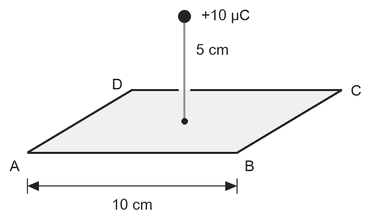
A point charge is at a distance 5 cm directly above the centre of a square of side 10 cm as shown in the given figure. What is the magnitude of electric flux through the square?
- 334 marks
Question 33
A uniformly charged conducting sphere of 2.4 m diameter has a surface charge density of . (a) Find the charge on the sphere. (b) What is the total electric flux leaving the surface of the sphere?
- 343 marks
Question 34
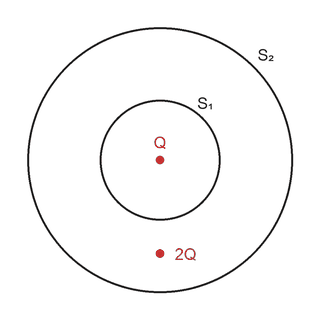
and are two concentric spheres enclosing charges and as shown in the given figure. (a) What is the ratio of the electric flux through and ? (b) How will the electric flux through the sphere change, if a medium of dielectric constant 5 is introduced in the space inside in place of air?
- 353 marks
Question 35
An infinite line charge produces a field of at a distance of 4 cm. Calculate the linear charge density.
- 363 marks
Question 36
Careful measurement of the electric field at the surface of a black box indicated that the net outward flux through the surface of the box is . (a) What is the net charge inside the box? (b) If the net outward flux through the surface of the box were zero, could you conclude that there were no charges inside the box? Why and why not?
- 373 marks
Question 37
(a) A conducting sphere of radius 0.10 m has an unknown charge. If the electric field 0.20 m from the centre of the sphere is and points radially inward, what is the net charge on the sphere? (b) Calculate the electric flux.
- 383 marks
Question 38
A conductor A with a cavity, as shown in the given figure, is given a charge. Show that the charge must appear on the outer surface of the conductor.

- 393 marks
Question 39
Derive the expression for the electric field at any point inside a spherically symmetric uniform charge distribution, applying Gauss' law.
- 405 marks
Question 40
Competency: Analysis & Evaluation
Newton's law of gravitation, like Coulomb's law, is an inverse-square law. So Gauss' theorem has a gravitational form: for any closed surface, , where is the mass enclosed by the surface. The Kolar Gold Fields in Karnataka, closed in 2001, had mine shafts more than 3 km deep. A survey team measures the acceleration due to gravity at the top of such a shaft and at two depths below it. Take the top of the shaft to be on the Earth's surface, treat the Earth as a sphere of radius made of concentric layers, each of uniform density, and ignore the Earth's rotation. ()
Depth below the top of the shaft (km) () 0 9.8000 1.6 9.8011 3.2 9.8023 (a) Using a spherical Gaussian surface of radius () centred on the Earth's centre, show that , where is the mass inside that surface. Hence show that, for an Earth of uniform density, at a depth would be , where is its value at the surface.
(b) Find the value of that the uniform-Earth model predicts at a depth of 3.2 km, and compare the model with the readings in the table.
(c) Use the result of (a) and the reading at 3.2 km to find the mass and the average density of the outer 3.2 km thick layer of the Earth. Compare this density with the Earth's mean density, and explain what the readings tell us about how the density inside the Earth changes with depth.
(Hypothetical data.)