
Question 342 marksMedium
State Gauss' theorem. Draw a graph showing the variation of electric field as one moves from the centre of a charged metal ball to a point on its surface and then to a far-off outside point.
Confirming your payment
Sign up now and get 250 free tokens.
Gauss' Theorem · Question 34 of 60
State Gauss' theorem. Draw a graph showing the variation of electric field as one moves from the centre of a charged metal ball to a point on its surface and then to a far-off outside point.
Solution:
Key idea: In a charged metal ball the free charges move until the field inside the metal is zero; the extra charge then sits on the surface.
Step 1 — State Gauss' theorem.
The total electric flux through any closed surface is times the net charge enclosed by that surface.
Step 2 — Field inside the ball ().
Let the ball have charge and radius . In equilibrium the free electrons are at rest, which is possible only if everywhere inside the metal. Gauss' theorem then shows that no net charge lies inside, so the charge is on the surface.
Step 3 — Field on the surface ().
A Gaussian sphere just outside the surface encloses , so the field there is the largest anywhere. With it can also be written .
Step 4 — Field outside ().
A Gaussian sphere of radius encloses the whole charge , so the ball acts like a point charge at its centre.
This falls off as towards zero far away.
Step 5 — Draw the graph.
The graph is zero from the centre to , jumps to its maximum at , then falls as :
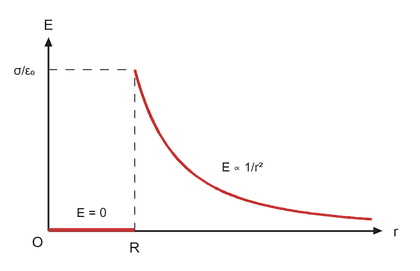
Therefore, inside the ball, (maximum) at the surface, and outside, falling as .