
Opening your dashboard
Class 12 Physics Chapter 18: Optical Instruments Solutions
85 textbook questions with step-by-step answers, free to read, for ISC 2026-27.
Get talked through Ch 18, not just shown the answer
Reading a finished solution is not the same as being able to do it. The AI tutor takes one question at a time and works it with you, in your own words, until you can.
- Ask it out loud, in your own words
- It gives you the next step, not the answer
- Stuck on part (ii)? Start there
85 questions with solutions
1–5 marks · Mixed difficulty
The first 58 solutions are on this page. This chapter is a long one, so the rest open on their own page to keep this one quick to load.
- 11 mark
Question 1
Ability of the eye to see objects at all distances is called
Solve with AIAnswer
(A) binocular vision
(B) myopic
(C) hypermetropia
- Correct
(D) accommodation
Answer: (D) accommodation
Concept: The eye lens is flexible. The ciliary muscles change its curvature, and so its focal length, so that images of both near and far objects fall on the retina.
Step 1 — Name the ability. This ability of the eye to change the focal length of its lens and focus objects at different distances is called accommodation.
Step 2 — Check the other options. Each of the other options names something different:
- (A) Binocular vision is seeing with two eyes together, which gives depth perception.
- (B) Myopia (short sight) is a defect in which far objects cannot be seen clearly.
- (C) Hypermetropia (long sight) is a defect in which near objects cannot be seen clearly.
Therefore, the answer is (D), accommodation.
- 21 mark
Question 2
For myopic eye, the defect is cured by
Solve with AIAnswer
(A) convex lens
- Correct
(B) concave lens
(C) cylindrical lens
(D) toric lens
Answer: (B) concave lens
Concept: In a myopic (short-sighted) eye, light from a far object is focused in front of the retina, because the eye lens is too converging or the eyeball too long.
Step 1 — What the correcting lens must do. The lens must spread the rays slightly so that the eye focuses them farther back, on the retina. A diverging (concave) lens does this.
Step 2 — Check the other options. Each of the other lenses corrects a different defect:
- (A) A convex lens converges light and is used for hypermetropia.
- (C) A cylindrical lens corrects astigmatism.
- (D) A toric lens is also used for astigmatism, not for simple myopia.
Therefore, the answer is (B), a concave lens.
- 31 mark
Question 3
Magnifying power of a simple microscope is (when final image is formed at cm from eye)
Solve with AIAnswer
(A)
- Correct
(B)
(C)
(D)
Answer: (B)
Concept: Magnifying power , where is the angle subtended by the image and the angle subtended by the object placed at .
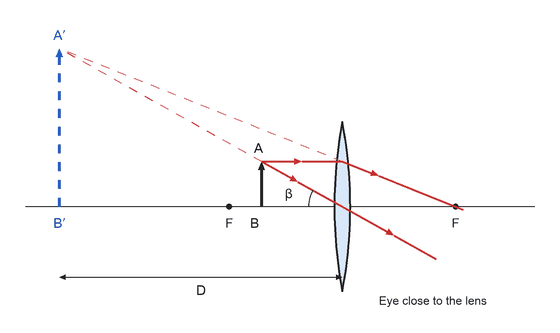
Step 1 — Use the lens formula. With the image at (figure), the lens formula gives the object distance through .
Step 2 — Find the ratio. The image subtends and the object at subtends . Dividing them and using Step 1:
Step 3 — Check the other options. Each of the other options fails for a definite reason:
- (A) is the magnifying power when the image is at infinity, not at .
- (C) This has the ratio upside down; for any lens shorter than 25 cm it lies between 1 and 2, far too small.
- (D) The sign is wrong; this would be negative for .
Therefore, the answer is (B).
- 41 mark
Question 4
If the focal length of objective lens is increased then magnifying power of
Solve with AIAnswer
(A) Microscope and telescope both will decrease
- Correct
(B) Microscope will decrease but that of telescope will increase
(C) Microscope will increase but that of telescope decrease
(D) Microscope and telescope both will increase
Answer: (B) Microscope will decrease but that of telescope will increase
Concept: For a compound microscope , so . For a telescope , so .
Step 1 — Microscope. A larger makes smaller, so the magnifying power of the microscope decreases.
Step 2 — Telescope. A larger makes larger, so the magnifying power of the telescope increases.
Step 3 — Check the other options. Each of the other options gets at least one instrument wrong:
- (A) The telescope's power increases, not decreases.
- (C) Both changes are the wrong way round.
- (D) The microscope's power decreases, not increases.
Therefore, the answer is (B).
- 51 mark
Question 5
An experiment is performed to find the refractive index of glass using a travelling microscope. In this experiment distances are measured by
Solve with AIAnswer
(A) A standard laboratory scale
(B) A meter scale provided on the microscope
(C) A screw gauge provided on the microscope
- Correct
(D) A vernier scale provided on the microscope
Answer: (D) A vernier scale provided on the microscope
Concept: A travelling microscope slides along a main scale fitted with a vernier, so its position (and hence the distance it moves) can be read to about 0.001 cm.
Step 1 — How the readings are taken. The microscope is focused on a mark, first directly and then through the glass slab, and the shifts are read on its vernier scale.
Step 2 — Check the other options. Each of the other options is not the measuring device used:
- (A) A laboratory scale reads only to 1 mm, which is too coarse here.
- (B) The main scale alone, without its vernier, reads only to its smallest division (0.5 mm or 1 mm).
- (C) The travelling microscope has no screw gauge; it uses a vernier.
Therefore, the answer is (D).
- 61 mark
Question 6
The magnifying power of telescope is high if
Solve with AIAnswer
(A) Both objective and eyepiece have short focal length
(B) Both objective and eyepiece have long focal length
- Correct
(C) The objective has a long focal length and the eyepiece has a short focal length
(D) The objective has a short focal length and the eyepiece has a long focal length
Answer: (C) The objective has a long focal length and the eyepiece has a short focal length
Concept: In normal adjustment the magnifying power of a telescope is .
Step 1 — Make the ratio large. The ratio is large when the numerator is large and the denominator is small.
Step 2 — Check the other options. Each of the other options gives a small ratio:
- (A) With both focal lengths short, cannot be much larger than , so the ratio stays small.
- (B) With both focal lengths long, is long too, so the ratio is small (and the tube is very long).
- (D) This is the arrangement of a microscope; for a telescope it gives .
Therefore, the answer is (C).
- 71 mark
Question 7
If tube length of astronomical telescope is 105 cm and magnifying power is 20 for normal setting, calculate the focal length of objective.
Solve with AIAnswer
- Correct
(A) 100 cm
(B) 10 cm
(C) 20 cm
(D) 25 cm
Answer: (A) 100 cm
Concept: In normal adjustment the tube length is and the magnifying power is .
Step 1 — Use the magnifying power. Write the magnifying power in normal setting and rearrange it:
Step 2 — Use the tube length. Substitute this in :
Step 3 — Find the objective's focal length. Multiply the eyepiece focal length by 20:
Step 4 — Check the other options. Each of the other options fails for a definite reason:
- (B) 10 cm is double the eyepiece's focal length, not the objective's.
- (C) 20 cm is the magnifying power written as a length.
- (D) 25 cm is the least distance of distinct vision, which does not enter normal adjustment.
Therefore, the answer is (A), 100 cm.
- 81 mark
Question 8
General expression for the resolving power of an optical instrument is
Solve with AIAnswer
- Correct
(A)
(B)
(C)
(D)
Answer: (A)
Concept: The resolving power of an instrument measures how well it separates two close things. For two close wavelengths and (as in a prism or grating), it is the ratio of the wavelength to the smallest difference that can just be separated.
Step 1 — Write the ratio. The smaller the resolvable difference , the better the instrument, so the resolving power is , a pure number.
Step 2 — Link with telescopes and microscopes. For telescopes and microscopes the same idea is written as the reciprocal of the limit of resolution ( or ).
Step 3 — Check the other options. Each of the other options fails for a definite reason:
- (B) This is the reciprocal; it becomes smaller as the instrument gets better.
- (C) This product grows when grows, that is, when the instrument gets worse.
- (D) This has the unit of 1/length, so it depends on the unit chosen and is not a general ratio.
Therefore, the answer is (A).
- 91 mark
Question 9
The astronomical telescope consists of objective and eyepiece. The focal length of the objective is
Solve with AIAnswer
(A) Equal to that of the eyepiece
- Correct
(B) Greater than that of the eyepiece
(C) Shorter than that of the eyepiece
(D) Five times shorter than that of the eyepiece
Answer: (B) Greater than that of the eyepiece
Concept: The magnifying power of a telescope is , and it must be greater than 1.
Step 1 — Apply the condition. For the objective's focal length must be greater than the eyepiece's.
Step 2 — Check the other options. Each of the other options gives :
- (A) Equal focal lengths give , so there is no magnification.
- (C) A shorter objective focal length gives ; the object looks smaller.
- (D) This is a particular case of (C), with .
Therefore, the answer is (B).
- 101 mark
Question 10
The resolving power of a telescope depends on
Solve with AIAnswer
(A) Focal length of eye lens
(B) Focal length of objective lens
(C) Length of the telescope
- Correct
(D) Diameter of the objective lens
Answer: (D) Diameter of the objective lens
Concept: The resolving power of a telescope is , where is the diameter of the objective.
Step 1 — Read the formula. The only property of the telescope in this formula is the diameter (aperture) of the objective.
Step 2 — Check the other options. Each of the other options affects the magnifying power or the size, not the resolution:
- (A) The eyepiece's focal length affects the magnifying power only.
- (B) The objective's focal length also affects the magnifying power only.
- (C) The length of the tube is ; it does not appear in .
Therefore, the answer is (D).
- 111 mark
Question 11
The working of which of the following is similar to that of a slide projector
Solve with AIAnswer
(A) Electron microscope
(B) Scanning electron microscope
- Correct
(C) Transmission electron microscope
(D) Atomic force microscope
Answer: (C) Transmission electron microscope
Concept: A slide projector sends light through a thin transparent slide and its lens projects the image onto a screen.
Step 1 — Compare with the TEM. In a transmission electron microscope the electron beam passes through a very thin specimen, and magnetic lenses project the magnified image onto a fluorescent screen. This is the same scheme as a slide projector.
Step 2 — Check the other options. Each of the other options works differently:
- (A) "Electron microscope" is the general name and includes types that do not work like a projector.
- (B) A scanning electron microscope scans the surface point by point and builds the picture from the electrons that come off it.
- (D) An atomic force microscope feels the surface with a fine tip; it uses no light or electron beam.
Therefore, the answer is (C).
- 121 mark
Question 12
In order to increase the magnifying power of a compound microscope
Solve with AIAnswer
- Correct
(A) The focal lengths of the objective and the eyepiece should be small
(B) Objective should have small focal length and the eyepiece large
(C) Both should have large focal lengths
(D) The objective should have large focal length and eyepiece should have small
Answer: (A) The focal lengths of the objective and the eyepiece should be small
Concept: For a compound microscope .
Step 1 — Read the formula. is inversely proportional to both and , so both focal lengths should be small.
Step 2 — Check the other options. Each of the other options makes one or both factors small:
- (B) A large makes small.
- (C) Large focal lengths make both factors small.
- (D) A large makes small; this is the telescope arrangement.
Therefore, the answer is (A).
- 131 mark
Question 13
The length of an astronomical telescope for normal vision (relaxed eye) ( = focal length of objective lens and = focal length of eye lens) is
Solve with AIAnswer
(A)
(B)
- Correct
(C)
(D)
Answer: (C)
Concept: In normal adjustment the image formed by the objective lies at its focus and also at the focus of the eyepiece, so that the final rays come out parallel.
Step 1 — Add the distances. The objective is from this image and the eyepiece is from it, so the distance between the lenses is .
Step 2 — Check the other options. Each of the other options fails for a definite reason:
- (A) A product of two lengths has the unit of area, not length.
- (B) This ratio is the magnifying power, a pure number.
- (D) is the length of a Galilean telescope, which uses a concave eyepiece.
Therefore, the answer is (C).
- 141 mark
Question 14
The number of lenses in a terrestrial telescope is
Solve with AIAnswer
(A) Two
- Correct
(B) Three
(C) Four
(D) Six
Answer: (B) Three
Concept: A terrestrial telescope must give an erect image, so an erecting lens is added between the objective and the eyepiece of an astronomical telescope.
Step 1 — Count the lenses. Objective, erecting lens and eyepiece make three lenses.
Step 2 — Check the other options. Each of the other options gives the wrong count:
- (A) Two lenses form an astronomical telescope, whose image is inverted.
- (C) Four lenses would mean an extra lens that this simple design does not use.
- (D) Six is far more than the three the design needs.
Therefore, the answer is (B), three.
- 151 mark
Question 15
The length of the tube of a microscope is 10 cm. The focal lengths of the objective and eye lenses are 0.5 cm and 1.0 cm. The magnifying power of the microscope is about
Solve with AIAnswer
(A) 5
(B) 23
(C) 166
- Correct
(D) 500
Answer: (D) 500
Concept: For a compound microscope, when and are small compared with the tube length , the magnifying power is approximately , with cm.
Step 1 — Substitute the values. Put cm, cm, cm:
Step 2 — How good the estimate is. This formula takes as the distance from the objective's second focus to the eyepiece's first focus (the optical tube length); with that reading and the final image at infinity it gives exactly 500. If the 10 cm is instead taken as the distance between the two lenses, the lens formula gives about 444 for the final image at 25 cm (425 for the image at infinity), which is still nearest to 500 among the options.
Step 3 — Check the other options. Each of the other options is far from this value:
- (A) 5 is far too small for a compound microscope with such short focal lengths.
- (B) 23 is even smaller than the eyepiece's own magnification, , so it leaves out the objective's large magnification.
- (C) 166 is only about one-third of the estimate; it would need an objective magnification of about 6.6 instead of about 20.
Therefore, the answer is (D), about 500.
- 161 mark
Question 16
If the red light is replaced by blue light illuminating the object in a microscope, the resolving power of the microscope
Solve with AIAnswer
(A) Decreases
- Correct
(B) Increases
(C) Gets halved
(D) Remains unchanged
Answer: (B) Increases
Concept: The resolving power of a microscope is , so .
Step 1 — Compare the wavelengths. Blue light has a shorter wavelength than red light: .
Step 2 — Effect on R.P. A shorter wavelength gives a larger resolving power.
Step 3 — Check the other options. Each of the other options fails for a definite reason:
- (A) A decrease would need a longer wavelength.
- (C) Halving would need the wavelength to double; it actually becomes shorter.
- (D) R.P. depends on , so it cannot stay the same.
Therefore, the answer is (B).
- 171 mark
Question 17
Which of the following is not correct regarding the radio telescope?
Solve with AIAnswer
- Correct
(A) It can not work at night
(B) It can detect a very faint radio signal
(C) It can be operated even in cloudy weather
(D) It is much cheaper than optical telescope
Answer: (A) It can not work at night
Concept: A radio telescope collects radio waves from space with a large dish. Radio waves from stars and galaxies arrive by day and by night and pass through clouds.
Step 1 — Judge statement (A). Radio sources do not depend on sunlight, so a radio telescope works equally well at night. The statement is not correct, so it is the answer.
Step 2 — Check the other options. The other statements are the ones the question treats as correct:
- (B) Large dishes and sensitive receivers do detect very faint radio signals.
- (C) Radio waves pass through clouds, so cloudy weather does not stop it.
- (D) The dish surface needs to be accurate only to a small fraction of a radio wavelength (millimetres), not of a light wavelength, so a dish costs much less than an optical mirror of the same size.
Note: statement (D) is true only size for size; very large radio dishes and arrays are themselves expensive. Statement (A) is the clearly incorrect one.
Therefore, the answer is (A).
- 181 mark
Question 18
Two points separated by a distance of 0.1 mm can just be resolved in a microscope when a light of wavelength 6000 Å is used. If the light of wavelength 4800 Å is used, this limit of resolution becomes
Solve with AIAnswer
- Correct
(A) 0.08 mm
(B) 0.10 mm
(C) 0.12 mm
(D) 0.06 mm
Answer: (A) 0.08 mm
Concept: The limit of resolution of a microscope is , so when nothing else changes.
Step 1 — Write the ratio. Write the ratio of the two limits as the ratio of the wavelengths:
Step 2 — Substitute. Put mm, Å and Å:
Step 3 — Check the other options. Each of the other options fails for a definite reason:
- (B) 0.10 mm would mean the limit does not depend on wavelength.
- (C) 0.12 mm comes from multiplying by , the inverted ratio.
- (D) 0.06 mm would need a wavelength of 3600 Å.
Therefore, the answer is (A), 0.08 mm.
- 191 mark
Question 19
What is the magnification produced by a single convex lens used as a simple microscope in normal use?
Solve with AIWritten solution
Solution:
Concept: In normal use the simple microscope forms the final image at the least distance of distinct vision, cm, where the eye sees most clearly.
Step 1 — Write the result. With the image at , the magnifying power is
where is the focal length of the lens. (If the eye is relaxed, with the image at infinity, .)
Therefore, .
- 201 mark
Question 20
What should be the position of an object relative to a biconvex lens, so that it behaves like a magnifying lens?
Solve with AIWritten solution
Solution:
Concept: A convex lens forms a virtual, erect and enlarged image only when the object lies between the lens and its focus.
Step 1 — State the position. The object must be placed between the focus and the optical centre of the lens (closer than the focal length).
Therefore, the object must be placed between the focus and the optical centre of the lens.
- 211 mark
Question 21
Define magnifying power of a compound microscope.
Solve with AIWritten solution
Solution:
Concept: Magnifying power compares visual angles: what the instrument gives against the best the naked eye can do.
Step 1 — Definition. The magnifying power of a compound microscope is the ratio of the angle subtended at the eye by the final image to the angle subtended at the eye by the object when it is placed at the least distance of distinct vision, :
Therefore, , the angle subtended by the final image divided by the angle subtended by the object at .
- 221 mark
Question 22
How does the magnifying power of telescope change on decreasing the aperture of its objective lens?
Solve with AIWritten solution
Solution:
Concept: The magnifying power of a telescope, , depends only on the focal lengths.
Step 1 — Apply it. The aperture does not appear in , so does not change. (A smaller aperture does make the image fainter and lowers the resolving power.)
Therefore, the magnifying power does not change.
- 231 mark
Question 23
Two lenses of focal lengths 5 cm and 50 cm are to be used for making a telescope. Which will you use for the objective?
Solve with AIWritten solution
Solution:
Concept: For a telescope , so the objective must have the longer focal length.
Step 1 — Choose. Take cm and cm. Then the magnifying power is
Therefore, the lens of focal length 50 cm is used as the objective.
- 241 mark
Question 24
On what factors does the magnifying power of a refracting type astronomical telescope depend?
Solve with AIWritten solution
Solution:
Concept: In normal adjustment ; with the image at , .
Step 1 — Read the factors. depends on the focal length of the objective () and of the eyepiece (), and slightly on where the final image is formed.
Therefore, it depends on the focal lengths of the objective and the eyepiece, and .
- 251 mark
Question 25
Express the angular magnification of an astronomical telescope in terms of the focal lengths of the objective and the eyepiece.
Solve with AIWritten solution
Solution:
Concept: Angular magnification , with and for the image formed by the objective.
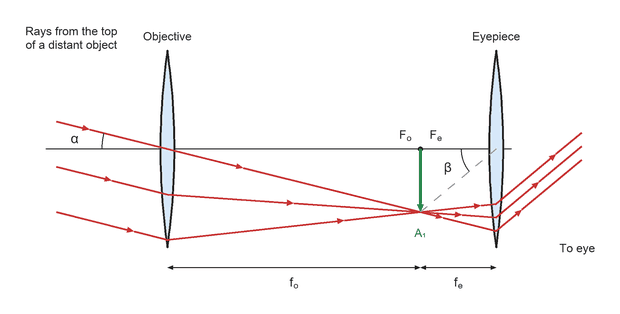
Step 1 — Final image at infinity (normal adjustment). Here is the image in the figure. In normal adjustment the image formed by the objective lies at the focus of the eyepiece, so its distance from the eyepiece is . Dividing by , with a minus sign for the inverted image, gives:

Step 2 — Final image at . The lens formula for the eyepiece, with its image at , gives the distance of the first image from it:
Putting this into and adding the minus sign gives:
The minus sign shows that the image is inverted.
Therefore, in normal adjustment and when the final image is at .
- 261 mark
Question 26
On what factors does the magnifying power of a compound microscope depend?
Solve with AIWritten solution
Solution:
Concept: For a compound microscope .
Step 1 — Read the factors. increases as the focal lengths and decrease, and it also depends on the tube length (and on ).
Therefore, it depends mainly on the focal lengths and (both should be small), and on the tube length.
- 271 mark
Question 27
What is the fundamental difference between the working of a telescope and a microscope?
Solve with AIWritten solution
Solution:
Concept: Both instruments increase the visual angle, but for different kinds of objects.
Step 1 — Compare. A microscope increases the visual angle of small objects placed close to it. A telescope increases the visual angle of large objects that are very far away.
Therefore, a microscope magnifies tiny nearby objects, while a telescope magnifies the angle of large distant objects.
- 281 mark
Question 28
In a compound microscope, the objective lens is of small aperture. Why?
Solve with AIWritten solution
Solution:
Concept: The objective of a microscope must have a very short focal length, and a lens of very short focal length has strongly curved surfaces.
Step 1 — Give the reason. A strongly curved lens can only be made small. Keeping its aperture small also cuts down spherical and chromatic aberrations, which are worst at the edges of such a lens, so the image stays sharp. Because the object sits very close to this small lens, the lens still accepts a wide cone of light (a large angular aperture), which the resolving power needs.
Note: the book's hint says a large lens would spread the light and dim the image; in fact a wider lens collects more light, so the real reasons are the very short focal length and the need to limit aberrations.
Therefore, the objective has a small aperture because it must have a very short focal length and a small aperture keeps its aberrations low.
- 291 mark
Question 29
“In a telescope the focal length of the objective is greater than that of the eyepiece.” Why?
Solve with AIWritten solution
Solution:
Concept: The magnifying power of a telescope is .
Step 1 — Give the reason. For to be large (greater than 1), must be greater than .
Therefore, the objective has the larger focal length so that the magnifying power is large.
- 301 mark
Question 30
“The objective of a telescope is of large aperture and the eyepiece is of small aperture.” Why?
Solve with AIWritten solution
Solution:
Concept: The light-gathering power and the resolving power of a telescope both increase with the aperture of the objective.
Step 1 — Objective. A large objective collects more light from faint, distant objects, giving a bright image, and it resolves finer detail.
Step 2 — Eyepiece. The eyepiece is small so that the beam leaving it is narrow enough for nearly all of it to enter the pupil of the eye.
Therefore, the large objective gathers more light and gives higher resolving power, and the small eyepiece lets almost all of that light enter the eye.
- 311 mark
Question 31
How are the resolving power and limit of resolution of an optical instrument related?
Solve with AIWritten solution
Solution:
Concept: The limit of resolution is the smallest separation (or angle) of two points that the instrument can just show as separate.
Step 1 — State the relation. The smaller this limit, the better the instrument, so
Therefore, the resolving power is the reciprocal of the limit of resolution.
- 321 mark
Question 32
An object is seen first in red light and then in violet light through a simple microscope. Will the magnification be the same in both cases?
Solve with AIWritten solution
Solution:
Concept: Glass has a larger refractive index for violet light, so the focal length is smaller for violet: .
Step 1 — Compare. Since , the smaller focal length gives the larger magnification, so .
Therefore, no; the magnification is greater in violet light than in red light.
- 331 mark
Question 33
What is resolving power of a microscope?
Solve with AIWritten solution
Solution:
Concept: A microscope is judged by how close two points of an object can be and still be seen as two.
Step 1 — Definition. The resolving power of a microscope is the reciprocal of the least distance between two points of an object that can just be seen as separate through it:
Therefore, the resolving power of a microscope is the reciprocal of the smallest distance between two just-resolved points of the object.
- 341 mark
Question 34
Write down the formula of the resolving power of a microscope.
Solve with AIWritten solution
Solution:
Concept: The limit of resolution of a microscope is by Abbe's criterion, or by Rayleigh's criterion, where is the refractive index of the medium between object and objective and the half-angle of the cone of light accepted by the objective.
Step 1 — Take the reciprocal. Resolving power is , so Abbe's form gives:
Step 2 — Rayleigh's form. Rayleigh's criterion, used in this chapter's worked examples, puts the factor 1.22 in the denominator:
Therefore, (with Rayleigh's factor, ).
- 351 mark
Question 35
An object is first seen in red light and then in violet light through a simple microscope. In which case is the magnifying power of simple microscope greater?
Solve with AIWritten solution
Solution:
Concept: For a simple microscope , and the focal length of a glass lens is smaller for violet light () because is larger for violet.
Step 1 — Compare. The smaller gives the larger .
Therefore, the magnifying power is greater when the object is seen in violet light.
- 361 mark
Question 36
Draw a labelled ray diagram showing the formation of image using a Newtonian type reflecting telescope. Give its two advantages.
Solve with AIWritten solution
Solution:
Concept: In a Newtonian telescope a large concave mirror is the objective. A small plane mirror at 45° turns the converging beam sideways to form the image near the eyepiece.

Step 1 — Image formation. Parallel light from a distant star is reflected by the concave mirror towards its focus. Before reaching the focus, the light meets the plane mirror and is reflected sideways to form the image I, which is seen through the eyepiece.
Step 2 — Two advantages. A mirror has no chromatic aberration, because reflection is the same for all colours. A large mirror is lighter and easier to support than a lens of the same aperture, so a larger aperture (more light, higher resolving power) is possible.
Therefore, the Newtonian telescope forms the image by a concave mirror and a 45° plane mirror; it is free from chromatic aberration and can be made with a large aperture.
- 371 mark
Question 37
Draw a labelled ray diagram to show the image formation in a reflecting type telescope.
Solve with AIWritten solution
Solution:
Concept: In a Cassegrain reflecting telescope a large concave mirror with a central hole is the objective, and a small convex mirror sends the light back through the hole to the eyepiece.
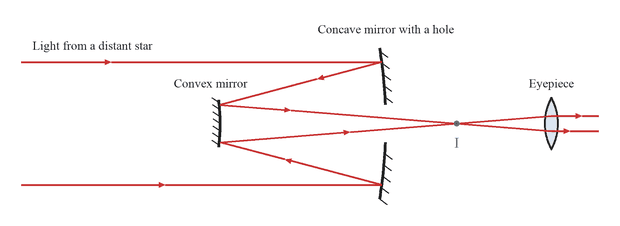
Step 1 — Image formation. Parallel light from a distant star falls on the concave mirror and converges towards its focus. The convex mirror, placed before this focus, reflects the light back through the hole in the concave mirror, and the final image I is formed just behind it, where it is viewed through the eyepiece.
Therefore, the diagram above shows a Cassegrain reflecting telescope forming the image I behind the hole of the concave mirror.
- 381 mark
Question 38
Write down the expression for the resolving power of a microscope.
Solve with AIWritten solution
Solution:
Concept: The least distance between two points that a microscope can show as separate is by Abbe's criterion, or by Rayleigh's criterion. Here is the refractive index of the medium between the object and the objective, is the half-angle of the cone of light from the object, and is the wavelength.
Step 1 — Write the reciprocal. Resolving power is , so Abbe's form gives:
Step 2 — Rayleigh's form. Rayleigh's criterion, used in this chapter's worked examples, puts the factor 1.22 in the denominator:
Therefore, (with Rayleigh's factor, ).
- 391 mark
Question 39
Write down the equation for the resolving power of a telescope.
Solve with AIWritten solution
Solution:
Concept: By Rayleigh's criterion the least angle a telescope can resolve is , where is the diameter of the objective.
Step 1 — Write the reciprocal. Resolving power is :
Therefore, , the reciprocal of the least resolvable angle .
- 401 mark
Question 40
Name the lens used for correcting (i) short sight and (ii) long sight.
Solve with AIWritten solution
Solution:
Concept: Short sight (myopia) focuses far objects in front of the retina; long sight (hypermetropia) focuses near objects behind it.
Step 1 — Short sight. A diverging lens moves the focus back onto the retina, so a concave lens is used.
Step 2 — Long sight. A converging lens moves the focus forward onto the retina, so a convex lens is used.
Therefore, (i) short sight is corrected by a concave lens and (ii) long sight by a convex lens.
- 412 marks
Question 41
What is meant by visual angle?
Solve with AIWritten solution
Solution:
Concept: How big an object looks depends on the size of its image on the retina, which depends on the angle the object subtends at the eye.

Step 1 — Definition. The angle subtended at the eye by an object is called the visual angle ( in the figure). For a small object of height at distance , radian.
Step 2 — Meaning. The larger the visual angle, the larger the image on the retina and the bigger the object appears. Bringing an object nearer increases the visual angle, but only down to about 25 cm, below which the eye cannot focus.
Therefore, the visual angle is the angle subtended at the eye by an object; the apparent size of the object depends on it.
- 422 marks
Question 42
Define angular magnification of a simple microscope.
Solve with AIWritten solution
Solution:
Concept: The best the naked eye can do is to view the object at the least distance of distinct vision , where it subtends the angle (first figure). Through the lens the image subtends a larger angle (second figure).
Step 1 — Definition. The angular magnification (magnifying power) of a simple microscope is the ratio of the angle subtended at the eye by the image to the angle subtended at the eye by the object placed at :
Step 2 — Its value. With the image at it equals ; with the image at infinity it equals .
Therefore, angular magnification , the angle subtended by the image divided by the angle subtended by the object at the least distance of distinct vision.
- 432 marks
Question 43
Define magnifying power of a compound microscope.
Solve with AIWritten solution
Solution:
Concept: The magnifying power compares the final image seen through the microscope with the object seen by the naked eye at its best position, the least distance of distinct vision .
Step 1 — Definition. The magnifying power of a compound microscope is the ratio of the angle subtended at the eye by the final image to the angle subtended at the eye by the object placed at :
Step 2 — Its value. It works out as , the magnification of the objective times that of the eyepiece; for the final image at , .
Therefore, the magnifying power of a compound microscope is , the angle subtended by the final image divided by the angle subtended by the object at .
- 442 marks
Question 44
Draw a labelled diagram of a compound microscope.
Solve with AIWritten solution
Solution:
Concept: A compound microscope has two convex lenses: an objective of very short focal length near the object and an eyepiece of short focal length near the eye.

Step 1 — The objective. The object AB is placed just beyond the focus of the objective. The objective forms a real, inverted and magnified image .
Step 2 — The eyepiece. lies between the eyepiece and its focus . The eyepiece acts as a simple microscope and forms the final image , which is virtual, inverted (with respect to AB) and much magnified, at the least distance of distinct vision .
Therefore, the figure shows a compound microscope: objective, eyepiece, the real image and the final virtual image at distance from the eye.
- 452 marks
Question 45
Define the angular magnification of a telescope.
Solve with AIWritten solution
Solution:
Concept: A distant object subtends a small angle at the eye (and at the objective). Through the telescope the final image subtends a larger angle at the eye.
Step 1 — Definition. The angular magnification (magnifying power) of a telescope is the ratio of the angle subtended at the eye by the final image to the angle subtended at the eye (or objective) by the object:
Step 2 — Its value. In normal adjustment this equals .
Therefore, , the angle subtended by the final image at the eye divided by the angle subtended by the object.
- 462 marks
Question 46
Draw a ray labelled diagram to show how an astronomical telescope forms its final image at the near point.
Solve with AIWritten solution
Solution:
Concept: When the final image is at the near point, the image formed by the objective lies inside the focal length of the eyepiece, so the eyepiece forms a virtual image at the least distance of distinct vision .
Step 1 — The objective. Parallel rays from the top of a distant object pass through the objective and meet at in its focal plane, forming the real, inverted image at .
Step 2 — The eyepiece. is between the eyepiece and its focus , so the rays leave the eyepiece as if they came from . The final image is virtual, inverted and magnified, at distance from the eye.
Therefore, the diagram shows the final image formed at the near point, distance from the eyepiece.
- 472 marks
Question 47
Draw a labelled diagram to show the image formation in a Newton's telescope.
Solve with AIWritten solution
Solution:
Concept: Newton's telescope uses a concave mirror as the objective and a small plane mirror at 45° to bring the image to the side of the tube.
Step 1 — The concave mirror. Parallel rays from a distant star are reflected by the concave mirror and converge towards its focus.
Step 2 — The plane mirror. A plane mirror at 45° to the axis, placed before the focus, reflects the converging rays sideways. They meet at I, which is the image seen through the eyepiece fixed in the side of the tube.
Therefore, the figure shows the image I formed by the concave mirror and the 45° plane mirror and seen through the side eyepiece.
- 482 marks
Question 48
Compare a refracting telescope with a reflecting telescope.
Solve with AIWritten solution
Solution:
Concept: A refracting telescope uses a lens as the objective; a reflecting telescope uses a concave mirror.
Step 1 — Aberrations. A lens objective shows chromatic aberration (and spherical aberration). A mirror has no chromatic aberration, and a parabolic mirror also removes spherical aberration.
Step 2 — Size and cost. Large, flawless lenses are very hard and costly to make, and they sag because they can be held only at the rim. A mirror can be supported over its whole back, so very large apertures are possible.
Step 3 — Light and resolution. The larger aperture of a reflector gathers more light and gives higher resolving power. A refractor also loses some light by absorption in the thick glass; a mirror does not.
Therefore, a reflecting telescope is free from chromatic aberration and can have a much larger aperture (brighter images, higher resolving power) than a refracting telescope.
- 492 marks
Question 49
What is the difference between angular magnification and magnification produced by a lens?
Solve with AIWritten solution
Solution:
Concept: One compares angles at the eye; the other compares actual sizes.
Step 1 — Angular magnification. It is the ratio of the angle subtended at the eye by the image to the angle subtended by the object:
Step 2 — Magnification of a lens. It is the ratio of the size of the image to the size of the object:
Step 3 — Why they differ. An image can be large but far away; then it may not look bigger. What the eye judges is the angle, so instruments are rated by angular magnification.
Therefore, angular magnification is a ratio of angles at the eye (), while magnification is a ratio of image size to object size.
- 502 marks
Question 50
“Stars which are invisible to naked eye becomes visible when viewed through a telescope.” Why?
Solve with AIWritten solution
Solution:
Concept: Stars are so far away that they look like points; how bright a point looks depends on how much of its light enters the eye.
Step 1 — Light gathering. The objective of a telescope has a much larger aperture than the pupil of the eye. It collects far more light, since the light gathered is proportional to the square of the aperture.
Step 2 — Result. All this light is brought into the eye, so a faint star gives enough light on the retina to be seen.
Therefore, faint stars become visible because the large objective gathers much more light than the pupil, and brightness depends on the light gathered.
- 512 marks
Question 51
What is the chief drawback of Galilean telescope?
Solve with AIWritten solution
Solution:
Concept: A Galilean telescope uses a concave lens as the eyepiece, so the image of the objective formed by the eyepiece (the eye ring) is virtual and lies inside the tube.
Step 1 — Effect. The eye cannot be placed at the eye ring, so it receives only part of the light leaving the eyepiece. Only a small part of the object is seen at one time.
Therefore, the chief drawback of a Galilean telescope is that its field of view is small.
- 522 marks
Question 52
Using the data given below, state which two of the given lenses will you prefer to construct a best possible (i) telescope and (ii) microscope. Also indicate which of the selected lenses is to be used as an objective and as an eyepiece in each case.
Lenses Power (P) Aperture (A) 6 D 1 cm 3 D 8 cm 10 D 1 cm Solve with AIWritten solution
Solution:
Concept: Focal length . A telescope needs an objective of long focal length and large aperture, and an eyepiece of short focal length. A microscope needs an objective of very short focal length and an eyepiece of short focal length.
Step 1 — Find the focal lengths. Convert each power to a focal length:
Step 2 — Telescope. has the longest focal length and the largest aperture (8 cm), so it is the objective. has the shortest focal length, so it is the eyepiece. This gives , the largest possible here.
Step 3 — Microscope. (shortest focal length, small aperture) is the objective, and is the eyepiece.
Therefore, (i) telescope: objective , eyepiece ; (ii) microscope: objective , eyepiece .
- 532 marks
Question 53
How does the resolving power of a telescope change when the aperture of the objective is increased?
Solve with AIWritten solution
Solution:
Concept: The resolving power of a telescope is , where is the aperture of the objective.
Step 1 — Apply it. R.P. is directly proportional to , so a larger aperture lets the telescope separate stars that are closer together in angle.
Therefore, the resolving power increases (in proportion to the aperture) when the aperture of the objective is increased.
- 542 marks
Question 54
How does the magnifying power of a telescope change on increasing the diameter of its objective?
Solve with AIWritten solution
Solution:
Concept: The magnifying power of a telescope is , which contains only focal lengths.
Step 1 — Apply it. The diameter of the objective does not appear in , so is unchanged. (The image becomes brighter and the resolving power increases.)
Therefore, the magnifying power does not change when the diameter of the objective is increased.
- 552 marks
Question 55
A boy uses spectacles of focal length cm. Name the defect of vision he is suffering from. Compute the power of the lens.
Solve with AIWritten solution
Solution:
Concept: A negative focal length means a concave (diverging) lens, which corrects short sight. Power with in metre.
Step 1 — Name the defect. A concave lens is used for myopia (short sight).
Step 2 — Compute the power. Put m (that is, cm):
Therefore, the boy is myopic (short-sighted), and the power of his lens is D.
- 562 marks
Question 56
How will the magnifying power of a refracting type astronomical telescope be affected on increasing, for its eyepiece (i) the focal length and (ii) the aperture? Justify your answer.
Solve with AIWritten solution
Solution:
Concept: The magnifying power of a telescope is .
Step 1 — Focal length of the eyepiece. is inversely proportional to , so increasing decreases .
Step 2 — Aperture of the eyepiece. The aperture does not appear in , so does not change.
Therefore, (i) the magnifying power decreases, because ; (ii) it does not change, because does not depend on the aperture.
- 572 marks
Question 57
Two convex lenses and of an astronomical telescope having focal lengths 54 cm and 20 cm respectively, are arranged as shown in the given figure.

(i) Which one of the two lenses will you select to use as the objective lens and why?
(ii) What should be the change in the distance between the lenses to have the telescope in its normal adjustment position?
(iii) Calculate the magnifying power of the telescope in the normal adjustment position.
Solve with AIWritten solution
Solution:
Concept: In a telescope the objective has the longer focal length. In normal adjustment the lenses are apart and .
Step 1 — Choose the objective. Lens A has the longer focal length (54 cm), so A is the objective and B (20 cm) the eyepiece. This makes greater than 1.
Step 2 — Distance for normal adjustment. The lenses must be apart:
The figure shows the lenses in normal adjustment, with their foci together.
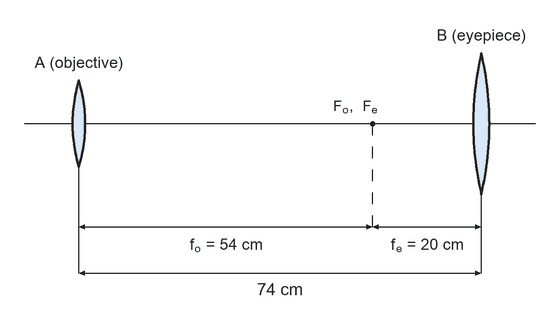
Step 3 — Change needed. They are now 15 cm apart, so the distance must be increased by
Step 4 — Magnifying power. Use :
The minus sign shows that the final image is inverted.
Note: the book's printed answer (objective B; separation 25 cm, an increase of 10 cm; magnifying power ) is the answer for focal lengths of 5 cm for A and 20 cm for B, so the printed 54 cm is probably a misprint of 5 cm; with the data as printed the results are as above.
Therefore, (i) lens A (54 cm) is the objective; (ii) the separation must be increased by 59 cm, to 74 cm; (iii) .
- 582 marks
Question 58
Four double convex lenses, with the following specifications are available:
Lens Focal length Aperture A 100 cm 10 cm B 100 cm 5 cm C 10 cm 2 cm D 5 cm 2 cm Which two of the given four lenses, should be selected as the objective and eyepiece to construct an astronomical telescope and why? What will be the magnifying power and normal length of the telescope tube so constructed?
Write the advantages of reflecting type telescope over such a telescope.
Solve with AIWritten solution
Solution:
Concept: A telescope objective should have a long focal length and a large aperture (more light, better resolution); the eyepiece should have a short focal length. In normal adjustment and the tube length is .
Step 1 — Choose the lenses. A and B both have cm, but A has the larger aperture (10 cm), so A is the objective. D has the shortest focal length (5 cm), so D is the eyepiece.
Step 2 — Magnifying power. Use :
Step 3 — Length of the tube. Add the two focal lengths:
The figure shows this telescope in normal adjustment.

Step 4 — Advantages of a reflecting telescope. A mirror objective has no chromatic aberration. There is no loss of light by absorption in thick glass, so the image is brighter. A mirror can be supported over its whole back, so a much larger aperture (higher resolving power) is possible.
Note: the book's printed answer reads "There is chromatic aberration"; this is a misprint for "There is no chromatic aberration".
Therefore, objective A and eyepiece D; (20 in magnitude) and tube length 105 cm; a reflector has no chromatic aberration, a brighter image and can have a larger aperture.
- 592 marks
Question 59
Draw a labelled ray diagram of an astronomical telescope, forming the image at infinity. An astronomical telescope uses two lenses of powers 10 dioptre and 1 dioptre.
(i) State with reason, which lens is preferred as objective and eyepiece.
(ii) Calculate the magnifying power of the telescope, if the final image is formed at the near point.
(iii) How do the light gathering power and resolving power of a telescope change, if the aperture of the objective lens is doubled?
- 603 marks
Question 60
Draw a ray diagram to show how the image of a distant object is formed by a reflected astronomical telescope when in normal use. State one advantage over a refracting type telescope.
- 613 marks
Question 61
What do you mean by the resolving power of a telescope? How does the resolving power of a telescope depend upon the wavelength of the light and the aperture of the objective lens?
- 623 marks
Question 62
Explain the statement, “angular magnification of a compound microscope in normal use is 30”.
- 633 marks
Question 63
(i) Define resolving power of a simple astronomical telescope.
(ii) State one advantage of a reflecting telescope over refracting telescope.
- 643 marks
Question 64
With regard to an astronomical telescope of refracting type, state how will you increase its:
(i) magnifying power and
(ii) resolving power.
- 653 marks
Question 65
Draw a labelled ray diagram of an image formed by a compound microscope when the final image lies at least distance of distinct vision. Write any one expression for its magnifying power. Why is its objective of a very small aperture?
- 663 marks
Question 66
Draw a labelled diagram of an image formed by a refracting telescope with final image formed at infinity. Derive an expression for its magnifying power with the final image at infinity.
- 673 marks
Question 67
Draw a neat labelled ray diagram showing the formation of an image at least distance of distinct vision by a simple microscope. When the final image is at , derive an expression for its magnifying power.
- 683 marks
Question 68
Explain the working of a simple microscope and show that its angular magnification is given by
(i) when is the least distance of distinct vision.
(ii) for relaxed eye.
- 695 marks
Question 69
(a) Explain the working of a simple microscope with a neat sketch.
(b) Define angular magnification.
(c) Derive an expression for the magnifying power of a simple microscope when the image is formed (i) at the near point, (ii) at infinity and (iii) at intermediate positions.
- 705 marks
Question 70
(a) With a neat sketch explain the working of a compound microscope.
(b) Define magnifying power of a compound microscope.
(c) Derive an expression for the magnifying power of a compound microscope when the image is formed (i) at the near point and (ii) at infinity.
- 715 marks
Question 71
(a) Explain the working of an astronomical telescope with the aid of a ray diagram.
(b) Define angular magnification of a telescope.
(c) Derive an expression for the angular magnification of an astronomical telescope when the final image is formed (i) at infinity and (ii) at the least distance of distinct vision.
(d) What is the best position for the observer's eye with such an instrument?
(e) Why is this the best position?
- 725 marks
Question 72
(a) Draw a ray diagram to show how distant objects are seen through a terrestrial telescope.
(b) Explain the function of the erecting lens.
(c) Write down an expression for its angular magnification.
- 735 marks
Question 73
(a) Explain the difference between a reflecting telescope and a refracting telescope.
(b) Describe the main parts of a reflecting telescope. Explain its working with a neat sketch.
(c) What is the magnifying power of a reflecting telescope?
- 745 marks
Question 74
(a) Define resolving power. Explain Rayleigh's criterion.
(b) What is limit of resolution of a telescope?
(c) Obtain the expression for resolving power of a telescope and microscope.
- 753 marks
Question 75
Calculate the magnifying power of a simple microscope whose lens has a focal length of 7.5 cm. Take the least distance of distinct vision as 25 cm.
- 763 marks
Question 76
The magnifying power of a simple microscope is 8. Find the focal length of the lens if the least distance of distinct vision is 25 cm.
- 773 marks
Question 77
A magnifying glass is made of combination of convex lens of power 20 D and concave lens of power 4 D. If the distance of distinct vision of eye is 25 cm. Calculate the size of the image of the object 2 cm high seen through the magnifying glass.
- 783 marks
Question 78
A compound microscope has a magnification of 30. The focal length of its eyepiece is 5 cm. Assuming the final image to be formed at the least distance of distinct vision (25 cm), calculate the magnification produced by the objective.
- 793 marks
Question 79
The optical powers of the objective and the eyepiece of a compound microscope are 33.33 dioptre and 11.11 dioptre. The distance between the objective and the eyepiece is 24 cm. What should the distance of the object from the objective so that the final image is formed at infinity?
- 803 marks
Question 80
The length of an astronomical telescope is 20 cm. The focal length of the eyepiece is 10/3 cm. Find the focal length of the objective and the magnifying power of the telescope.
- 814 marks
Question 81
A telescope has an objective of focal length 0.5 m and an eyepiece of focal length 0.05 m. The least distance of distinct vision is 0.25 m. The telescope is focussed for distinct vision on a scale 2.0 m away from the objective. Calculate (i) separation between the objective and the eyepiece and (ii) the overall magnification.
- 823 marks
Question 82
The focal length of the objective and the eyepiece of a terrestrial telescope are 75 cm and 5 cm respectively. The focal length of the erecting lens used is 10 cm. What is the length of the telescope tube?
- 833 marks
Question 83
The objective of a terrestrial telescope has a focal length of 125 cm and the eyepiece has a focal length of 5.0 cm. What is the magnifying power of the telescope when the final image is formed at (i) infinity and (ii) the least distance of distinct vision?
- 843 marks
Question 84
The distance between the objective and the eyepiece of a Galilean telescope is 60 cm. If the focal length of the eyepiece is 5 cm, what is the focal length of the objective?
- 853 marks
Question 85
The eyepiece of an astronomical telescope has a focal length of 6 cm and the two lenses are to be fixed 90 cm apart in normal adjustment. Find the focal length of the objective and the magnifying power of the telescope.
What Class 12 Physics Ch 18 covers
The sections of the chapter, in the order the book takes them. Every question above comes from one of these.
- 01The Human Eye and Visual Angle
- 02Simple Microscope
- 03Compound Microscope
- 04Astronomical Telescope
- 05Reflecting Telescope
- 06Resolving Power of Instruments
More ways to study this chapter
The same chapter asked three other ways. Practise it, revise it, and see what the board has set on Ch 18 before.
- Competency-Based Questions (CBQ)Case study questions: a situation, and the part of the chapter that answers it.42questionsOpen
- Previous Year QuestionsQuestions that have actually appeared in board papers, each tagged with its year.19questionsOpen
- Practice QuestionsExtra questions per chapter, for when one attempt at a method is not enough.103questionsOpen
Ch 18 in past ISC papers
The same chapter as the board has actually asked it. These are worded differently from the textbook exercise, which is the point of reading them.
- 11 mark
Board paper question 1
What type of lens is used to correct long-sightedness?
Solve with AIWritten solution
Solution:
Key idea: A long-sighted (hypermetropic) eye sees distant objects clearly but cannot focus on near objects, because the image of a near object would form behind the retina.
Step 1 — Find what the eye lacks.
The eye lens of a long-sighted person does not converge light enough (or the eyeball is too short), so rays from a near object meet behind the retina.
Step 2 — Choose the correcting lens.
A converging lens adds the missing converging power. It makes the rays from a near object (at ) appear to come from the person's own near point, which lies farther away, so the eye can focus them on the retina.
Therefore, long-sightedness is corrected with a convex (converging) lens.
- 21 mark
Board paper question 2
State any one advantage of using a reflecting telescope in place of a refracting telescope.
Solve with AIWritten solution
Solution:
Key idea: A reflecting telescope uses a concave mirror instead of a lens as its objective. A mirror reflects all colours in the same way, while a lens refracts different colours by different amounts.
Step 1 — Recall the defect of a lens objective.
A lens bends violet light more than red light, so the different colours of a white star come to a focus at slightly different points. The image shows coloured fringes; this is chromatic aberration.
Step 2 — Compare with a mirror.
The law of reflection does not depend on wavelength, so a mirror brings all colours to the same focus. (A paraboloidal mirror also removes spherical aberration, and a large mirror can be supported from its back, so it can be made much bigger than a lens.)
Therefore, a reflecting telescope is free from chromatic aberration, which a refracting telescope suffers from.
- 33 marks
Board paper question 3
Draw a labelled ray diagram of an image formed by a compound microscope, when the final image lies at the least distance of distinct vision (D).
Solve with AIWritten solution
Solution:
Key idea: A compound microscope has two convex lenses. The objective (very short focal length ) forms a real, inverted, magnified image of an object placed just beyond its focus. The eyepiece (focal length ) acts as a simple microscope: lies just inside its focus, so the final image is virtual, magnified and at the least distance of distinct vision .
Step 1 — Draw the rays through the objective.
The object AB is placed just beyond the first focus of the objective. A ray from A parallel to the axis is refracted through the second focus , and a ray through the optical centre goes on undeviated. They meet at , giving the real, inverted image .
Step 2 — Draw the rays through the eyepiece.
The eyepiece is placed so that lies between its optical centre and its focus . From , one ray goes parallel to the axis and is refracted through the second focus ; another goes through the optical centre of the eyepiece undeviated.
Step 3 — Locate the final image.
These two rays diverge after the eyepiece. Extended backwards (dashed lines), they meet at , so the final image is virtual, inverted with respect to AB, highly magnified and at the distance from the eyepiece (the eye is close to the eyepiece).

Therefore, the labelled diagram above shows the compound microscope: the objective forms the real image A₁B₁ just inside Fₑ, and the eyepiece forms the final virtual, inverted, magnified image A₂B₂ at the least distance of distinct vision D.
- 42 marks
Board paper question 4
With regard to an astronomical telescope of refracting type, state how you will increase its:
(i) magnifying power
(ii) resolving power
Solve with AIWritten solution
Solution:
Key idea: For a refracting astronomical telescope in normal adjustment the magnifying power is , and the resolving power is , where is the diameter (aperture) of the objective and the wavelength of light.
Step 1 — Part (i): increase the magnifying power.
The magnifying power is the ratio of the focal lengths, so it grows when the numerator grows or the denominator shrinks.
We use an objective of larger focal length and an eyepiece of smaller focal length .
Step 2 — Part (ii): increase the resolving power.
The resolving power is directly proportional to the aperture of the objective.
We use an objective of larger diameter (aperture). The eyepiece has no effect on the resolving power.
Therefore, (i) the magnifying power is increased by using an objective of longer focal length and an eyepiece of shorter focal length; (ii) the resolving power is increased by using an objective of larger aperture.
- 51 mark
Board paper question 5
What is meant by short-sightedness?
Solve with AIWritten solution
Solution:
Key idea: A normal eye can focus objects from its near point (about ) out to infinity (its far point). In a defective eye one of these limits moves.
Step 1 — Describe the defect.
A short-sighted (myopic) person sees nearby objects clearly but cannot see distant objects clearly. The far point of the eye is at a finite distance instead of at infinity.
Step 2 — Give its cause and correction.
Parallel rays from a distant object meet in front of the retina, because the eyeball is too long or the eye lens converges too strongly. It is corrected with a concave (diverging) lens.
Therefore, short-sightedness (myopia) is the defect in which distant objects cannot be seen clearly, because their image forms in front of the retina; near objects are seen clearly.
- 62 marks
Board paper question 6
A convex lens of a focal length is used as a simple microscope. Where should an object be placed so that the image formed by it lies at the least distance of distinct vision ()?
Solve with AIWritten solution
Solution:
Key idea: A convex lens used as a simple microscope forms a virtual, erect, magnified image when the object is placed between the lens and its focus. We find the object distance from the lens formula , with distances measured against the incoming light taken as negative (New Cartesian convention).
Step 1 — Write the data with signs.
The lens is convex, so its focal length is positive.
The virtual image is on the same side as the object, at the least distance of distinct vision.
Step 2 — Rearrange the lens formula for u.
We move to one side.
Step 3 — Substitute the values.
We put in and .
Step 4 — Interpret the answer.
The minus sign shows that the object is on the same side as the incoming light, in front of the lens. Its distance is less than the focal length , so it lies between the lens and its focus, as a simple microscope needs. The magnification tells us how much larger the image is.
So the image is erect and six times larger. The figure is drawn to scale.
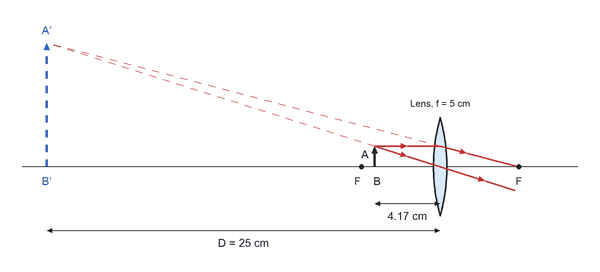
Therefore, the object should be placed 25/6 cm ≈ 4.17 cm in front of the lens, between the lens and its focus.
All 19 board paper questions for this chapter, solved the same way.
Class 12 Physics Ch 18 questions students ask
How many questions are there in Class 12 Physics Ch 18?
85 questions. Every one is solved step by step on this page.
Are these Class 12 Physics solutions free?
Yes. Every question and its full working is free to read, with no account needed.
Can I download the Class 12 Physics Ch 18 solutions as a PDF?
There is no PDF to download. Every solution is on this page instead, which means it is searchable, always the current syllabus, and readable on a phone. Use your browser's print option if you want it on paper.