
Opening your dashboard
Class 12 Physics Chapter 18 Optical Instruments: Competency-Based Questions (CBQ)
42 questions on Chapter 18, each worked through on its own page with the AI tutor. Class 12 Physics, ICSE 2026-27.
42 questions
1–4 marks · Mixed difficulty
- 13 marks
Question 1
Competency: Application
A normal eye can just tell two points apart when they subtend an angle of about (one minute of arc, ) at the eye. Riya's phone screen has pixels per inch (). Her laptop screen is wide and has pixels across. (Hypothetical data.)
(a) Find the distance between neighbouring pixels on the phone, and the greatest distance from her eye at which Riya could still pick out single pixels.
(b) She uses the laptop with her eyes from the screen. Find the angle one pixel subtends at her eye, and say whether she can see single pixels.
(c) How far from the laptop screen must she be for its pixels to merge into a smooth picture?
- 21 mark
Question 2
Competency: Analysis & Evaluation
At an eye clinic, distance vision is tested with a chart of letters fixed on the far wall of the room.
Assertion (A): A chart for testing distance vision is placed about from the patient, not at .
Reason (R): A letter of fixed size subtends a larger visual angle at the eye when it is away than when it is away.
- 31 mark
Question 3
Competency: Analysis & Evaluation
Meera, aged 12, has a near point of . Her father, who is not wearing his spectacles, has a near point of . Each of them looks at the same tiny print, holding it as close as they can while still seeing it clearly. Meera can make out finer details of the print than her father. (Hypothetical data.) Which statement best explains this?
- 41 mark
Question 4
Competency: Application
During a total solar eclipse, the Moon just covers the Sun's disc for a few minutes. The Sun's diameter () is about times the Moon's diameter (). What does the eclipse tell us about their distances from the Earth?
- 54 marks
Question 5
Competency: Application
A student photographs a butterfly's wing with her phone. The phone's camera lens has a focal length of and is set to focus on very distant objects, so its sensor lies in the focal plane of that lens. She clips a small convex "macro" lens of focal length just in front of the camera lens, as shown in the figure. (Hypothetical data.)
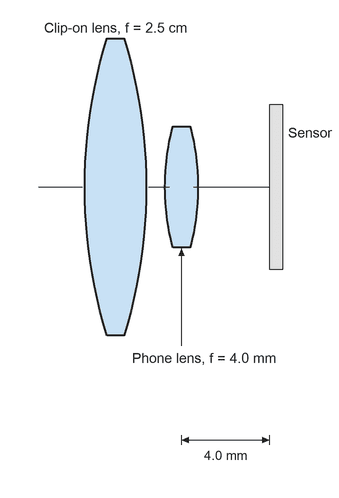
(a) How far from the clip-on lens must the wing be for a sharp photograph? Explain.
(b) A vein on the wing is wide. Find the angle that the two edges of the vein subtend at the clip-on lens, and the width of the vein's image on the sensor.
(c) Without the clip-on lens, the phone can focus no closer than . Find the width of the vein's image on the sensor when the wing is photographed from without the clip-on lens, and how many times wider the image is with the clip-on lens.
- 64 marks
Question 6
Competency: Analysis & Evaluation
A reading magnifier is a convex lens of focal length on a stand. A reader with normal vision (near point ) keeps his eye from the lens, that is, at its second focal point . He looks at a letter tall on a page. The figure shows the set-up for part (a). (Hypothetical data.)
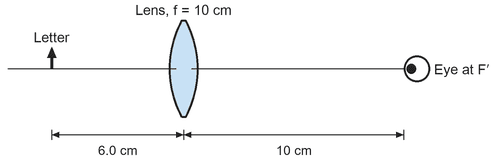
(a) The page is from the lens. Find the position and size of the image of the letter, and the angle the image subtends at his eye.
(b) The page is moved to from the lens. Find the same three quantities again.
(c) What do you notice about the angle? Explain it using the ray from the top of the letter that reaches his eye.
- 71 mark
Question 7
Competency: Analysis & Evaluation
A student tries to read the expiry date printed on a medicine strip held from her eye, but the print is blurred. She then holds a convex lens of focal length against her eye, with the strip still away. Her near point is . (Hypothetical data.)
Assertion (A): With the lens against her eye, she sees the print sharply, although it is only away.
Reason (R): The lens forms a virtual image of the print about from her eye, beyond her near point, so her eye can focus on it.
- 81 mark
Question 8
Competency: Application
A school biology kit has three hand lenses, marked , and . A student whose near point is wants to see the hairs on a bee's leg as large as possible while keeping her eye relaxed, with the final image at infinity. (Hypothetical data.) Which choice is correct?
- 94 marks
Question 9
Competency: Application
A school microscope has an objective of focal length and an eyepiece of focal length , fixed apart. A student whose near point is looks at a slide of cheek cells, with her eye close to the eyepiece. (Hypothetical data.)
(a) She first focuses for a relaxed eye (final image at infinity). How far from the objective is the specimen?
(b) She then refocuses, without changing the distance between the lenses, so that the final image is at her near point. Through what distance, and in which direction, must the specimen move?
(c) Find the magnifying power in each setting.
- 104 marks
Question 10
Competency: Application
A school turns a microscope into a digital microscope. The eyepiece is removed, and a camera sensor is fixed in the tube exactly where the objective forms its real image. The objective has a focal length of and must form an image times as long as the specimen. Each pixel of the sensor is wide. (Hypothetical data.)
(a) How far from the objective must the specimen and the sensor be?
(b) A diatom (a one-celled alga) is long. How many pixels long is its image on the sensor?
(c) The sensor's image is shown on a monitor wide with pixels across, one sensor pixel to one screen pixel, and viewed from . How many times larger is the angle the diatom's picture subtends at the eye than the angle the diatom itself would subtend at the naked eye from ?
- 111 mark
Question 11
Competency: Analysis & Evaluation
While looking down through a school compound microscope, a student slowly pushes the slide towards her left.
Assertion (A): The image she sees moves towards her right.
Reason (R): The eyepiece of a compound microscope forms a virtual image.
- 121 mark
Question 12
Competency: Analysis & Evaluation
The International Liquid Mirror Telescope at Devasthal in Uttarakhand uses a dish of liquid mercury about across as its main mirror. The dish spins steadily about a vertical axis, and the surface of the mercury takes up a curved shape that focuses starlight.
Assertion (A): Like an ordinary reflecting telescope, this liquid-mirror telescope can be turned to point at any part of the sky.
Reason (R): The surface of a spinning liquid takes the shape of a paraboloid whose axis is vertical, which is the shape needed to focus light from a star directly overhead.
- 131 mark
Question 13
Competency: Application
A student's microscope has an objective of focal length and an eyepiece of focal length , placed apart. She views with a relaxed eye (final image at infinity; near point ). She then pulls out the draw tube so that the lenses are apart, and refocuses, still with a relaxed eye. (Hypothetical data.) What happens?
- 144 marks
Question 14
Competency: Application
On an optical bench, a student makes an astronomical telescope to look at a distant window. The objective (focal length ) is fixed at the mark, and the eyepiece (focal length ) is placed at the mark, as shown in the figure. Her eye is close to the eyepiece and her near point is . Treat the window as very far away. (Hypothetical data.)

(a) At which mark should the eyepiece be for viewing with a relaxed eye (final image at infinity)?
(b) With the eyepiece at the mark, where is the final image? Can she see it clearly?
(c) Between which two marks can the eyepiece be placed for her to see a clear image?
- 153 marks
Question 15
Competency: Application
A pair of binoculars is marked "": its magnifying power is and each objective is across. Each half works as an astronomical telescope in normal adjustment, with an objective of focal length , but the body is only about long because two prisms fold the light path. (Hypothetical data.)
(a) Find the focal length of the eyepiece and the distance between the objective and the eyepiece measured along the light path.
(b) Give two reasons why the prisms are used.
(c) A bird wide sits on a wire away. Find the angle it subtends at the naked eye and through the binoculars, and how close it would have to come to look as large to the naked eye.
- 161 mark
Question 16
Competency: Analysis & Evaluation
An observer looks at a distant hill through an astronomical telescope with a relaxed eye. She then turns the telescope towards a bird on a tree about away.
Assertion (A): To see the bird with a relaxed eye, she must increase the distance between the objective and the eyepiece.
Reason (R): For an object that is far away but not infinitely far, such as the bird, the objective forms its image beyond its second focal point.
- 171 mark
Question 17
Competency: Analysis & Evaluation
An astronomy club's telescope has an objective of focal length and an eyepiece of focal length . Inside the eyepiece, a circular opening across (the field stop) lies in the plane where the objective forms its image; only the part of that image inside the opening can be seen (see the figure). The Pleiades star cluster spans about of the sky. (Hypothetical data.) What is the widest angle of sky that the telescope shows at one time?

- 184 marks
Question 18
Competency: Application
An amateur astronomer grinds a concave mirror across, with a radius of curvature of , for a Newtonian reflecting telescope. The figure shows the depth she must grind. (Hypothetical data.)
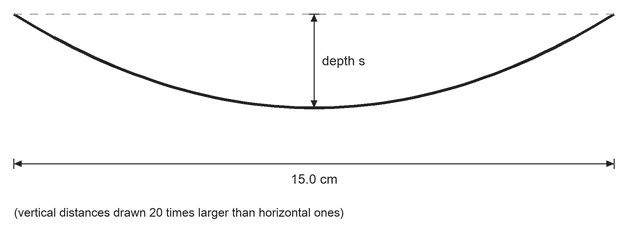
(a) Find the focal length of the mirror, and the depth of the hollow at its centre, measured from the straight line joining its edges.
(b) For sharp star images the mirror's surface must be correct to within about one-eighth of the wavelength of light (). How many times smaller than the depth is this allowed error?
(c) Using Rayleigh's criterion with , find the smallest distance between two craters on the Moon ( away) that this mirror can show as separate.
- 191 mark
Question 19
Competency: Analysis & Evaluation
A visitor to a large observatory reads about its main mirror.
Assertion (A): The largest optical telescopes today, with mirrors about across, have primary mirrors made of many smaller hexagonal segments.
Reason (R): A single piece of glass across would be too heavy and too hard to cast, polish, support and transport.
- 201 mark
Question 20
Competency: Application
A school has a reflecting telescope with a primary mirror across and a refracting telescope with an objective across. In the reflector the light is reflected by two aluminium-coated mirrors, each of which reflects per cent of the light falling on it; the refractor's objective lets through per cent. Ignore the light blocked by the reflector's small mirror. (Hypothetical data.) How many times as much light from a star reaches the eyepiece of the reflector as reaches the eyepiece of the refractor?
- 211 mark
Question 21
Competency: Analysis & Evaluation
Two reflecting telescopes have mirrors of the same diameter, . Mirror P has a focal length of and mirror Q a focal length of . Both are used with the same eyepiece, of focal length , in normal adjustment. (Hypothetical data.) Which statement is correct?
- 223 marks
Question 22
Competency: Application
An Earth-observation satellite orbits above the ground. Its camera must show two objects apart on the ground as separate. Take the wavelength of light as , use Rayleigh's criterion, and ignore the blurring caused by the atmosphere. (Hypothetical data.)
(a) Find the smallest angle that the camera's telescope must resolve.
(b) Find the smallest diameter that its objective mirror can have.
(c) A news report claims that such a satellite can read the number plate of a car. The strokes of the characters on a number plate are about apart. Check the claim.
- 231 mark
Question 23
Competency: Analysis & Evaluation
A student looks at the same faint star through two telescopes that are identical except for the diameter of the objective.
Assertion (A): The telescope with the larger objective shows the star brighter.
Reason (R): The telescope with the larger objective has a smaller limit of resolution.
- 241 mark
Question 24
Competency: Analysis & Evaluation
Assertion (A): Large optical telescopes are usually built on high, dry mountain sites, such as the Indian Astronomical Observatory at Hanle in Ladakh, rather than near sea level.
Reason (R): At high altitude the wavelength of starlight is shorter, so the limit of resolution of a telescope is smaller there.
- 251 mark
Question 25
Competency: Analysis & Evaluation
On a still, clear night a student looks at two small lamps on a distant tower through her telescope, whose objective is across and whose eyepiece gives a magnifying power of . However carefully she focuses, the two lamps look like a single blur. (Hypothetical data.) Which single change could let her see them as two separate lamps?
- 264 marks
Question 26
A compound microscope is used to project the image of a specimen onto a screen. The objective has a focal length of and the specimen is in front of it. The eyepiece, of focal length , is moved so that it forms a sharp real image on a screen behind it. (Hypothetical data.)
(i) Find the separation of the two lenses.
(ii) Find the total magnification, and state whether the image on the screen is erect or inverted compared with the specimen.
(iii) A part of the specimen is long. How long is its image on the screen?
- 274 marks
Question 27
A Cassegrain reflecting telescope has a concave primary mirror of focal length with a small central hole. A small convex secondary mirror faces it on the axis, in front of the primary. Light from a distant star, reflected by both mirrors, forms a real final image behind the primary, through the hole, as shown in the figure. (Hypothetical data.)
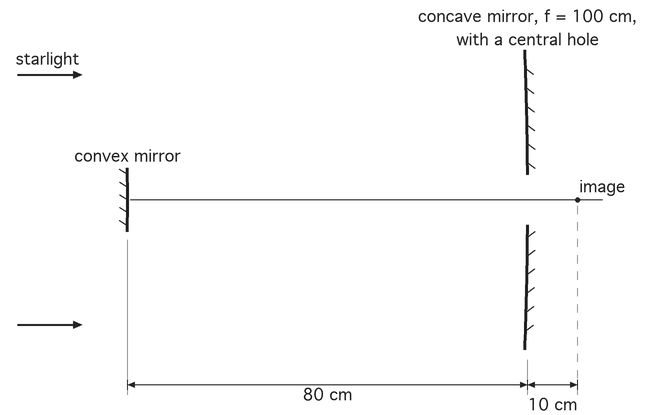
(a) Find the focal length of the convex mirror.
(b) By what factor does the convex mirror enlarge the image that the primary alone would have formed? What is the focal length of a single concave mirror that would give the same image size?
(c) Find the magnifying power with an eyepiece of focal length in normal adjustment. Compare the length of this telescope with that of a refracting telescope of the same magnifying power using the same eyepiece.
- 283 marks
Question 28
A converging lens of focal length 6.25 cm is used as a magnifying glass. If the near point of the observer is 25 cm from the eye and the lens is held close to the eye, calculate (i) the distance of the object from the lens and (ii) the angular magnification. Find the angular magnification when the final image is formed at infinity.
- 294 marks
Question 29
An object is kept at a distance of 6 cm from a magnifier of focal length 7 cm and is viewed through it by keeping the eye (a) just close to the lens and (b) 15 cm from the lens. Compare the magnifying power in each case.
- 303 marks
Question 30
The focal lengths of the objective and the eyepiece of a compound microscope are 2 cm and 5 cm respectively. At what distance an object must be placed in order that the magnification produced by the compound microscope is 20. The least distance of distinct vision is 25 cm.
- 313 marks
Question 31
In compound microscope the focal length of the objective is 1 cm and that of the eyepiece is 2.5 cm. The real image formed by the objective is 12 cm from it. Calculate the magnification if the final image is at the minimum distance of distinct vision.
- 324 marks
Question 32
In a certain microscope the focal length of the objective is 0.8 cm and that of the eyepiece is 2.0 cm. The distance between the objective and the eyepiece is 15 cm. At what distance from the objective should an object be placed in order to obtain the final image at (i) the least distance of distinct vision and (ii) at infinity?
- 333 marks
Question 33
A linear object of size 0.07 cm is placed at a distance of 2 cm from the objective of a compound microscope. Find the size of the image produced if the focal lengths of the objective and the eyepiece are 1.5 cm and 3.5 cm respectively. Take cm.
- 343 marks
Question 34
An angular magnification of 30 X is desired using an objective of focal length 1.25 cm and an eyepiece of focal length 5 cm. How will you set up the compound microscope?
- 353 marks
Question 35
In a compound microscope the objective and the eyepiece have focal length of 0.95 cm and 5 cm respectively and are kept at a distance of 20 cm. The last image is formed at a distance of 25 cm from the eyepiece. Calculate the position of the object and the total magnification.
- 363 marks
Question 36
An astronomical telescope having magnifying power of 4 consists of two thin lenses 20 cm apart. Find the focal length of the lenses when the telescope is set for normal adjustment.
- 373 marks
Question 37
The focal length of the objective of an astronomical telescope is 80 cm and that of the eyepiece is 5 cm. If the final image is formed at a distance 25 cm from the eye, calculate the magnification produced.
- 383 marks
Question 38
A telescope with an objective of focal length 25 cm is used to observe an object 175 cm away from the objective. When the eyepiece is adjusted to form the image at infinity the magnifying power is 6. Find (a) the focal length of the eyepiece and (b) the magnifying power of the telescope, if the eyepiece is adjusted to view objects at infinity.
- 393 marks
Question 39
An astronomical telescope is set in the normal adjustment position. The telescope is focussed for infinity, so that the object and the image are both at infinity. Show that the position of the eye ring is given by .
- 404 marks
Question 40
In a Galilean telescope the objective has a focal length of 120 cm and its eyepiece has a focal length of 3 cm. This telescope is used to focus an object 1 m away from the objective. Find the tube length and the angular magnification, if the final image is formed at infinity.
- 413 marks
Question 41
A compound microscope consists of two convex lenses of focal lengths 2 cm and 5 cm. When an object is kept at a distance of 2.1 cm from the objective, a virtual and magnified image is formed 25 cm from the eyepiece. Calculate the magnifying power of a microscope.
- 423 marks
Question 42
A compound microscope consists of two convex lenses of focal lengths 1.5 cm and 5 cm. When an object is kept at a distance of 1.6 cm from the objective, the final image is formed at the least distance of distinct vision ( cm). Calculate the magnifying power of the compound microscope.