
Opening your dashboard
Class 12 Physics Chapter 18 Optical Instruments: Previous Year Questions
19 questions on Chapter 18, each solved step by step. Class 12 Physics, ICSE 2026-27.
19 questions with solutions
1–5 marks · Mixed difficulty
- 11 mark
Question 1
What type of lens is used to correct long-sightedness?
Solve with AIWritten solution
Solution:
Key idea: A long-sighted (hypermetropic) eye sees distant objects clearly but cannot focus on near objects, because the image of a near object would form behind the retina.
Step 1 — Find what the eye lacks.
The eye lens of a long-sighted person does not converge light enough (or the eyeball is too short), so rays from a near object meet behind the retina.
Step 2 — Choose the correcting lens.
A converging lens adds the missing converging power. It makes the rays from a near object (at ) appear to come from the person's own near point, which lies farther away, so the eye can focus them on the retina.
Therefore, long-sightedness is corrected with a convex (converging) lens.
- 21 mark
Question 2
State any one advantage of using a reflecting telescope in place of a refracting telescope.
Solve with AIWritten solution
Solution:
Key idea: A reflecting telescope uses a concave mirror instead of a lens as its objective. A mirror reflects all colours in the same way, while a lens refracts different colours by different amounts.
Step 1 — Recall the defect of a lens objective.
A lens bends violet light more than red light, so the different colours of a white star come to a focus at slightly different points. The image shows coloured fringes; this is chromatic aberration.
Step 2 — Compare with a mirror.
The law of reflection does not depend on wavelength, so a mirror brings all colours to the same focus. (A paraboloidal mirror also removes spherical aberration, and a large mirror can be supported from its back, so it can be made much bigger than a lens.)
Therefore, a reflecting telescope is free from chromatic aberration, which a refracting telescope suffers from.
- 33 marks
Question 3
Draw a labelled ray diagram of an image formed by a compound microscope, when the final image lies at the least distance of distinct vision (D).
Solve with AIWritten solution
Solution:
Key idea: A compound microscope has two convex lenses. The objective (very short focal length ) forms a real, inverted, magnified image of an object placed just beyond its focus. The eyepiece (focal length ) acts as a simple microscope: lies just inside its focus, so the final image is virtual, magnified and at the least distance of distinct vision .
Step 1 — Draw the rays through the objective.
The object AB is placed just beyond the first focus of the objective. A ray from A parallel to the axis is refracted through the second focus , and a ray through the optical centre goes on undeviated. They meet at , giving the real, inverted image .
Step 2 — Draw the rays through the eyepiece.
The eyepiece is placed so that lies between its optical centre and its focus . From , one ray goes parallel to the axis and is refracted through the second focus ; another goes through the optical centre of the eyepiece undeviated.
Step 3 — Locate the final image.
These two rays diverge after the eyepiece. Extended backwards (dashed lines), they meet at , so the final image is virtual, inverted with respect to AB, highly magnified and at the distance from the eyepiece (the eye is close to the eyepiece).

Therefore, the labelled diagram above shows the compound microscope: the objective forms the real image A₁B₁ just inside Fₑ, and the eyepiece forms the final virtual, inverted, magnified image A₂B₂ at the least distance of distinct vision D.
- 42 marks
Question 4
With regard to an astronomical telescope of refracting type, state how you will increase its:
(i) magnifying power
(ii) resolving power
Solve with AIWritten solution
Solution:
Key idea: For a refracting astronomical telescope in normal adjustment the magnifying power is , and the resolving power is , where is the diameter (aperture) of the objective and the wavelength of light.
Step 1 — Part (i): increase the magnifying power.
The magnifying power is the ratio of the focal lengths, so it grows when the numerator grows or the denominator shrinks.
We use an objective of larger focal length and an eyepiece of smaller focal length .
Step 2 — Part (ii): increase the resolving power.
The resolving power is directly proportional to the aperture of the objective.
We use an objective of larger diameter (aperture). The eyepiece has no effect on the resolving power.
Therefore, (i) the magnifying power is increased by using an objective of longer focal length and an eyepiece of shorter focal length; (ii) the resolving power is increased by using an objective of larger aperture.
- 51 mark
Question 5
What is meant by short-sightedness?
Solve with AIWritten solution
Solution:
Key idea: A normal eye can focus objects from its near point (about ) out to infinity (its far point). In a defective eye one of these limits moves.
Step 1 — Describe the defect.
A short-sighted (myopic) person sees nearby objects clearly but cannot see distant objects clearly. The far point of the eye is at a finite distance instead of at infinity.
Step 2 — Give its cause and correction.
Parallel rays from a distant object meet in front of the retina, because the eyeball is too long or the eye lens converges too strongly. It is corrected with a concave (diverging) lens.
Therefore, short-sightedness (myopia) is the defect in which distant objects cannot be seen clearly, because their image forms in front of the retina; near objects are seen clearly.
- 62 marks
Question 6
A convex lens of a focal length is used as a simple microscope. Where should an object be placed so that the image formed by it lies at the least distance of distinct vision ()?
Solve with AIWritten solution
Solution:
Key idea: A convex lens used as a simple microscope forms a virtual, erect, magnified image when the object is placed between the lens and its focus. We find the object distance from the lens formula , with distances measured against the incoming light taken as negative (New Cartesian convention).
Step 1 — Write the data with signs.
The lens is convex, so its focal length is positive.
The virtual image is on the same side as the object, at the least distance of distinct vision.
Step 2 — Rearrange the lens formula for u.
We move to one side.
Step 3 — Substitute the values.
We put in and .
Step 4 — Interpret the answer.
The minus sign shows that the object is on the same side as the incoming light, in front of the lens. Its distance is less than the focal length , so it lies between the lens and its focus, as a simple microscope needs. The magnification tells us how much larger the image is.
So the image is erect and six times larger. The figure is drawn to scale.
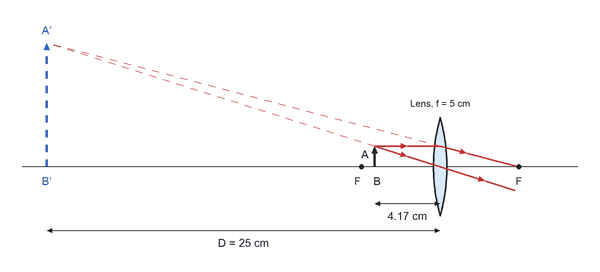
Therefore, the object should be placed 25/6 cm ≈ 4.17 cm in front of the lens, between the lens and its focus.
- 73 marks
Question 7
Draw a labelled ray diagram showing the formation of an image by a refracting telescope when the final image lies at infinity.
Solve with AIWritten solution
Solution:
Key idea: A refracting astronomical telescope has an objective of long focal length and large aperture, and an eyepiece of short focal length . For a final image at infinity (normal adjustment) the image formed by the objective lies at the focus of the objective and also at the focus of the eyepiece, so the lenses are apart.
Step 1 — Draw the rays through the objective.
Light from the top of a distant object arrives as a parallel beam inclined at a small angle to the axis. The objective brings this beam to a point in its focal plane, so it forms a real, inverted, diminished image at its focus.
Step 2 — Place the eyepiece.
The eyepiece is placed so that its first focus coincides with . The image is then at the focus of the eyepiece.
Step 3 — Draw the emergent rays.
Rays diverging from leave the eyepiece parallel to one another, parallel to the dashed line from through the centre of the eyepiece. Parallel rays mean the final image is at infinity; it is inverted, and it subtends the larger angle at the eye.
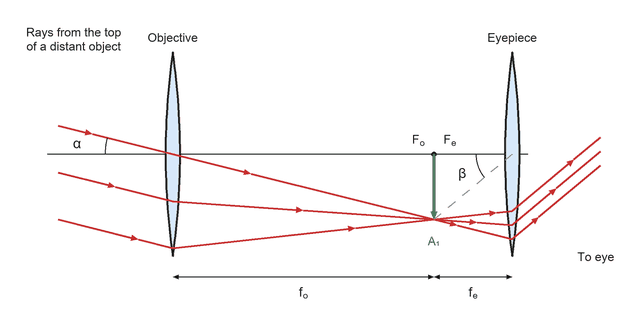
Therefore, the labelled diagram above shows the telescope in normal adjustment: the objective forms the real image FₒA₁ at the common focus, and the rays leave the eyepiece parallel, so the final inverted image is at infinity.
- 83 marks
Question 8
A compound microscope consists of two convex lenses of focal length and . When an object is kept at a distance of from the objective, a virtual and magnified image is formed from the eye piece. Calculate the magnifying power of the microscope.
Solve with AIWritten solution
Solution:
Key idea: The magnifying power of a compound microscope is the product of the magnification of the objective and that of the eyepiece, .
The objective gives .
An eyepiece forming the final image at the least distance of distinct vision gives .
For a normal eye the least distance of distinct vision is .
Step 1 — Decide which lens is the objective.
The objective of a microscope has the shorter focal length, so and . The object is from the objective, just beyond its focus, so .
Step 2 — Find the image formed by the objective.
We use the lens formula for the objective.
Step 3 — Find the magnification of the objective.
The magnification is the ratio of the image distance to the object distance.
The minus sign shows the image is real and inverted.
Step 4 — Find the magnification of the eyepiece.
The final image is from the eyepiece, which is the least distance of distinct vision , so the eyepiece works as a simple microscope with its image at .
Step 5 — Multiply the two magnifications.
The size of the magnifying power is the product of the two magnifications.
The final image is inverted with respect to the object, so with signs .
Watch out: Use only when the final image is at ; for a final image at infinity it would be .
Therefore, the magnifying power of the microscope is 120 (the final image is inverted, so M = −120 with signs).
- 92 marks
Question 9
(i) What is meant by resolving power of a telescope ?
(ii) State any one method of increasing the resolving power of an astronomical telescope.
Solve with AIWritten solution
Solution:
Key idea: Two distant objects (for example two stars) very close together in the sky can be seen as separate only if the diffraction patterns of their images do not overlap too much. By Rayleigh's criterion the smallest angle a telescope can resolve is , where is the diameter of the objective and the wavelength of light.
Step 1 — Part (i): define resolving power.
The resolving power of a telescope is its ability to show two distant objects that are very close together as two separate objects. It is measured as the reciprocal of the smallest angular separation between two distant objects whose images are just resolved.
Step 2 — Part (ii): state a method of increasing it.
The formula shows that the resolving power is directly proportional to the aperture of the objective. So we use an objective lens (or mirror) of larger diameter.
Therefore, (i) resolving power is the reciprocal of the smallest angular separation of two distant objects that the telescope can just show as separate, R.P. = a/(1.22λ); (ii) it is increased by using an objective of larger aperture.
- 105 marks
Question 10
Draw a labelled ray diagram of an image formed by a refracting telescope with final image formed at inifity. Derive an expression for its magnifying power with the final image at infinity.
Solve with AIWritten solution
Solution:
Key idea: The magnifying power of a telescope is , where is the angle the distant object subtends at the eye (the same as at the objective, since the object is very far away) and is the angle the final image subtends at the eye. In normal adjustment the image formed by the objective lies at the common focus of the two lenses.
Step 1 — Draw the ray diagram.
A parallel beam from the top of a distant object, inclined at angle to the axis, is focused by the objective at in its focal plane. The real, inverted image (height ) lies at the focus of the objective, which is also the first focus of the eyepiece. The rays from leave the eyepiece parallel, so the final image is at infinity.
Step 2 — Write the angle α in terms of the image.
The ray from the top of the object through the optical centre of the objective goes on undeviated to . In the right triangle formed with the axis, the side opposite is and the adjacent side is . The angle is small, so .
Step 3 — Write the angle β in terms of the image.
The emergent rays are parallel to the line joining to the optical centre of the eyepiece, so this line makes the angle with the axis. Its triangle has opposite side and adjacent side .
Step 4 — Divide β by α.
The magnifying power is the ratio of the two angles.
Step 5 — Interpret the result.
The final image is inverted, so with signs the result is often written . A large magnifying power needs an objective of long focal length and an eyepiece of short focal length. The length of the telescope in this adjustment is .
Therefore, for a refracting telescope with the final image at infinity, the magnifying power is M = fₒ/fₑ (in size; M = −fₒ/fₑ with signs, since the image is inverted).
- 115 marks
Question 11
Draw a neat labelled ray diagram showing the formation of an image at the least distance of distinct vision D by a simple microscope. When the final image is at D, derive an expansions for its magnifying power at D.
Solve with AIWritten solution
Solution:
Key idea: A simple microscope is a convex lens of short focal length . With the object between the lens and its focus, the lens forms a virtual, erect, magnified image. Its magnifying power is , where is the angle the image subtends at the eye (held close to the lens) and is the angle the object subtends at the unaided eye when placed at the least distance of distinct vision .
Step 1 — Draw the ray diagram.
The object AB (height ) is placed inside the focus F. A ray from A parallel to the axis is refracted through the focus F on the other side, and a ray through the optical centre goes on undeviated. These rays diverge; extended backwards (dashed lines), they meet at . The image is virtual, erect, magnified and at the distance .

Step 2 — Write the angle α for the unaided eye.
Without the lens, the object is seen most clearly at the distance . The angle it subtends at the eye is small, so .
Step 3 — Write the angle β with the lens.
With the lens, the image subtends at the eye the same angle as the object AB, because both lie on the same lines through the optical centre. Let the object distance be .
Step 4 — Form the magnifying power.
We divide β by α; the height cancels.
Step 5 — Find |u| from the lens formula.
We use the lens formula with the image at and the object at .
Step 6 — Substitute into M.
We multiply the last result by to get .
A lens of shorter focal length therefore gives a larger magnifying power.
Therefore, the magnifying power of a simple microscope with the final image at D is M = 1 + D/f.
- 121 mark
Question 12
In an astronomical telescope of refracting type.
Solve with AIAnswer
(A) Objective should have small focal length.
- Correct
(B) Objective should have large focal length.
(C) Eyepiece should have large focal length
(D) Both objective and eyepieces should have large focal length
Answer: (B) Objective should have large focal length.
Key idea: In normal adjustment the magnifying power of a refracting astronomical telescope is , where is the focal length of the objective and that of the eyepiece.
Step 1 — Find what makes M large.
The ratio is large when the numerator is large and the denominator is small.
Step 2 — Pick the matching option.
So the objective should have a large focal length (and a large aperture, to collect more light), while the eyepiece should have a small focal length. Only option (B) says this.
Why the others are wrong:
- (A) An objective of small focal length would make small; a short-focus objective is what a microscope uses, not a telescope.
- (C) An eyepiece of large focal length makes the denominator large, so the magnifying power falls.
- (D) If both focal lengths are large the ratio need not be large, and a long-focus eyepiece reduces the magnifying power.
Therefore, the objective of a refracting astronomical telescope should have a large focal length, option (B).
- 133 marks
Question 13
A compound microscope consists of two convex lenses having focal length of 1.5cm and 5cm. When an object is kept at a distance of 1.6cm from the objective, the final image is virtual and lies at a distance of 25cm from the eyepiece. Calculate magnifying power of the compound microscope in this set-up.
Solve with AIWritten solution
Solution:
Key idea: The magnifying power of a compound microscope is the product of the two magnifications, .
The objective gives , with found from the lens formula .
An eyepiece forming the final image at the least distance of distinct vision gives .
For a normal eye the least distance of distinct vision is .
Step 1 — Decide which lens is the objective.
The objective has the shorter focal length, so and . The object is in front of the objective, so .
Step 2 — Find the image formed by the objective.
We rearrange the lens formula for .
Step 3 — Find the magnification of the objective.
We divide the image distance by the object distance.
Step 4 — Find the magnification of the eyepiece.
The final virtual image is from the eyepiece, that is at , so the eyepiece acts as a simple microscope with its image at .
Step 5 — Multiply the two magnifications.
The size of the magnifying power is the product of the two.
The final image is inverted with respect to the object, so with signs .
Therefore, the magnifying power of the compound microscope in this set-up is 90 (M = −90 with signs, since the final image is inverted).
- 141 mark
Question 14
What is meant by a microscope in normal use?
Solve with AIWritten solution
Solution:
Key idea: The final image formed by a microscope can be placed anywhere from the least distance of distinct vision out to infinity. The magnifying power is greatest when the final image is at .
Step 1 — State the meaning.
A microscope is said to be in normal use when it is adjusted so that the final, virtual image is formed at the least distance of distinct vision, from the eye, which is held close to the eyepiece.
Step 2 — Say why this setting is used.
At this setting the image is seen clearly and the magnifying power is the largest possible, for example for a simple microscope. (If the final image is at infinity, the eye is relaxed but the magnifying power is a little smaller.)
Therefore, a microscope is in normal use when its final image is formed at the least distance of distinct vision, D = 25 cm, from the eye.
- 155 marks
Question 15
Read the passage given below and answer the question that follows.
There are two types of optical instruments: Microscopes and Telescopes. Microscopes are used to magnify very tiny objects whereas telescopes are used to study distant objects. Both of them deploy convex lenses. In his telescope, Newton used a large parabolic mirror to collect light from the stars and reduce aberrations.
i. Rohit observed the launch of Chandrayan 3 with the help of an optical instrument. Name the instrument used by him.
ii. State any one advantage of a reflecting telescope over a refracting telescope.
iii. Which instrument is used to study the structure of a virus?
iv. What is the ability of an optical instrument to form enlarged images called?
v. What is the difference between a compound microscope and an astronomical telescope (refracting type), as far as their lenses are concerned?
Solve with AIWritten solution
Solution:
Key idea: A microscope gives an enlarged image of a tiny nearby object; a telescope increases the angle that a distant object subtends at the eye. A reflecting telescope uses a concave mirror as its objective. The magnifying power of an instrument is the ratio of the angle subtended at the eye by the image to the angle subtended by the object seen without the instrument.
Step 1 — Part i: name the instrument.
The rocket was far away from Rohit, and an instrument that makes distant objects appear larger and nearer is a telescope (a terrestrial telescope or a pair of binoculars, which are two small telescopes side by side). So Rohit used a telescope.
Step 2 — Part ii: give an advantage of a reflecting telescope.
A mirror reflects all colours in the same way, so a reflecting telescope is free from chromatic aberration (a paraboloidal mirror also removes spherical aberration). A large mirror can also be supported from its back, so it can be given a much larger aperture than a lens, which collects more light and gives a higher resolving power.
Step 3 — Part iii: name the instrument for a virus.
An optical microscope cannot resolve details much smaller than about , because light has wavelengths of about to . Most viruses are smaller than this, so their structure is studied with an electron microscope, which uses electron beams of much shorter wavelength.
Step 4 — Part iv: name the ability.
The ability of an optical instrument to form an enlarged image is called its magnifying power (magnification).
Step 5 — Part v: compare the lenses.
In a compound microscope the objective has a very short focal length and a small aperture, and the eyepiece has a focal length larger than the objective's, so . In a refracting astronomical telescope the objective has a long focal length and a large aperture, and the eyepiece has a short focal length, so .
Note: Newton's first reflecting telescope (1668) actually used a small spherical metal mirror, only about across; large paraboloidal mirrors came later.
Therefore, i. a telescope; ii. it is free from chromatic aberration (and allows a larger aperture); iii. an electron microscope; iv. magnifying power; v. in a compound microscope the objective has a shorter focal length and smaller aperture than the eyepiece, while in a telescope the objective has a longer focal length and larger aperture than the eyepiece.
- 161 mark
Question 16
Hubble telescope employs a large parabolic mirror as an objective. State any one advantage of using a mirror in place of a lens in such a telescope.
Solve with AIWritten solution
Solution:
Key idea: A lens refracts different colours by different amounts, but the law of reflection is the same for every wavelength.
Step 1 — Recall the defect of a lens objective.
A lens objective focuses violet light a little nearer than red light, so the image of a star shows coloured fringes. This defect is chromatic aberration.
Step 2 — Compare with a mirror.
A mirror brings all colours to the same focus, so its image has no chromatic aberration. A large mirror can also be supported from its back and is much easier to make than a large lens, so the telescope can have a very large aperture, which collects more light and resolves finer detail.
Note: Strictly, Hubble's primary mirror is hyperbolic (a Ritchey–Chrétien design), not parabolic; the advantage of a mirror is the same.
Therefore, a mirror objective is free from chromatic aberration (and can be made with a much larger aperture than a lens).
- 172 marks
Question 17
A convex lens having small focal length is to be used as a magnifying glass (simple microscope) to obtain an image of a small diamond. If the image lies at least distance of distinct vision (D):
(i) Where will you keep the diamond to obtain its image at D?
(ii) State any two characteristics of the image formed by the magnifying glass.
Solve with AIWritten solution
Solution:
Key idea: A convex lens forms a virtual, erect, magnified image on the same side as the object only when the object lies between the lens and its focus. For the image to be at , the lens formula fixes the object distance.
Step 1 — Part (i): find where the diamond must be.
We put and into the lens formula.
This distance is a little less than , because is less than 1. So the diamond is kept between the lens and its focus, at a distance from the lens, on the side away from the eye.
Step 2 — Part (ii): describe the image.
The rays leaving the lens diverge, and their backward extensions meet on the object's side of the lens. So the image is virtual, erect (upright) and magnified, with magnification , and it lies at on the same side of the lens as the diamond.
Therefore, (i) the diamond is kept between the lens and its focus, at a distance fD/(f + D) from the lens; (ii) the image is virtual and erect (and also magnified).
- 181 mark
Question 18
The image below shows a compound microscope. Which one of the two lenses or has a larger focal length?
 Solve with AI
Written solution
Solution:
Key idea: In a compound microscope the lens near the object is the objective and the lens at the eye is the eyepiece. The objective must have a very short focal length to give a large first magnification, while the eyepiece has a larger focal length than the objective.
Step 1 — Identify the lenses in the picture.
Lens is at the top of the tube, where the eye looks in, so it is the eyepiece. Lens is just above the object, so it is the objective.
Step 2 — Compare their focal lengths.
The objective forms a large real image of an object placed just beyond its focus, and is large only when the focal length (and so ) is very small. The eyepiece only needs to magnify this image, and its focal length is larger than that of the objective ().
Therefore, L₁ (the eyepiece) has the larger focal length.
- 193 marks
Question 19
Draw a labelled diagram of an astronomical telescope when its final image lies at infinity.
Solve with AIWritten solution
Solution:
Key idea: An astronomical telescope in normal adjustment has its objective (long focal length ) and eyepiece (short focal length ) placed apart, so that the real image formed by the objective lies at the focus of the eyepiece and the final image is at infinity.
Step 1 — Draw the incoming beam and the objective.
Light from the top of a distant object arrives as a parallel beam at a small angle to the axis. The objective focuses it at in its focal plane, forming a real, inverted image at its focus.
Step 2 — Place the eyepiece.
The eyepiece is placed so that its focus coincides with , so the image is at the focus of the eyepiece.
Step 3 — Draw the emergent rays.
The rays from leave the eyepiece parallel to the dashed line from through the centre of the eyepiece. Parallel rays reaching the eye mean that the final image is at infinity. It is inverted and subtends the angle , larger than .
Therefore, the labelled diagram above shows the astronomical telescope with its final image at infinity: objective and eyepiece fₒ + fₑ apart, the image FₒA₁ at the common focus, and parallel emergent rays.