Solution:
Concept: A simple microscope is a convex lens of short focal length f. With the object inside the focal length it forms a virtual, erect, magnified image, and it lets the object be held much closer to the eye than the near point D. With the eye close to the lens, magnifying power M=αβ.
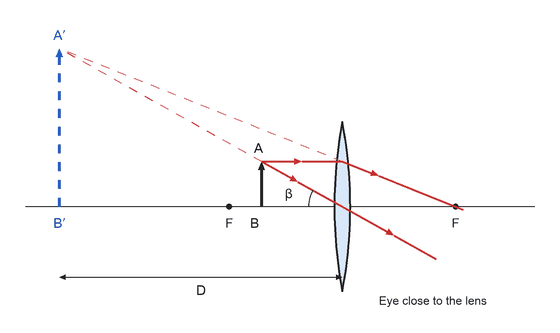
Step 1 — (a) Working. The object AB is placed between the lens and its focus F. A ray from A parallel to the axis is refracted through F; a ray through the optical centre goes straight. These rays diverge after the lens as if they came from A′, so the eye (close to the lens) sees a virtual, erect and magnified image A′B′. The object is moved until the image is at a comfortable distance, between D and infinity.

Step 2 — (b) Angular magnification. It is the ratio of the angle β subtended at the eye by the image to the angle α subtended at the eye by the object placed at the least distance of distinct vision D (figure above):
M=αβ
Step 3 — The two angles. Let the object have height h and stand at distance ∣u∣ from the lens, with the eye at the lens; the image then subtends the same angle as the object:
β=∣u∣h
α=Dh
Dividing, for every position of the image
M=∣u∣D
Step 4 — (c)(iii) Intermediate position. Let the image be at distance ∣v∣ from the lens (D≤∣v∣<∞). The lens formula with u=−∣u∣, v=−∣v∣ gives
∣u∣1=f1+∣v∣1
Multiply by D:
M=fD+∣v∣D
Step 5 — (c)(i) Image at the near point. Put ∣v∣=D:
M=fD+1
This is the largest magnifying power.

Step 6 — (c)(ii) Image at infinity. The object is at the focus, ∣u∣=f, and the rays leave parallel (figure above). Put ∣v∣→∞:
M=fD
This is the least magnifying power, but the eye is relaxed.
Step 7 — Compare. For intermediate positions M lies between fD and 1+fD.
Therefore, M=1+fD at the near point, M=fD at infinity, and M=fD+∣v∣D for an image at an intermediate distance ∣v∣.
