Solution:
Concept: A compound microscope has an objective of very short focal length fo and an eyepiece of short focal length fe. The objective forms a real, magnified image of the object; the eyepiece magnifies this image like a simple microscope.

Step 1 — (a) Working. The object AB is placed just beyond the focus Fo of the objective. The objective forms a real, inverted and magnified image A1B1 inside the tube. The eyepiece is adjusted so that A1B1 lies within its focal length; it then forms the final virtual, magnified image A2B2, inverted with respect to AB, at the near point (figure) or at infinity.
Step 2 — (b) Definition. The magnifying power is the ratio of the angle β subtended at the eye by the final image to the angle α subtended at the eye by the object placed at the least distance of distinct vision D:
M=αβ
Step 3 — The two angles. Let the object have height h and A1B1 height h1. The object at D subtends α=Dh. The final image subtends at the eye (close to the eyepiece) the same angle as A1B1, which is at distance ∣ue∣ from the eyepiece: β=∣ue∣h1. So
M=hh1×∣ue∣D
Step 4 — Magnification by the objective. For the objective, with object distance ∣uo∣ and image distance vo,
mo=hh1
mo=∣uo∣vo
Step 5 — (c)(i) Image at the near point. The eyepiece forms its image at D, so by the lens formula ∣ue∣1=fe1+D1, and
∣ue∣D=1+feD
Hence
M=∣uo∣vo(1+feD)
Since the object is close to Fo and A1B1 is close to the eyepiece, ∣uo∣≈fo and vo≈L (the tube length), so M≈foL(1+feD).
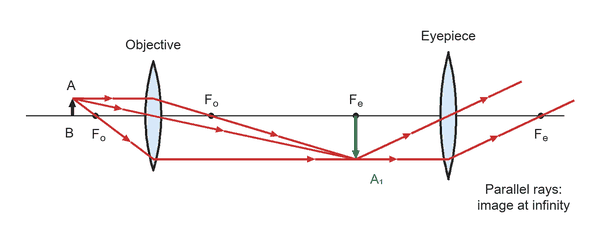
Step 6 — (c)(ii) Image at infinity. Now A1B1 is at the focus of the eyepiece, ∣ue∣=fe (figure above):
M=∣uo∣vo×feD
and approximately M≈foL×feD.
Step 7 — Conclusion. In both cases M is large when fo and fe are both small.
Therefore, M=∣uo∣vo(1+feD) for the final image at the near point and M=∣uo∣vo⋅feD for the final image at infinity.
