Solution:
Concept: An astronomical telescope has an objective of long focal length fo and large aperture, and an eyepiece of short focal length fe. The objective forms a real, inverted image of a distant object at its focus; the eyepiece magnifies it.
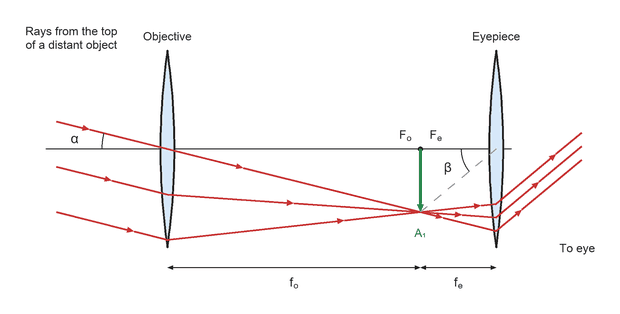
Step 1 — (a) Working. Parallel rays from the top of a distant object, inclined at angle α to the axis, are brought by the objective to A1 in its focal plane, forming the real, inverted image A1B1 (height h). The eyepiece is adjusted so that A1B1 is at its focus (normal adjustment, figure above) or just inside it (image at D). The eye sees the final, inverted and magnified image.
Step 2 — (b) Definition. The angular magnification is the ratio of the angle β subtended at the eye by the final image to the angle α subtended at the eye by the object:
M=αβ
Step 3 — The angle α. The object is very far away, so it subtends at the eye the same angle as at the objective, which is the angle A1B1 subtends at the objective:
α=foh
Step 4 — (c)(i) Final image at infinity. A1B1 is at the focus of the eyepiece, so β=feh:
M=h/foh/fe
M=fefo
The length of the telescope is fo+fe.

Step 5 — (c)(ii) Final image at D. Now A1B1 is at distance ∣ue∣ from the eyepiece, with ∣ue∣1=fe1+D1 (lens formula, image at D). Then β=∣ue∣h:
M=∣ue∣fo
M=fefo(1+Dfe)
This is larger than in normal adjustment. (With the sign convention both are written with a minus sign, for the inverted image.)

Step 6 — (d) Best position for the eye. The eye should be placed at the eye ring, the image of the objective formed by the eyepiece, just behind the eyepiece. In normal adjustment the objective is fo+fe from the eyepiece, so the eye ring is at
v=fofe(fo+fe)
from the eyepiece, which is slightly more than fe.
Step 7 — (e) Why it is best. Every ray that passes through the objective and the eyepiece also passes through the eye ring (figure). With the pupil there, the eye receives all the light collected by the objective, so the image is brightest and the field of view is largest.
Therefore, M=fefo for the image at infinity and M=fefo(1+Dfe) for the image at D; the eye is best placed at the eye ring, where all the refracted light passes, giving the largest field of view.
