
Question 725 marksHard
(a) Draw a ray diagram to show how distant objects are seen through a terrestrial telescope.
(b) Explain the function of the erecting lens.
(c) Write down an expression for its angular magnification.
Confirming your payment
Sign up now and get 250 free tokens.
Optical Instruments · Question 72 of 85
(a) Draw a ray diagram to show how distant objects are seen through a terrestrial telescope.
(b) Explain the function of the erecting lens.
(c) Write down an expression for its angular magnification.
Solution:
Concept: A terrestrial telescope is an astronomical telescope with an extra convex lens (the erecting lens) between the objective and the eyepiece, so that the final image of an object on the Earth is erect.
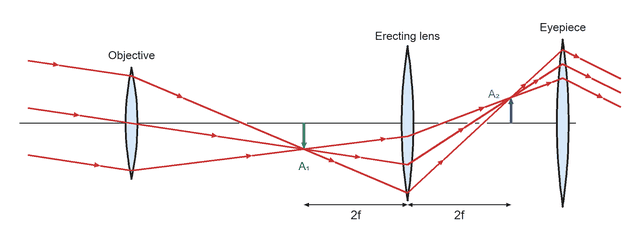
Step 1 — (a) Ray diagram. Parallel rays from the top of a distant object pass through the objective and form the real, inverted image at its focus. The erecting lens, of focal length , is placed at a distance from , so it forms a real image of the same size, at on the other side, and inverted again, that is, erect. is at the focus of the eyepiece, so the final image is at infinity and erect.
Step 2 — (b) Function of the erecting lens. The erecting lens only turns the inverted image upside down again. With object and image both at , its magnification is : it changes the orientation but not the size.
Step 3 — (c) Angular magnification. Since the erecting lens has unit magnification, the angular magnification is the same as for an astronomical telescope. In normal adjustment
and with the final image at
Step 4 — Length. The erecting lens adds to the length, so in normal adjustment the tube is long, which is the main disadvantage.
Therefore, the erecting lens makes the final image erect without changing its size, and the angular magnification is in normal adjustment.