Solution:
Concept: A refracting telescope uses a convex lens as the objective; a reflecting telescope uses a large concave mirror. The eyepiece is a lens in both.
Step 1 — (a) Difference. In a refracting telescope the objective is a lens, which has chromatic aberration and is hard to make large (it can be held only at its rim and sags). In a reflecting telescope the objective is a concave (often parabolic) mirror: it has no chromatic aberration, no spherical aberration if parabolic, no absorption of light in glass, and it can be supported from the back, so much larger apertures are possible. This gives brighter images and higher resolving power.
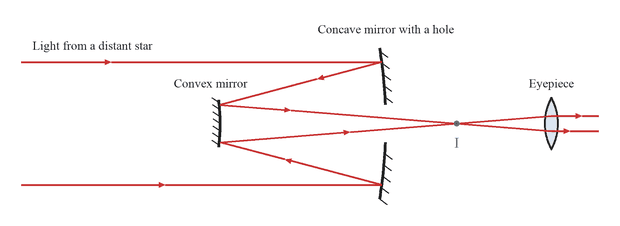
Step 2 — (b) Main parts. A Cassegrain reflecting telescope (figure) has a large concave mirror with a hole at its centre (the objective), a small convex mirror placed in front of it on the axis (the secondary), and an eyepiece behind the hole.
Step 3 — (b) Working. Parallel light from a distant star falls on the concave mirror and is reflected towards its focus. Before reaching it, the light meets the convex mirror, which reflects it back through the hole. The image I is formed just behind the concave mirror, and it is viewed through the eyepiece. When I is at the focus of the eyepiece, the final image is at infinity.
Step 4 — (c) Magnifying power. As for a refracting telescope, in normal adjustment
M=fefo
where fo is the focal length of the objective mirror (fo=2R, R its radius of curvature) and fe that of the eyepiece. In a Cassegrain telescope fo is the effective focal length of the mirror pair, which the convex mirror makes longer.
Therefore, a reflecting telescope uses a concave mirror (free from chromatic aberration, larger aperture) instead of a lens, and its magnifying power is M=fefo, where fo is the focal length of the objective (2R for a single mirror, the effective focal length of the mirror pair in a Cassegrain telescope).
