
Question 745 marksHard
(a) Define resolving power. Explain Rayleigh's criterion.
(b) What is limit of resolution of a telescope?
(c) Obtain the expression for resolving power of a telescope and microscope.
Confirming your payment
Sign up now and get 250 free tokens.
Optical Instruments · Question 74 of 85
(a) Define resolving power. Explain Rayleigh's criterion.
(b) What is limit of resolution of a telescope?
(c) Obtain the expression for resolving power of a telescope and microscope.
Solution:
Concept: Light passing through the circular aperture of a lens is diffracted, so a point source forms a small central bright disc surrounded by faint rings, not a point. Two such patterns can overlap so much that they look like one.
Step 1 — (a) Resolving power. The resolving power of an optical instrument is its ability to show two close point objects as separate. It is the reciprocal of the limit of resolution, the smallest separation (distance or angle) of two points that can just be seen as separate.
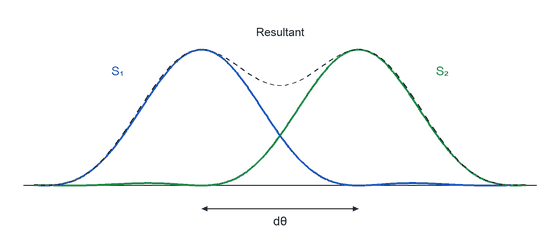
Step 2 — (a) Rayleigh's criterion. Two point sources are just resolved when the central maximum of the diffraction pattern of one falls on the first minimum of the other (figure). The resultant intensity then shows a dip of about 74% of the peak between the two maxima, which the eye can just notice. If the patterns are closer, they merge into one.
Step 3 — (b) Limit of resolution of a telescope. For an objective of diameter , the first minimum of the pattern is at angle from the centre. By Rayleigh's criterion the smallest angle between two just-resolved stars is
Step 4 — (c) Resolving power of a telescope. Take the reciprocal:
It increases with the aperture and decreases with the wavelength.
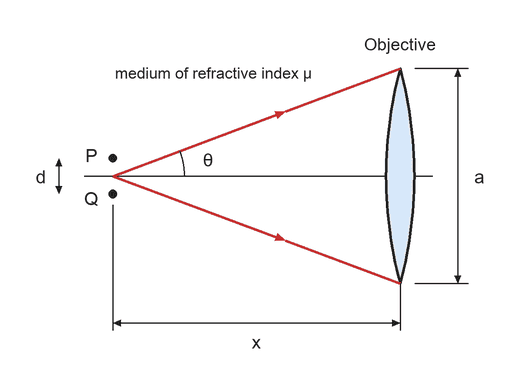
Step 5 — (c) Microscope: angular limit at the objective. Let two points of the object, distance apart, be at distance from the objective of diameter . They subtend the angle , which must be at least :
Step 6 — Use the half-angle of the cone. If is the half-angle of the cone of light from the object to the objective, , so :
Step 7 — Include the medium. If the space between object and objective is filled with a medium of refractive index , the wavelength there is :
Here is the numerical aperture of the objective.
Step 8 — Abbe's form. Abbe's criterion, which the book's own formula uses, leaves out the factor 1.22:
Therefore, the limit of resolution of a telescope is , its resolving power is , and the resolving power of a microscope is (with Rayleigh's factor, ).