
Question 683 marksMedium
Explain the working of a simple microscope and show that its angular magnification is given by
(i) when is the least distance of distinct vision.
(ii) for relaxed eye.
Confirming your payment
Sign up now and get 250 free tokens.
Optical Instruments · Question 68 of 85
Explain the working of a simple microscope and show that its angular magnification is given by
(i) when is the least distance of distinct vision.
(ii) for relaxed eye.
Solution:
Concept: A simple microscope is a convex lens of short focal length. With the object inside the focal length, it forms a virtual, erect and magnified image; it lets the object be held much closer than , so the visual angle increases. .
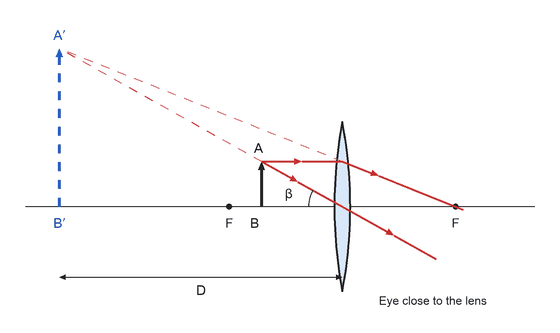
Step 1 — Working. The object AB is placed between the lens and its focus . The rays from A leave the lens diverging, as if from , so the eye sees a virtual, erect, magnified image . The object is adjusted until the image is at (or at infinity for a relaxed eye).
Step 2 — Angle without the lens. With the naked eye the object AB (height ) is seen best at the least distance of distinct vision , as the figure below shows.

There it subtends the angle
Step 3 — Angle with the lens. The eye is close to the lens, so the image subtends at the eye the same angle as the object AB does at the lens, from distance :
Step 4 — Divide the two angles. The magnifying power is the ratio of the two angles:
Step 5 — Use the lens formula. Put the image distance and the object distance into the lens formula:
Multiply both sides by :
Step 6 — Result. Hence
This proves part (i).

Step 7 — Relaxed eye (image at infinity). For a relaxed eye the object is placed at the focus, , and the rays leave parallel (second figure). The image subtends
Step 8 — Divide by . We divide by the naked-eye angle found in Step 2:
Therefore, (i) when the image is at , and (ii) for a relaxed eye.