Solution:
Concept: The focal length is f=P1. A telescope objective has the longer focal length. With the final image at the near point D, M=−fefo(1+Dfe). Light gathered ∝a2 and resolving power ∝a.
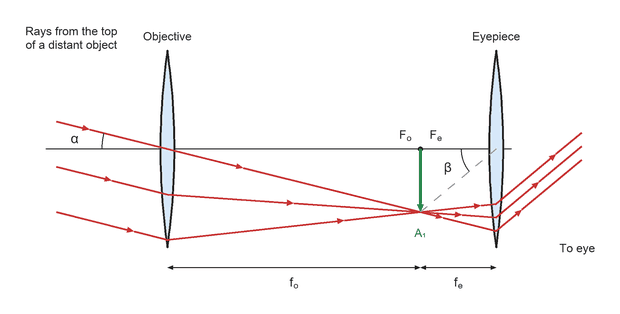
Step 1 — Ray diagram. The figure shows parallel rays from a distant object meeting at A1 in the common focal plane of the objective and eyepiece, and leaving the eyepiece parallel, so the final image is at infinity.
Step 2 — Choose the lenses. The 1 D lens has fo=1 m (longer), so it is the objective. The 10 D lens has fe=0.1 m, so it is the eyepiece. This makes fefo large.
Step 3 — Magnifying power at the near point. Put fo=1 m, fe=0.1 m and D=0.25 m:
M=−0.11(1+0.250.1)
M=−10×1.4
M=−14
Step 4 — Doubling the aperture. Light gathering power ∝a2, so it becomes 22=4 times. Resolving power ∝a, so it becomes 2 times.
Therefore, (i) the 1 D lens is the objective and the 10 D lens the eyepiece; (ii) M=−14; (iii) the light gathering power becomes 4 times and the resolving power 2 times.
