
Question 603 marksMedium
Draw a ray diagram to show how the image of a distant object is formed by a reflected astronomical telescope when in normal use. State one advantage over a refracting type telescope.
Confirming your payment
Sign up now and get 250 free tokens.
Optical Instruments · Question 60 of 85
Draw a ray diagram to show how the image of a distant object is formed by a reflected astronomical telescope when in normal use. State one advantage over a refracting type telescope.
Solution:
Concept: A reflecting (Cassegrain) telescope uses a large concave mirror as the objective. A small convex mirror reflects the converging light back through a hole in the concave mirror to form the image, which is viewed through an eyepiece. In normal use the final image is at infinity.
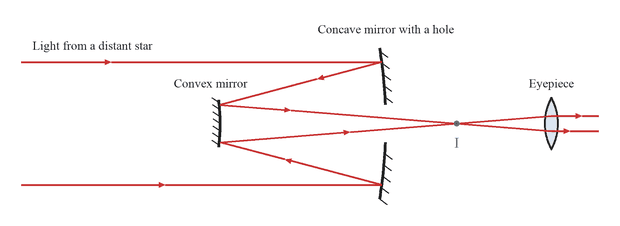
Step 1 — Concave mirror. Parallel rays from a distant star fall on the concave mirror and are reflected towards its focus.
Step 2 — Convex mirror. Before they reach that focus, a small convex mirror reflects them back along the axis. They pass through the central hole of the concave mirror and form the real image I behind it.
Step 3 — Eyepiece. The image I lies at the focus of the eyepiece, so the rays leave the eyepiece parallel and the final image is at infinity (normal use).
Step 4 — One advantage. A mirror objective has no chromatic aberration, since reflection does not depend on colour. (A large mirror is also easier to make and support, so a larger aperture and higher resolving power are possible.)
Therefore, the figure shows the image formed by the concave and convex mirrors; one advantage of a reflecting telescope is that it is free from chromatic aberration.