Solution:
Concept: We use the Cartesian sign convention: every distance is measured from the lens, positive in the direction in which light travels and negative against it. The lens formula is v1−u1=f1, with f positive for a convex lens.
For a near object the overall magnification is the ratio of the final image size to the object size. It is the product MoMe of the two lens magnifications, each given by uv for that lens.
Step 1 — Image formed by the objective. The scale is at uo=−2.0 m and fo=0.5 m:
vo1=0.51−2.01
vo1=2−0.5
vo1=1.5 m−1
vo≈0.667 m
Step 2 — Object distance for the eyepiece. The final image is at the distance of distinct vision, ve=−0.25 m, with fe=0.05 m:
ue1=−0.251−0.051
ue1=−4−20
ue1=−24 m−1
ue≈−0.0417 m
Step 3 — Separation of the lenses (part i). The separation is vo+∣ue∣:
L=0.6667+0.0417
L≈0.708 m
Step 4 — Overall magnification (part ii). We find each stage and multiply:
Mo=−2.00.6667
Mo=−31
Me=−0.04167−0.25
Me=6
M=−31×6
M=−2.0
Note: the book's printed 0.712 m and 1.99 come from rounding vo to 0.67 m and ue to 0.042 m before combining them; unrounded working gives 0.708 m and exactly 2.0, and both agree with the printed values to two significant figures (0.71 m, 2.0).
The figure shows the positions found above, drawn to scale along the axis.
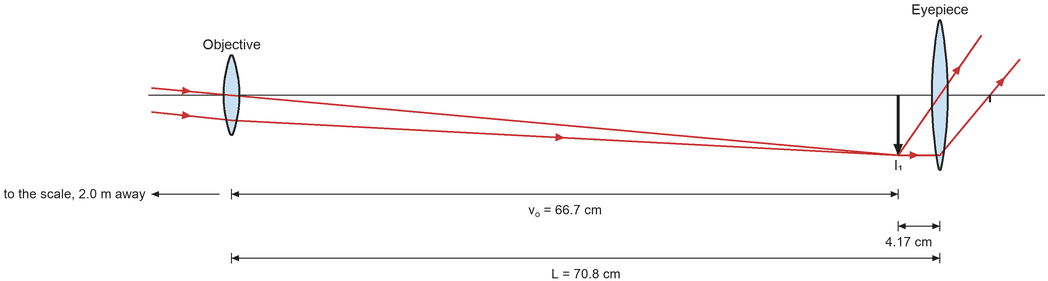
Therefore, (i) the lenses are about 0.708 m (≈ 0.71 m) apart and (ii) the overall magnification is −2.0 (the image of the scale is twice its size, inverted).
