
Opening your dashboard
Class 12 Physics Chapter 18 Optical Instruments: Practice Questions
103 questions on Chapter 18, each worked through on its own page with the AI tutor. Class 12 Physics, ICSE 2026-27.
103 questions
1–4 marks · Mixed difficulty
- 11 mark
Question 1
Three objects are seen with the unaided eye from where a student stands: a tall tower away, a wide stamp away, and a tall person away. (Hypothetical data.) Which one has the largest apparent size?
- 22 marks
Question 2
The Moon has a diameter of and is at a distance of from an observer on the Earth.
(i) Find the visual angle subtended by the Moon at the observer's eye, in radian and in degree.
(ii) A coin of diameter is held in front of one eye. How far from the eye must it be held so that it just covers the Moon?
- 31 mark
Question 3
A normal eye sees a distant star clearly and then, without delay, reads a book held at its near point of . Treat the eye as a single lens at a fixed distance from the retina. By how much does the power of the eye change between the two views?
- 43 marks
Question 4
A short-sighted student can see distant objects clearly only up to from her eye, and her near point is . (Hypothetical data.) Treat the spectacle lens as being very close to the eye.
(i) Find the focal length and power of the lens that lets her see very distant objects clearly.
(ii) While wearing these spectacles, what is the nearest distance at which she can read a book clearly?
- 53 marks
Question 5
A man aged 55 cannot read print held closer than from his eyes, though he sees distant objects clearly. (Hypothetical data.) Treat the spectacle lens as being very close to the eye.
(i) Find the focal length and power of the reading glasses that let him read print held at .
(ii) He borrows a friend's reading glasses of power instead. What is now the nearest distance at which he can read?
- 61 mark
Question 6
A woman can see clearly only those objects that lie between and from her eyes. (Hypothetical data.) She is given bifocal spectacles: the upper part lets her see very distant objects, and the lower part is for reading. Treat the lenses as being very close to the eye. The lower part has power . Through the lower part, over what range of distances can she see objects clearly?
- 73 marks
Question 7
On a standard distance-vision chart read from , each letter on the line for normal vision subtends a visual angle of (5 minutes of arc) at the eye, and each stroke of the letter subtends .
(i) Find the height of a letter on this line.
(ii) Find the width of one stroke of such a letter.
(iii) A printed letter is tall. At what distance from the eye does it subtend the same visual angle of ?
- 83 marks
Question 8
In a simple model of the eye, the eye lens is in front of the retina, and a ray through the centre of the lens goes straight on. A bottle tall stands in front of the eye. (Hypothetical data.)
(i) Find the height of the image on the retina when the bottle is from the eye.
(ii) Find the height of the image when the bottle is from the eye.
(iii) At the image on the retina would be even taller. Why does the bottle not look clearer and bigger to a normal eye when held at ?
- 91 mark
Question 9
Asha's near point is and Ravi's is . (Hypothetical data.) Each in turn looks at the same tiny seed through the same convex lens of focal length , with the seed at the focus of the lens so that the final image is at infinity. Which statement about the magnifying power that each of them gets is correct?
- 103 marks
Question 10
A jeweller examines a diamond wide with a loupe (a single convex lens) marked . The marking gives its magnifying power when the final image is at infinity, for a near point of . (Hypothetical data.)
(i) Find the focal length of the loupe.
(ii) Find the angle subtended at the jeweller's eye by the final image.
(iii) How close would the diamond have to be to the unaided eye to subtend the same angle? Can a normal eye see it clearly there?
- 113 marks
Question 11
In the 1670s, Antonie van Leeuwenhoek observed bacteria and other micro-organisms with single-lens microscopes made from tiny, strongly curved lenses. Suppose such a lens has a focal length of , and the observer's near point is . (Hypothetical data.)
(i) Find its magnifying power when the final image is at infinity.
(ii) The final image can be anywhere from infinity to the near point. Find the range of object distances from the lens over which the specimen can be seen clearly.
(iii) What does your answer to (ii) tell you about focusing such a microscope?
- 122 marks
Question 12
An equiconvex lens is made of glass of refractive index , and each of its surfaces has a radius of curvature of . (Hypothetical data.) It is used as a simple microscope with the final image at the near point (). Find
(i) the focal length of the lens, and
(ii) its magnifying power.
- 131 mark
Question 13
A student holds a convex lens of focal length right against her eye and looks at a postage stamp. She starts with the stamp at the focus of the lens and slowly moves it towards the lens until the image reaches her near point (). (Hypothetical data.) During this movement, the angle subtended at her eye by the image of the stamp
- 142 marks
Question 14
A watch repairer works with a magnifying lens for hours at a time. Explain why she usually places the watch part at the focus of the lens, so that the final image is at infinity, even though placing the image at her near point would give a slightly larger magnifying power.
- 153 marks
Question 15
A person with a near point of wants to read printed letters tall. She finds them comfortable to read only if they subtend an angle of at least at her eye. (Hypothetical data.)
(i) What angle do the letters subtend when she holds them at her near point without a lens?
(ii) She uses a convex lens with the letters at its focus. Find the largest focal length that will do.
(iii) Find the magnifying power and the power (in dioptre) of that lens.
- 161 mark
Question 16
A girl holds a magnifying glass of focal length horizontally, above a printed page, and looks down at the page through it with her eye above the lens. (Hypothetical data.) What does she see?
- 171 mark
Question 17
A school microscope has an objective marked and an eyepiece marked . The objective's marking is its linear magnification at the microscope's standard tube length, and the eyepiece's marking is its magnifying power with the final image at infinity. The total magnifying power of the microscope in this setting is
- 184 marks
Question 18
A compound microscope has an objective of focal length and an eyepiece of focal length . A specimen is placed in front of the objective. (Hypothetical data.) The observer's near point is .
(i) Find the separation of the two lenses, and the magnifying power, when the final image is at infinity.
(ii) Find the separation, and the magnifying power, when the final image is at the near point.
(iii) Hence state by how much, and in which direction, the eyepiece alone must be moved to change from setting (i) to setting (ii).
- 191 mark
Question 19
In normal use, the final image seen through a compound microscope is, compared with the object,
- 201 mark
Question 20
The objective of a compound microscope has a focal length of . A specimen is placed in front of it. (Hypothetical data.) The size of the linear magnification produced by the objective is
- 213 marks
Question 21
A biology student measures cells with a microscope fitted with an eyepiece scale (a graticule). The scale lies in the focal plane of the eyepiece, exactly where the objective forms its image, and one division of the scale is . (Hypothetical data.)
(i) A stage scale long, placed under the microscope, exactly covers divisions of the eyepiece scale. Find the linear magnification of the objective.
(ii) A cell then covers divisions of the eyepiece scale. Find the real length of the cell.
(iii) The objective has a focal length of . How far from the objective is the specimen, and how far behind the objective is the graticule?
- 223 marks
Question 22
In a compound microscope, the objective (focal length , aperture diameter ) and the eyepiece (focal length ) are apart. (Hypothetical data.)
(i) Find where the observer should place his eye behind the eyepiece.
(ii) Find the diameter of the eye ring.
(iii) Is a pupil of diameter about wide enough to take in all the light that passes through the microscope? Give a reason.
- 231 mark
Question 23
The figure shows a compound microscope focused on a small object. A card is now placed so that it covers the lower half of the objective lens, as shown.
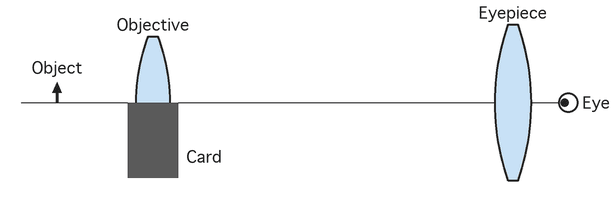
Which of these best describes the final image seen by the observer?
- 243 marks
Question 24
A school microscope with a eyepiece has three objectives, marked , and . With the objective, the circle of the specimen seen in the eyepiece (the field of view) is across. Assume that, with the same eyepiece, the width of the field of view is inversely proportional to the magnification of the objective. (Hypothetical data.)
(i) Find the width of the field of view with the and with the objectives.
(ii) An insect leg is long. With which objective(s) can the whole leg be seen at once?
(iii) Cells wide lie side by side across the field of the objective. About how many cells span the field?
- 251 mark
Question 25
Mohan views a distant ship with a relaxed eye through his refracting telescope (objective , eyepiece ). He swaps in an eyepiece of focal length and refocuses so that he again sees the ship with a relaxed eye. Which statement about the swap is correct? (Hypothetical data.)
- 261 mark
Question 26
A student looks at the Moon through an astronomical telescope set in normal adjustment. In the eyepiece she sees a small crater close to the upper-left edge of the Moon's disc. Where is this crater when she looks at the Moon with the naked eye?
- 271 mark
Question 27
An astronomical telescope in normal adjustment has an objective of focal length and an eyepiece of focal length . A ray from a distant star travels parallel to the principal axis and strikes the objective above the axis, as shown in the figure. (Horizontal and vertical scales in the figure differ.) (Hypothetical data.)

After passing through the eyepiece, the ray travels
- 281 mark
Question 28
A telescope has an objective of focal length and an eyepiece of focal length , kept apart. A student turns it round and looks through the objective, with the eyepiece facing a distant tree. The tree subtends at her naked eye. (Hypothetical data.) Through the reversed telescope the tree subtends about
- 293 marks
Question 29
A school telescope has an objective of focal length and three eyepieces of focal lengths , and . Tonight Jupiter subtends (45 seconds of arc) at the naked eye. The astronomy club wants Jupiter, seen in normal adjustment, to look at least as large as the full Moon looks to the naked eye, . (Hypothetical data.)
(a) Find the least magnifying power needed.
(b) Which eyepiece has the lowest magnifying power that still meets this need? What angle does Jupiter then subtend?
(c) How far apart are the objective and this eyepiece?
- 303 marks
Question 30
A telescope has an objective of focal length and an eyepiece of focal length . A friend with normal vision has set it in normal adjustment. Riya is short-sighted: without her spectacles her far point is from her eye, so with a relaxed eye she sees clearly only objects at that distance. She takes off her spectacles and refocuses the telescope so that she can view a distant hill with a relaxed eye, keeping her eye close to the eyepiece. (Hypothetical data.)
(a) Through what distance, and in which direction, must she move the eyepiece?
(b) Find the angular magnification she now gets, and compare it with the normal-adjustment value.
- 314 marks
Question 31
Looking at the Sun through a telescope can blind a person instantly, so a teacher shows sunspots safely by projection: nobody looks into the eyepiece. Her telescope has an objective of focal length and an eyepiece of focal length . She pulls the eyepiece slightly outwards from its normal-adjustment position until a sharp image of the Sun forms on a white card held behind the eyepiece, as in the figure. (Horizontal scale compressed; vertical sizes exaggerated.) The Sun subtends at the Earth. (Hypothetical telescope data.)

(a) Find the diameter of the image of the Sun formed by the objective.
(b) Find the distance between the objective and the eyepiece.
(c) Find the diameter of the Sun's image on the card.
- 323 marks
Question 32
A beginner makes a telescope objective from a single biconvex lens of crown glass. Its focal length for red light is . The refractive index of the glass is for red light and for violet light. (Hypothetical data.)
(a) Find the focal length of the lens for violet light.
(b) How far apart along the axis are the red and violet images of a star?
(c) What does the beginner see around a bright star, and how do telescope makers cure this defect?
- 331 mark
Question 33
An amateur builds a reflecting telescope with a spherical concave mirror of large aperture. Even in white starlight the star images are slightly blurred. When the mirror is reshaped into a paraboloid, the blur disappears. The paraboloid removes the blur because it
- 341 mark
Question 34
In a reflecting telescope the primary mirror has a diameter of . The secondary mirror and its holder block a central circle of diameter in the incoming beam. What fraction of the starlight that would fall on the primary mirror is blocked? (Hypothetical data.)
- 351 mark
Question 35
The tube of an amateur's reflecting telescope is labelled ", f/8": the primary mirror is across and its focal length is times its diameter. (Hypothetical data.) She wants a magnifying power of in normal adjustment. The focal length of the eyepiece she needs is
- 362 marks
Question 36
On a dark night the pupil of a young observer's eye opens to about . She points a reflecting telescope with a mirror of diameter at a star cluster. (Hypothetical data.)
(a) How many times more light from a star does the telescope collect than her naked eye?
(b) Could the telescope show her a star that sends times less light than the faintest star she can see with the naked eye? Give a reason.
- 373 marks
Question 37
In a Newtonian telescope, the concave primary mirror has a focal length of and a diameter of . A small plane mirror, tilted at to the axis, has its centre on the axis in front of the primary, as in the figure. It turns the converging light sideways towards the eyepiece. (Hypothetical data.)

(a) Where is the image of a star on the axis formed?
(b) What is the least width of the plane mirror, measured at right angles to the plane of the figure, that catches all the light reflected by the primary?
(c) Why is such a plane mirror made elliptical rather than circular?
- 382 marks
Question 38
A household mirror has its reflecting coating on the back of the glass, but the mirror of a reflecting telescope is coated with aluminium on its front surface. Give two reasons why the telescope mirror is coated on the front.
- 391 mark
Question 39
A Cassegrain telescope and a Newtonian telescope have identical primary mirrors and are used with the same eyepiece. The Cassegrain gives the larger magnifying power because its convex secondary mirror
- 401 mark
Question 40
The two stars of a double star are (seconds of arc) apart (take ). (Hypothetical data.) Using light of wavelength and Rayleigh's criterion, the smallest diameter of telescope objective that can just resolve them is about
- 413 marks
Question 41
At night the pupil of a driver's eye is about wide. An approaching car has its two headlights apart. Take the wavelength of the light as .
(a) Using Rayleigh's criterion, find the smallest angle the eye could resolve if diffraction at the pupil were the only limit.
(b) Find the greatest distance at which the two headlights could then be seen as separate.
(c) In practice the two lights merge into one at a much shorter distance. Give one reason.
- 421 mark
Question 42
A telescope with an objective of diameter gives a magnifying power of . Its owner fits an eyepiece of half the focal length, so the magnifying power becomes . (Hypothetical data.) What happens to the finest angular detail the telescope can reveal?
- 431 mark
Question 43
A microscope objective, used in air, can just resolve two points apart. A drop of oil of refractive index is now placed between the slide and the objective. The light used and the half-angle of the cone of light accepted by the objective stay the same. (Hypothetical data.) The least separation it can now resolve is about
- 443 marks
Question 44
A biology student uses an oil-immersion microscope objective for which . She wants to resolve fine details apart in a stained specimen. She has three colour filters: blue (), green () and red (). (Hypothetical data.)
(a) Find the longest wavelength with which the details can just be resolved.
(b) Which filters let her resolve the details, and which gives the clearest separation? Support your answer with the least resolvable separation for each filter.
- 453 marks
Question 45
A radio telescope dish of diameter observes the radio waves given out by hydrogen gas in space. A small optical telescope has an objective of diameter and is used with light of wavelength .
(a) Find the least angle each telescope can resolve.
(b) Which shows finer detail, and by roughly what factor?
(c) What dish diameter would a radio telescope need at to match the optical telescope?
- 463 marks
Question 46
The Hubble Space Telescope has a primary mirror across and orbits above the atmosphere. A ground-based telescope has an mirror, but turbulence in the air blurs star images to about on a typical good night. Take and .
(a) Find the least angle Hubble can resolve, in seconds of arc.
(b) Find the diffraction limit of the ground-based telescope, in seconds of arc.
(c) Without any correction for the air, which telescope reveals finer detail? Explain.
- 473 marks
Question 47
A telescope has an objective of diameter . (Hypothetical data.) Take , and take the smallest angle a normal eye can resolve as .
(a) Find the least angle the objective can resolve.
(b) Two stars that the objective just resolves are viewed with an eyepiece giving a magnifying power of . Can the eye see them as separate? Explain with numbers.
(c) Find the least magnifying power at which the eye can see every detail the objective resolves.
- 483 marks
Question 48
A camera lens has a focal length of . At the setting f/4 its aperture diameter is ; at the setting f/16 it is . The camera's sensor has pixels apart. Take and use Rayleigh's criterion for a distant scene. (Hypothetical data.)
(a) At f/4, find the least angle the lens can resolve and the separation of two just-resolved image points on the sensor.
(b) Repeat part (a) for f/16.
(c) At which setting does the pixel size, rather than diffraction, limit the detail in the photograph?
- 492 marks
Question 49
The angle subtended at the eye by an object is equal to the angle subtended at the eye by the virtual image produced by a magnifying glass. In what sense, then does a magnifying glass provide angular magnification?
- 502 marks
Question 50
In viewing through a magnifying glass, one usually positions one's eyes very close to the lens. Does angular magnification change if the eye is moved back?
- 512 marks
Question 51
Magnifying power of a simple microscope is inversely proportional to the focal length of the lens. What then stops us from using a convex lens of smaller and smaller focal length and achieving greater and greater magnifying power?
- 522 marks
Question 52
The image of the objective in the eyepiece is known as the eye ring. Why is this the best position of our eyes for viewing?
- 531 mark
Question 53
What is the main disadvantage of a Galilean telescope?
- 541 mark
Question 54
The objective of a telescope A has a diameter 3 times that of the objective of the telescope B. How much greater amount of light is gathered by A compared to B?
- 552 marks
Question 55
The Sun appears to be a small disc, even though its diameter is about m, why?
- 562 marks
Question 56
Can you convert a microscope into a telescope by interchanging its objective and eyepiece?
- 571 mark
Question 57
Suppose four lenses of focal lengths cm, cm, cm, and cm are given to you. Which pairs would you pick for making (a) telescope and (b) microscope?
- 582 marks
Question 58
Using a simple microscope an object is viewed first in violet light and then in yellow light. In which case will the magnifying power be large?
- 592 marks
Question 59
What is persistence of vision?
- 601 mark
Question 60
On what factors does the resolving power of a telescope depend?
- 612 marks
Question 61
How will you increase the resolving power of microscope?
- 621 mark
Question 62
Name the wave and its approximate wavelength used in an electron microscope.
- 633 marks
Question 63
The power of a magnifier is 15 dioptre. Where should an object be placed in order to get a maximum angular magnification for a normal eye?
- 643 marks
Question 64
A compound microscope is used to enlarge an object kept at a distance of 0.03 m from its objective which consists of several convex lenses in contact and has focal length 0.02 m. If a lens of focal length 0.1 m is removed from the objective, find out the distance by which the eyepiece of the microscope must be moved to refocus the image.
- 652 marks
Question 65
A compound microscope has a magnification of 30. The focal length of the eyepiece is 5 cm. Assuming the final image to be formed at the least distance of distinct vision (25 cm), calculate the magnification produced by the objective.
- 663 marks
Question 66
The focal length of the eyepiece and objective of a compound microscope are 5 cm and 1 cm respectively and the length of the tube is 20 cm. Calculate the magnifying power of the microscope, when the final image is formed at infinity. The value of least distance of distinct vision is 25 cm.
- 672 marks
Question 67
The focal lengths of the objective and the eyepiece of a telescope are 120 cm and 10 cm respectively. Find the magnifying power.
- 682 marks
Question 68
The magnifying power of an astronomical telescope is 16. If the focal length of the objective is 50 cm, what is the focal length of its eyepiece?
- 694 marks
Question 69
A telescope is formed of two convex lenses of 0.10 m and 0.01 m focal length respectively. If the telescope is focused on an object 0.6 m from the objective, the final image is formed 0.25 m from the eye. Find the magnification produced and the length of the telescope.
- 703 marks
Question 70
In an astronomical telescope the focal length of the objective is 50 cm and it has a diameter of 2.5 cm. If the diameter of the pupil of the eye is 2 mm, find (a) the normal magnification of the telescope and (b) the focal length of the eyepiece.
- 714 marks
Question 71
A telescope objective of focal length 1 m forms a real image of the Moon 0.92 cm in diameter. Calculate the diameter of the Moon taking its mean distance from the Earth to be km. If the telescope uses an eyepiece of 5 cm focal length, what would be the distance between the two lenses for (i) the final image to be formed at infinity and (ii) the final image (virtual) at 25 cm from the eye?
- 722 marks
Question 72
A reflecting telescope has a concave reflector of radius of curvature 120 cm. Calculate the focal length of the eyepiece to secure a magnification of 20.
- 733 marks
Question 73
A Galilean telescope has a minimum length of 45 cm and magnifying power 10 when viewing distant object. Find the focal lengths of the lenses.
- 742 marks
Question 74
A simple microscope (or a magnifying glass) with a focal length of 5 cm forms an image at the near point of the eye. Find its magnification.
- 751 mark
Question 75
State one advantage of a reflecting astronomical telescope over a refracting astronomical telescope.
- 762 marks
Question 76
An astronomical telescope set for normal adjustment has its magnifying power 10. If the focal length of the objective is 1.20 m, what is the focal length of the eyepiece?
- 772 marks
Question 77
An astronomical refracting telescope consists of two lenses of focal length 75 cm and 5 cm. Calculate the magnifying power of the telescope when the final image is formed at a distance of 25 cm from the eye.
- 782 marks
Question 78
An astronomical telescope is adjusted to form the final image at infinity. The separation between the lenses is 80 cm. The angular displacement is 15. Calculate the focal length of the objective and the eyepiece.
- 792 marks
Question 79
What are the two possible values of the magnifying power of a simple microscope made of a convex lens of focal length cm?
- 802 marks
Question 80
(i) Define magnifying power of a microscope in terms of visual angle.
(ii) What is the advantage of compound microscope over a simple microscope?
- 811 mark
Question 81
State any one advantage of using a reflecting telescope in place of a refracting telescope.
- 822 marks
Question 82
A convex lens of focal length 5 cm is to be used as a simple microscope. Where should an object be placed so that the image formed by it lies at the least distance of distinct vision ( cm)? Also calculate the magnifying power of this instrument in this set up.
- 831 mark
Question 83
The aperture a telescope is 0.1 m and the wavelength of light is 6000 Å. Resolving limit will be nearly
- 841 mark
Question 84
In an astronomical telescope of refracting type,
- 851 mark
Question 85
The focal lengths of the objective and eyepiece of a telescope are respectively 100 cm and 2 cm. The moon subtends an angle of 0.5° at the eye. If it is looked through the telescope, the angle subtended by the moon's image will be
- 861 mark
Question 86
In a laboratory four convex lenses , , and of focal lengths 2, 4, 6 and 8 cm respectively are available. Two of these lenses form a telescope of length 10 cm and magnifying power 4. The objective and eye lenses are
- 871 mark
Question 87
A simple telescope, consisting of an objective of focal length 60 cm and a single eye lens of focal length 5 cm is focused on a distant object in such a way that parallel rays come out from the eye lens. If the object subtends an angle 2° at the objective, the angular width of the image is
- 881 mark
Question 88
An astronomical telescope has objective and eyepiece lens of powers 0.5 D and 20 D respectively, its magnifying power will be
- 891 mark
Question 89
The diameter of the objective of the telescope is 0.1 metre and wavelength of light is 6000 Å. Its resolving power would be approximately
- 901 mark
Question 90
An astronomical telescope has a magnifying power 10. The focal length of eyepiece is 20 cm. The focal length of objective is
- 911 mark
Question 91
A telescope of diameter 2 m uses light of wavelength 5000 Å for viewing stars. The minimum angular separation between two stars whose image is just resolved by this telescope is
- 921 mark
Question 92
In a simple microscope, if the final image is located at infinity then its magnifying power is
- 931 mark
Question 93
In a compound microscope, the objective of and eyepiece of are placed at distance such that equals
- 941 mark
Question 94
Four lenses of focal length + 15 cm, + 20 cm, + 150 cm and + 250 cm are available for making an astronomical telescope. To produce the largest magnification, the focal length of the eyepiece should be
- 951 mark
Question 95
The aperture of the objective lens of a telescope is made large so as to
- 961 mark
Question 96
For a telescope to have large resolving power the
- 971 mark
Question 97
The angular resolution of a 10 cm diameter telescope at a wavelength of 5000 Å is of the order
- 981 mark
Question 98
An astronomical refracting telescope will have large angular magnification and high angular resolution when it has an objective lens of
- 991 mark
Question 99
Calculate the limit of resolution of a telescope objective having a diameter of 200 cm, if it has to detect light of wavelength 500 nm coming from a star.
- 1001 mark
Question 100
The value of numerical aperture of the objective lens of a microscope is 1.25. If light of wavelength 5000 Å is used, the minimum separation between two points, to be seen as distinct, will be
- 1011 mark
Question 101
The magnifying power of a telescope with tube 60 cm is 5. What is the focal length of its eyepiece?
- 1021 mark
Question 102
Your friend is having eye sight problem. She is not able to see clearly a distant uniform window mesh and it appears to her as non-uniform and distorted. The doctor diagnosed the problem as
- 1031 mark
Question 103
A lens of large focal length and large aperture is best suited as an objective of an astronomical telescope since