
Opening your dashboard
Class 12 Physics Chapter 16: Refraction of Light at Spherical Surfaces - Lenses Solutions
88 textbook questions with step-by-step answers, free to read, for ISC 2026-27.
Get talked through Ch 16, not just shown the answer
Reading a finished solution is not the same as being able to do it. The AI tutor takes one question at a time and works it with you, in your own words, until you can.
- Ask it out loud, in your own words
- It gives you the next step, not the answer
- Stuck on part (ii)? Start there
88 questions with solutions
1–5 marks · Mixed difficulty
The first 19 solutions are on this page. This chapter is a long one, so the rest open on their own page to keep this one quick to load.
- 11 mark
Question 1
Four lenses are made from the same type of glass. The radius of curvature of each face is given below. Which will have the greatest positive power?
Solve with AIAnswer
(A) 10 cm convex and 15 cm concave
- Correct
(B) 5 cm convex and 10 cm concave
(C) 15 cm convex and plane
(D) 20 cm convex and 30 cm concave
Answer: (B) 5 cm convex and 10 cm concave
Key idea: By the lens maker's formula, . All four lenses are made of the same glass, so is the same and the lens with the largest positive curvature bracket has the greatest positive power.
Step 1 — See how each face adds to the bracket.
A lens with one convex face and one concave face is a meniscus: both centres of curvature lie on the same side. The convex face adds to the bracket and the concave face takes away . A plane face adds nothing, because its radius is infinite.
Step 2 — Work out the bracket for each lens.
We work in and call the bracket .
Step 3 — Compare the values.
All four brackets are positive, so all four lenses are converging. Lens (B) has the largest bracket, , so it has the greatest positive power.
Why the other options are wrong:
- (A) is wrong: Its bracket is only , a third of the value for (B).
- (C) is wrong: Its single curved face gives , less than .
- (D) is wrong: Its bracket is , the smallest of all four.
Therefore, the lens with a 5 cm convex face and a 10 cm concave face has the greatest positive power: option (B).
- 21 mark
Question 2
A convex lens of focal length 40 cm is in contact with a concave lens of focal length 25 cm. The power of the combination is
Solve with AIAnswer
- Correct
(A) −1.5 D
(B) −6.5 D
(C) +6.5 D
(D) +6.67 D
Answer: (A) −1.5 D
Key idea: The power of a lens is with in metres, positive for a convex lens and negative for a concave lens. For thin lenses in contact the powers add, .
Step 1 — Write the focal lengths in metres with signs.
The convex lens has a positive focal length and the concave lens a negative one.
Step 2 — Find the power of each lens.
Each power is the reciprocal of the focal length in metres.
Step 3 — Add the powers.
The lenses are in contact, so the power of the combination is the sum of the two powers.
Why the other options are wrong:
- (B) is wrong: It comes from taking both lenses as diverging, , but the convex lens has a positive power.
- (C) is wrong: It comes from taking both lenses as converging, , but the concave lens has a negative power.
- (D) is wrong: It comes from subtracting the focal lengths ( cm) and taking ; focal lengths do not add or subtract, powers do.
Therefore, the power of the combination is −1.5 D: option (A).
- 31 mark
Question 3
Two lenses of power +12 and −2 dioptres are placed in contact. What will be the focal length of the combination?
Solve with AIAnswer
- Correct
(A) 10 cm
(B) 12.5 cm
(C) 16.6 cm
(D) 8.33 cm
Answer: (A) 10 cm
Key idea: For thin lenses in contact the powers add, . The focal length of the combination is in metres.
Step 1 — Add the powers.
The two lenses are in contact, so we add their powers with their signs.
Step 2 — Find the focal length.
The focal length is the reciprocal of the power, in metres; we then change it to centimetres.
Why the other options are wrong:
- (B) is wrong: cm is the focal length of an D lens; no correct way of combining D and D gives D.
- (C) is wrong: cm is the focal length of a lens of about D, a power that the data do not give.
- (D) is wrong: cm is cm, the focal length of the D lens alone; it ignores the D lens.
Therefore, the focal length of the combination is 10 cm: option (A).
- 41 mark
Question 4
A concave and convex lens have the same focal length of 20 cm and are put into contact to form a lens combination. The combination is used to view an object of 5 cm length kept at 20 cm from the lens combination. As compared to the object, the image will be
Solve with AIAnswer
(A) magnified and inverted
(B) reduced and erect
- Correct
(C) of the same size and erect
(D) of the size as the object and inverted
Answer: (C) of the same size and erect
Key idea: For thin lenses in contact, . A convex lens and a concave lens of equal focal length cancel each other, so the pair has zero power.
Step 1 — Find the focal length of the combination.
The convex lens has cm and the concave lens cm, so we combine them.
The combination has zero power and an infinite focal length; it behaves like a plane glass plate.
Step 2 — Find the image position and magnification.
Since the combination has zero power, the lens formula reduces to the following, so the image is where the object is.
The magnification is the ratio of these two equal distances.
Step 3 — Describe the image.
A magnification of means the image is the same size as the object ( cm) and erect. Light passes through the pair without being bent, so the object is seen as it is.
Why the other options are wrong:
- (A) is wrong: A magnified, inverted image needs a converging system with the object between and ; here the power is zero.
- (B) is wrong: A reduced, erect image is what a diverging system gives; this combination is not diverging.
- (D) is wrong: An inverted image needs a real image with the rays crossing the axis; with zero power they do not, and shows the image is erect.
Therefore, the image is of the same size as the object and erect: option (C).
- 51 mark
Question 5
In a plano-convex lens, the radius of curvature of the convex surface is 10 cm and the focal length of the lens is 30 cm, then the refractive index of the material of the lens will be
Solve with AIAnswer
(A) 1.5
(B) 1.66
- Correct
(C) 1.33
(D) 3
Answer: (C) 1.33
Key idea: For a plano-convex lens, the plane face has an infinite radius, so the lens maker's formula becomes , where is the radius of the curved face.
Step 1 — Substitute the given values.
We put cm and cm into the formula for a plano-convex lens.
Step 2 — Solve for the refractive index.
We multiply both sides by and then add .
Why the other options are wrong:
- (A) is wrong: With the formula gives a focal length of cm ( divided by ), not cm.
- (B) is wrong: With the formula gives a focal length of about cm ( divided by ), not cm.
- (D) is wrong: With the formula gives a focal length of cm ( divided by ), not cm.
Therefore, the refractive index of the lens material is 1.33: option (C).
- 61 mark
Question 6
A converging lens is used to form an image on a screen. When the upper half of the lens is covered by an opaque screen,
Solve with AIAnswer
(A) half the image will disappear
(B) complete image will be formed of the same intensity
(C) half image will be formed of the same intensity
- Correct
(D) complete image will be formed of decreased intensity
Answer: (D) complete image will be formed of decreased intensity
Key idea: Every point of the object sends rays through every part of the lens, and each part of the lens sends those rays to the same image point.
Step 1 — Ask whether any part of the image is lost.
The uncovered lower half of the lens still receives rays from every point of the object. It brings them to the same image points as before, so every point of the image is still formed. The whole image appears on the screen.
Step 2 — Ask what happens to the brightness.
Covering half the lens blocks about half of the light from each object point. Each image point therefore receives less light, so the whole image is dimmer.
Why the other options are wrong:
- (A) is wrong: No part of the image disappears, because each image point still receives rays through the lower half.
- (B) is wrong: About half the light is blocked, so the intensity of the image falls.
- (C) is wrong: The image is complete, not half, and it is also dimmer than before.
Therefore, the complete image is formed, but with decreased intensity: option (D).
- 71 mark
Question 7
A thin convex lens made from crown glass has focal length . When it is measured in two different liquids having refractive indices and ; it has the focal lengths and , respectively. The correct relation between the focal lengths is
Solve with AIAnswer
(A)
- Correct
(B) and becomes negative
(C) and becomes negative
(D) and both becomes negative
Answer: (B) and becomes negative
Key idea: In a liquid of index , the lens maker's formula uses the relative index: .
In air the first factor is (from ). The curvature bracket is the same in every medium, so the focal lengths are in the inverse ratio of the first factors.
Step 1 — Find the first factor in the liquid of index 4/3.
We divide the index of the glass by the index of the liquid and subtract .
Step 2 — Compare with .
The focal lengths are in the inverse ratio of the first factors.
So : the lens still converges, but more weakly, and .
Step 3 — Find the first factor in the liquid of index 5/3.
We repeat Step 1 with the denser liquid.
Step 4 — Compare with .
The factor is now negative, so the focal length changes sign.
So : in the denser liquid the lens diverges, and is negative.
Why the other options are wrong:
- (A) is wrong: is , which is greater than , and has the opposite sign to , so they cannot be equal.
- (C) is wrong: It has the two liquids the wrong way round: the focal length becomes negative in the denser liquid (), not in the liquid of index .
- (D) is wrong: In the liquid of index , which is less than , the lens still converges, so is positive.
Therefore, is greater than and is negative: option (B).
- 81 mark
Question 8
The given ray diagram could be correct,
 Solve with AI
Answer
(A) if
(B) if and
- Correct
(C) if and
(D) under no circumstances
Answer: (C) if and
Key idea: With the same medium of index on both sides of a lens of index , the lens maker's formula is . Whether the lens converges or diverges depends on the sign of .
Step 1 — Read the figure.
The lens in the figure has a convex (biconvex) shape. A parallel beam falls on it and comes out diverging, so the lens is acting as a diverging lens: its focal length must be negative.
Step 2 — Find the sign of the curvature bracket.
For a convex shape the first face has its centre beyond the lens () and the second face has its centre before the lens (). So the bracket is positive.
Step 3 — Find the condition for a negative focal length.
With a positive bracket, is negative only if the first factor is negative, that is, if . This means : the surrounding medium must be optically denser than the lens. So the diagram is correct if and .
Why the other options are wrong:
- (A) is wrong: With all three indices equal there is no refraction at either face, so the rays would go straight on, still parallel.
- (B) is wrong: With the first factor is positive, so the lens converges the beam, the usual case of a convex lens in air.
- (D) is wrong: The diagram is possible, as Step 3 shows, when the lens is in a denser medium.
Therefore, the ray diagram could be correct if and : option (C).
- 91 mark
Question 9
A biconvex lens of focal length and radii of curvature of both surfaces is made of a material of refractive index . This lens is placed in a liquid of refractive index . Now this lens will behave like
(A) either as a concave or as a convex lens depending solely on
(B) a convex lens depending on and
(C) a concave lens depending on and
(D) a convex lens of the same focal length irrespective of , and
Solve with AIWritten solution
Solution:
Key idea: The lens maker's formula for a lens of refractive index placed in a medium of refractive index uses the relative refractive index :
Here is the focal length in the liquid, and , are the radii of the two faces with New Cartesian signs.
Step 1 — Put in the radii of the biconvex lens.
For a biconvex lens with equal radii, the first face has its centre of curvature on the far side, so , and the second face has its centre on the near side, so .
Step 2 — Write the focal length in the liquid.
We put this geometric factor into the formula.
The factor is positive and fixed by the shape of the lens. So the sign of , and hence the nature of the lens, is decided only by the bracket .
Step 3 — Decide the nature for each case.
If , the bracket is positive, so is positive and the lens converges light like a convex lens. This is option (B).
If , the bracket is negative, so is negative and the lens diverges light like a concave lens. This is option (C).
So whether the lens acts as a convex or a concave lens depends on and , and both (B) and (C) describe a correct possibility.
Step 4 — Check the other two options.
Each of the remaining options makes a claim that the formula in Step 2 contradicts.
- (A) is wrong: The radius only sets the size of through the factor , which is always positive; it can never change the sign of .
- (D) is wrong: The bracket changes when the liquid is changed, so the focal length does not stay the same; it can even change sign.
Note: Two printed options are correct here, so this item is given as a short-answer question naming both.
Therefore, options (B) and (C) are both correct: the lens acts as a convex lens if and as a concave lens if .
- 101 mark
Question 10
If and be the size of the images, respectively, for the two positions of the lens in the displacement method, then the size of the object is given by
Solve with AIAnswer
(A)
(B)
- Correct
(C)
(D)
Answer: (C)
Key idea: In the displacement method the object and the screen stay fixed, and the lens is moved between two positions that both give a sharp image. In the two positions the object distance and the image distance simply interchange.
Step 1 — Write the magnification in each lens position.
Let the object have size . In the first position let the object be at distance from the lens and the image at distance . In the second position the object is at distance and the image at distance . The size of an image divided by the size of the object equals the image distance divided by the object distance.
Step 2 — Multiply the two equations.
Multiplying makes the distances cancel, so the result does not depend on where the lens is.
Step 3 — Solve for the object size.
Taking the positive square root, since a size is positive:
So the object size is the geometric mean of the two image sizes.
Why the other options are wrong:
- (A) is wrong: Dividing the two image sizes gives , the ratio of the two magnifications. It is a pure number, not a length.
- (B) is wrong: The product of the two image sizes equals , so it has the unit of area; this is the step before taking the square root.
- (D) is wrong: The square root of the ratio gives , the magnification in the first position. It is a pure number, not the size of the object.
Therefore, the size of the object is , option (C).
- 111 mark
Question 11
A convex lens of crown glass () will behave as a divergent lens if immersed in
Solve with AIAnswer
(A) water ()
- Correct
(B) carbon disulphide ()
(C) a medium of
(D) it cannot act as a divergent lens
Answer: (B) carbon disulphide ()
Key idea: In a medium, the lens maker's formula uses the refractive index of the lens relative to the medium:
For a convex lens the second bracket is positive, so the lens diverges light only when the first bracket is negative.
Step 1 — State the condition for a convex lens to diverge.
The first bracket is negative only when , so the medium must be optically denser than the lens.
Step 2 — Test carbon disulphide.
Carbon disulphide has , which is greater than . We find the first bracket for it.
The bracket is negative, so is negative and the convex lens behaves as a diverging lens.
Why the other options are wrong:
- (A) is wrong: Since its refractive index (1.33) is less than that of crown glass, water is the less dense medium, so the bracket is . The lens still converges, only with a longer focal length.
- (C) is wrong: In a medium of the same index the bracket is zero, so is infinite. The lens neither converges nor diverges light; it simply has no effect.
- (D) is wrong: Step 2 shows that the lens does act as a diverging lens in carbon disulphide.
Note: The measured refractive index of carbon disulphide is about for yellow light; with this value the bracket is still negative, so the answer is the same.
Therefore, the crown-glass convex lens behaves as a divergent lens in carbon disulphide, option (B).
- 121 mark
Question 12
An object is placed at a distance of 10 cm from a co-axial combination of two lenses and in contact. The combination forms a real image three times the size of the object. If the lens is concave with focal length of 30 cm, the nature and focal length of lens is
Solve with AIAnswer
(A) convex, 12 cm
(B) concave, 12 cm
- Correct
(C) convex, 6 cm
(D) convex, 18 cm
Answer: (C) convex, 6 cm
Key idea: Two thin lenses in contact act as one lens of focal length , where . We first find from the object and image distances with the lens formula (New Cartesian signs).
Step 1 — Find the image distance.
A real image formed by a lens is inverted, so the magnification is negative.
The object is on the left, so cm.
The magnification of a lens is , so the image distance is .
Step 2 — Find the focal length of the combination.
We put and into the lens formula.
Step 3 — Find the focal length of lens A.
Lens B is concave, so cm. We subtract its power from the power of the combination.
The positive sign shows that lens A is convex.
Why the other options are wrong:
- (A) is wrong: A convex lens of 12 cm with the concave 30 cm lens gives , so cm. With the object at 10 cm, inside this focal length, the image would be virtual, not real.
- (B) is wrong: Two concave lenses together make a diverging combination, which can never form a real image of a real object.
- (D) is wrong: A convex lens of 18 cm with lens B gives , so cm. The object at 10 cm would again be inside the focal length and the image would be virtual.
Therefore, lens A is a convex lens of focal length 6 cm, option (C).
- 131 mark
Question 13
An equiconvex lens of glass of focal length 0.1 m is cut along a plane perpendicular to the principal axis into two equal parts. The ratio of focal length of the new lenses formed is
Solve with AIAnswer
- Correct
(A) 1 : 1
(B) 1 : 2
(C) 2 : 1
(D)
Answer: (A) 1 : 1
Key idea: The focal length of a thin lens in air is given by the lens maker's formula . A plane face has an infinite radius, so it adds nothing to the bracket.
Step 1 — Describe the two pieces.
A cut along a plane perpendicular to the principal axis passes through the middle of the lens's thickness. Each piece keeps one curved face of radius and gets one plane face, so the two pieces are identical plano-convex lenses.
Step 2 — Find the focal length of the whole lens.
For the equiconvex lens, and .
Step 3 — Find the focal length of each piece.
For each plano-convex piece, one radius is and the other is infinite.
With m, each piece has the same focal length.
Step 4 — Write the ratio.
Both new lenses have m, so the ratio of their focal lengths is , or .
Why the other options are wrong:
- (B) is wrong: is the ratio of the original focal length to the new one (), not the ratio between the two new lenses.
- (C) is wrong: is the ratio of a new focal length to the original one (), again not a comparison of the two new lenses.
- (D) is wrong: This ratio, equal to , would mean one piece has four times the focal length of the other, but the two pieces are identical.
Therefore, the two new lenses have equal focal lengths (0.2 m each), so the ratio is 1 : 1, option (A).
- 141 mark
Question 14
A parallel beam of light is incident on a converging lens parallel to its principal axis. As one moves away from the lens on the other side of the principal axis, the intensity of light
Solve with AIAnswer
(A) first decreases and then increases
(B) continuously increases
(C) continuously decreases
- Correct
(D) first increases and then decreases
Answer: (D) first increases and then decreases
Key idea: Intensity is the light power falling on unit area. The same power passes through every cross-section of the beam, so the intensity is larger where the beam is narrower.
Step 1 — Follow the beam from the lens to the focus.
A converging lens bends a parallel beam towards the principal focus. Moving away from the lens towards the focus, the beam's cross-section keeps shrinking, so the same power falls on a smaller area and the intensity rises.
Step 2 — Find where the intensity is greatest.
The beam is narrowest at the principal focus, so the intensity is greatest there.
Step 3 — Follow the beam beyond the focus.
After passing through the focus the rays spread out again. The cross-section grows with distance, so the intensity falls steadily.
Why the other options are wrong:
- (A) is wrong: It describes the opposite order: the beam narrows first and spreads later, so the intensity rises first and falls later.
- (B) is wrong: It ignores the spreading of the beam beyond the focus, where the intensity falls.
- (C) is wrong: It ignores the converging part between the lens and the focus, where the intensity rises.
Therefore, moving away from the lens, the intensity first increases (up to the focus) and then decreases, option (D).
- 151 mark
Question 15
When a lens of refractive index is placed in a liquid of refractive index , the lens seems to disappear only if
Solve with AIAnswer
(A)
(B)
- Correct
(C)
(D)
Answer: (C)
Key idea: We see a transparent object only because light bends (refracts) and partly reflects at its surfaces. Both effects happen only when the refractive indices on the two sides of a surface differ.
Step 1 — Find the condition for no bending at the surfaces.
If the lens and the liquid have the same refractive index, light crosses each surface of the lens without bending and without reflection. The rays then travel as if the lens were not there, so it cannot be seen.
Step 2 — Confirm with the lens maker's formula.
In a liquid, the lens maker's formula is
When the first bracket is zero.
So is infinite: the lens has no power and does not change the light at all.
Why the other options are wrong:
- (A) is wrong: If , the lens is optically less dense than the liquid, so the bracket is . The lens bends light (it acts as a diverging lens if convex) and stays visible.
- (B) is wrong: If , the bracket is , which is not zero, so light is still bent at the surfaces.
- (D) is wrong: If , the bracket is , which is not zero, so the lens still bends light and can be seen.
Therefore, the lens seems to disappear only when , option (C).
- 161 mark
Question 16
A double convex thin lens made of glass (refractive index ) has both radii of curvature of magnitude 20 cm. Incident rays parallel to the axis of the lens will converge at a distance such that
Solve with AIAnswer
- Correct
(A) cm
(B) cm
(C) cm
(D) cm
Answer: (A) cm
Key idea: Rays parallel to the axis converge at the principal focus, so the required distance is the focal length . For a thin lens in air, the lens maker's formula is .
Step 1 — Write the radii with signs.
For a double convex lens the first face has its centre of curvature on the far side and the second face on the near side.
Step 2 — Find the geometric factor.
We put the two signed radii into the bracket of the lens maker's formula.
Step 3 — Find the focal length.
We multiply by .
So the parallel rays converge at cm from the lens.
Why the other options are wrong:
- (B) is wrong: 10 cm comes from leaving out the factor . The bracket alone is per cm, and taking its reciprocal gives 10 cm.
- (C) is wrong: 40 cm is the focal length of a plano-convex lens with only one curved face of radius 20 cm; this lens has two curved faces.
- (D) is wrong: cm comes from using in place of . This makes three times too large, instead of .
Therefore, the parallel rays converge at cm, option (A).
- 171 mark
Question 17
A lens behaves as a converging lens in air and a diverging lens in water. The refractive index of the material is
Solve with AIAnswer
(A) equal to unity
(B) equal to 1.33
- Correct
(C) between unity and 1.33
(D) greater than 1.33
Answer: (C) between unity and 1.33
Key idea: The power of a lens in a medium depends on the factor . For a lens of fixed shape, this factor decides whether the lens converges (factor positive) or diverges (factor negative).
Step 1 — Use the behaviour in air.
The lens converges in air (), so the factor is positive in air.
Step 2 — Use the behaviour in water.
The same lens diverges in water (), so the factor is negative in water.
Step 3 — Combine the two conditions.
Both conditions hold together only if the refractive index lies between them.
Why the other options are wrong:
- (A) is wrong: With the factor in air is zero, so the lens would have no power in air and could not converge light.
- (B) is wrong: With the factor in water is zero, so the lens would have no power in water; it would not diverge light.
- (D) is wrong: With the factor is positive in water as well, so the lens would converge in water too.
Therefore, the refractive index of the material lies between unity and 1.33, option (C).
- 181 mark
Question 18
Two thin lenses are kept in contact. The focal length of one of the lenses is 20 cm. If the focal length of the combination is 12 cm, then the focal length of the other lens is
Solve with AIAnswer
(A) 15 cm
(B) 20 cm
(C) 25 cm
- Correct
(D) 30 cm
Answer: (D) 30 cm
Key idea: For two thin lenses in contact, the powers add, so , where is the focal length of the combination.
Step 1 — Write the unknown power.
We subtract the known lens's term from the combination's term.
Step 2 — Put in the values.
Here cm and cm. We use the common denominator 60.
Step 3 — Find the focal length.
The focal length is the reciprocal of the value found in Step 2.
The positive value shows that the other lens is also a convex lens.
Why the other options are wrong:
- (A) is wrong: A 15 cm lens with the 20 cm lens gives , so cm, not 12 cm.
- (B) is wrong: A second 20 cm lens gives , so cm, not 12 cm.
- (C) is wrong: A 25 cm lens gives , so cm, not 12 cm.
Therefore, the focal length of the other lens is 30 cm, option (D).
- 191 mark
Question 19
The image of an object, formed by a plano-convex lens at a distance of 8 m behind the lens is real and is one-third of the size of the object. The wavelength of the light inside the lens is times the wavelength in free space. The radius of the curved surface of the lens is
Solve with AIAnswer
(A) 1 m
(B) 2 m
- Correct
(C) 3 m
(D) 6 m
Answer: (C) 3 m
Key idea: The refractive index is the ratio of the wavelength in free space to the wavelength in the medium. The focal length follows from the lens formula , and for a plano-convex lens in air the lens maker's formula reduces to .
Step 1 — Find the refractive index of the lens.
The wavelength inside the lens is of the free-space wavelength.
Step 2 — Find the object distance.
A real image is inverted, so a one-third-size real image has .
The image is 8 m behind the lens, so m.
Since , the object distance is .
Step 3 — Find the focal length.
We put and into the lens formula.
Step 4 — Find the radius of the curved face.
For a plano-convex lens, , so .
Why the other options are wrong:
- (A) is wrong: 1 m comes from multiplying by instead of dividing. The object distance then comes out as m, the focal length as 2 m and the radius as 1 m.
- (B) is wrong: 2 m comes from taking the object distance equal to the image distance (8 m). The focal length then comes out as 4 m and the radius as 2 m.
- (D) is wrong: 6 m is the focal length found in Step 3, not the radius of curvature.
Therefore, the radius of the curved surface of the lens is 3 m, option (C).
- 201 mark
Question 20
Two thin lenses having optical powers of −10 D and +6 D are placed in contact with each other. The focal length of the combination is
- 211 mark
Question 21
What is lens maker's formula?
- 221 mark
Question 22
Why is lens maker's formula called so?
- 231 mark
Question 23
What is the unit of power of a lens?
- 241 mark
Question 24
What is lens maker's formula? Why is it so called?
- 251 mark
Question 25
What happens to a focal length of a convex lens when it is immersed in water?
- 261 mark
Question 26
A lens of glass is immersed in water. What will be its effect on the power of the lens?
- 271 mark
Question 27
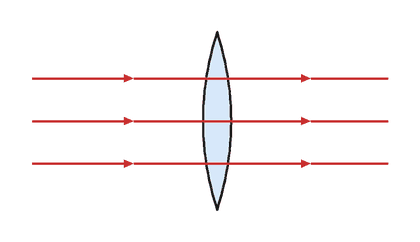
In the given figure, path of a parallel beam of light passing through a convex lens of refractive index kept in a medium of refractive index is shown. Is (i) or (ii) or (iii) ?
- 281 mark
Question 28
How does the focal length of a convex lens change if monochromatic red light is used instead of violet light?
- 291 mark
Question 29
The image of an object formed by a lens on the screen is not in sharp focus. Suggest a method to get clear focusing of the image on the screen without disturbing the position of the object, the lens or the screen.
- 301 mark
Question 30
What should be the position of an object relative to a biconvex lens so that it behaves like a magnifying glass?
- 311 mark
Question 31
Three lenses with magnifications 2, 3 and 10 form a combination. What is its total magnification?
- 321 mark
Question 32
A double convex lens, made from a material of refractive index , is immersed in a liquid of refractive index , where . What change, if any, would occur in the nature of the lens?
- 331 mark
Question 33
How does the power of a convex lens vary, if the incident red light is replaced by violet light.
- 342 marks
Question 34
Define (i) pole, (ii) centre of curvature, (iii) radius of curvature and (iv) principal axis of a spherical surface.
- 352 marks
Question 35
What is a lens? Name the different types.
- 362 marks
Question 36
Define (i) centre of curvature, (ii) radius of curvature and (iii) optic centre of a lens.
- 372 marks
Question 37
Define principal focus. Why is it called so?
- 382 marks
Question 38
A convex lens is called a converging lens. Why?
- 392 marks
Question 39
A concave lens is called a diverging lens. Why?
- 402 marks
Question 40
Define focal length of a lens.
- 412 marks
Question 41
Draw ray diagrams to show how a convex lens forms (i) a real magnified image and (ii) a virtual magnified image.
- 422 marks
Question 42
Derive the relation connecting , and .
- 432 marks
Question 43
Two lenses are kept in contact. Write down the expression for (i) equivalent focal length and (ii) equivalent power.
- 442 marks
Question 44
When a lens is fully immersed in a transparent liquid, it becomes invisible. What is the refractive index of the liquid?
- 452 marks
Question 45
A convex lens is made of two different materials. A point object is placed on the principal axis of this lens. How many images will be obtained?
- 462 marks
Question 46
In which case a lens has higher power – when it is (i) in air or (ii) in water?
- 472 marks
Question 47
What is the power of a plane glass plate?
- 482 marks
Question 48
The refractive index of glass is 1.5 and that of carbon disulphide is 1.65. A lens made of glass is immersed in carbon disulphide. Will it now also behave like a convex lens?
- 492 marks
Question 49
A lighted candle is kept in front of a convex lens and its position is adjusted to get a clear image on the screen. The lower half of the lens is covered with a black paper. Will there be any change in the nature and size of the image now?
- 502 marks
Question 50
An equiconvex lens of focal length 15 cm is cut into two equal halves in thickness. What is the focal length of each half?
- 512 marks
Question 51
A concave lens made of refractive index is immersed in a medium whose refractive index is (i) greater than, (ii) equal to and (iii) less than . When a parallel beam of light is incident on the lens, trace the path of rays in each of the above case.
- 522 marks
Question 52
What changes in the focal length of a (i) concave mirror and (ii) convex lens occur, when the incident violet light on them is replaced with red light?
- 532 marks
Question 53
A thin converging lens has a focal length '' in air. If it is completely immersed in a liquid, briefly explain how the focal length of the lens will vary?
- 542 marks
Question 54
Find the position of the image formed by the lens shown in the figure. Another lens is placed in contact with this lens to shift the image further away from the lens. What is the nature of the second lens?

- 553 marks
Question 55
Define focal length and power of a lens. How are they related?
- 563 marks
Question 56
What is linear magnification () produced by a lens? Obtain the relation connecting (i) , and and (ii) , and .
- 573 marks
Question 57
Derive the formula for a lens.
- 583 marks
Question 58
Write down the lens maker's formula. What happens to the focal length of the lens when it is dipped in a medium whose refractive index is (i) greater than that of the lens and (ii) less than that of the lens?
- 593 marks
Question 59
Starting with an expression for the refraction at a single spherical surface, obtain an expression for the lens maker's formula.
- 603 marks
Question 60
Obtain an expression for refraction at a single convex spherical surface, that is the relation between (rarer medium), (denser medium), the object distance , the image distance and the radius of curvature .
- 613 marks
Question 61
When two thin lenses of focal lengths and are kept in contact, prove that their combined focal length is given by .
- 625 marks
Question 62
Derive the relation for refraction at a single spherical surface with the convex surface facing towards a rarer medium.
- 635 marks
Question 63
Define principal focus and focal length of a lens. Explain why a convex lens is called a converging lens and a concave lens is called a diverging lens. State the sign convention used in the case of a lens.
- 645 marks
Question 64
Derive lens maker's formula. What is (i) first principal focal point and (ii) second principal focal point? Write down the lens maker's formula for a plano-convex lens.
- 655 marks
Question 65
How will you determine the focal length of a convex lens using a plane mirror? How will you determine the focal length of a concave lens using a concave mirror?
- 665 marks
Question 66
When two thin lenses are kept in contact, obtain the relation and discuss the nature of the combined lens when , and .
- 673 marks
Question 67
The eye can be regarded as a single spherical refracting surface of radius of curvature of cornea 7.79 mm, separating two media of refractive indices 1.00 and 1.34. What is the distance from the refracting surface at which a parallel beam of light will come to focus?
- 683 marks
Question 68
A concave spherical glass has radius of curvature of 60 cm and . An object is placed in air such that its image is formed on the object side at a distance of 20 cm from the spherical surface. What is the object distance?
- 693 marks
Question 69
A convex spherical surface of radius of curvature 20 cm and refractive index 1.5 is placed in air. At what distance should an object be placed in air so that its image is formed at a distance 100 cm from the pole of the surface in the denser medium?
- 704 marks
Question 70
A parallel beam of light passing through water of refractive index 4/3 is allowed to strike a spherical air bubble of radius 3 mm situated in water. Considering the paraxial rays, find the position of the final image formed.
- 713 marks
Question 71
A point object is kept in air at a distance of 70 cm from the convex spherical surface of refractive index 1.5. If the image is formed on the other side of the object at a distance of 262.5 cm from the surface, what is the radius of curvature of the surface?
- 723 marks
Question 72
A point object is kept in air at a distance of 24 cm from the end of a glass dumbbell of length 40 cm and refractive index 1.5. The curved end of the dumbbell has a radius of curvature of 6 cm. Find the position of the image.
- 733 marks
Question 73
One end of a glass rod is ground such that it has the shape of a hemisphere of radius 6 cm as shown in the given figure. An object of height 1 cm is kept perpendicular to the axis of the rod at a distance of 25 cm from the rounded edge. If the refractive index of the material of the glass rod is 1.5, find the position of the image and its height.

- 743 marks
Question 74
Find the position and magnification of the image formed by a convex lens of focal length 15 cm, where an object is placed at a distance 20 cm from its optic centre, on its principal axis.
- 753 marks
Question 75
An object is placed at a distance of 75 cm from a screen. Where should a convex lens of focal length 12 cm be placed so as to obtain a real image of the object on the screen?
- 763 marks
Question 76
An object 10 cm long is placed at a distance of 15 cm from a convex lens of 10 cm focal length. Find the nature, position and size of the image.
- 773 marks
Question 77
An object is 60 cm in front of a thin lens, the image being 300 cm on the other side of the lens. Calculate the displacement of the image, when the object is moved 20 cm nearer to the lens.
- 783 marks
Question 78
At what distance should an object be placed from a convex lens of focal length 30 cm to obtain a real image 4 times the size of the object?
- 793 marks
Question 79
A lens placed at a distance of 20 cm from an object produces a virtual image 2/3 size of the object. Find the position of the image, kind of the lens and its focal length.
- 803 marks
Question 80
At what distance must an object be placed from a convex lens of power 4 D to obtain a virtual image three times the size of the object?
- 813 marks
Question 81
Light is converging to a point and a convex lens of focal length 20 cm is placed at in the path of the beam, where cm. The beam now converges to . Find the distance .
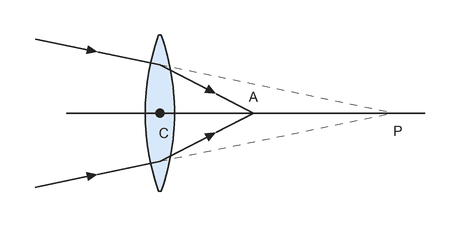
- 823 marks
Question 82
At what distance an object must be placed in front of a concave lens of focal length 24 cm, so that the image is formed at a distance of 6 cm from the lens?
- 833 marks
Question 83
The focal length of a concave lens is 20 cm. An object of height 5 cm is placed at a distance of 30 cm from the lens. Calculate the position, nature and size of the image formed.
- 843 marks
Question 84
A convex lens of focal length 8 cm and a concave lens of focal length 4 cm are kept in contact. Will the combination behave as converging or diverging?
- 853 marks
Question 85
The effective focal length of combination of two lenses in contact is +30 cm. If the focal length of one lens is +12 cm, what is the nature and focal length of the other lens?
- 863 marks
Question 86
A converging lens forms a real image of a real object. If the image is twice the size of the object and the distance between the object and the image is 72 cm, calculate
(i) the distance of the image from the lens and
(ii) the focal length of the lens.
- 873 marks
Question 87
The radius of curvature of each surface of a thin biconvex lens made of glass of refractive index 1.5 is 20 cm each. One of the surfaces of the lens is silvered. Where should an object be placed so that its image coincides with the object?
- 883 marks
Question 88
When normally through the flat surface, the greatest thickness of a plano-convex surface appears to be 2.0 cm, but when seen normally through the curved surface, it appears to be 2.5 cm. The actual thickness is 3.0 cm. Find the radius of curvature of curved side and the refractive index of its material.
What Class 12 Physics Ch 16 covers
The sections of the chapter, in the order the book takes them. Every question above comes from one of these.
- 01Refraction at a Single Spherical Surface
- 02Spherical Lenses and Principal Focus
- 03Image Formation by Lenses
- 04Lens Formula and Sign Convention
- 05Lateral Magnification
- 06Power of a Lens
More ways to study this chapter
The same chapter asked three other ways. Practise it, revise it, and see what the board has set on Ch 16 before.
- Competency-Based Questions (CBQ)Case study questions: a situation, and the part of the chapter that answers it.59questionsOpen
- Previous Year QuestionsQuestions that have actually appeared in board papers, each tagged with its year.19questionsOpen
- Practice QuestionsExtra questions per chapter, for when one attempt at a method is not enough.107questionsOpen
Ch 16 in past ISC papers
The same chapter as the board has actually asked it. These are worded differently from the textbook exercise, which is the point of reading them.
- 13 marks
Board paper question 1
A point object O is placed at a distance of from a convex lens L of focal length as shown in Figure 5 below. On the other side of the lens, a convex mirror M is placed such that its distance from the lens is equal to the focal length of the lens. The final image formed by this combination is observed to coincide with the object O. Find the focal length of the convex mirror.
 Solve with AI
Written solution
Solution:
Key idea: The final image can coincide with the object only if the light retraces its own path. So, after passing through the lens, the rays must strike the convex mirror normally, that is, along lines through the mirror's centre of curvature.
Step 1 — State the sign convention and the data.
We use the New Cartesian sign convention: distances are measured from the lens (or from the pole of the mirror), positive in the direction of the incident light (left to right) and negative against it. So for the convex lens and .
Step 2 — Find where the lens alone would form the image.
The lens formula gives the image distance :
So the rays leaving the lens converge towards a point , 30 cm to the right of the lens.
Step 3 — Locate this point relative to the mirror.
The mirror is 10 cm from the lens, so lies behind the mirror at a distance
Step 4 — Use the condition for the light to retrace its path.
The rays converging towards meet the mirror along lines that pass through . A ray returns along its own path only if it meets the mirror normally, that is, along a radius. Every line through is a radius only if is the centre of curvature C of the mirror. The reflected rays then go back through the lens and meet again at O, as the figure shows.

Step 5 — Find the focal length of the mirror.
The radius of curvature is the distance from the pole to C, and the focal length of a spherical mirror is half of it:
Here is the focal length of the mirror. The centre of curvature of this convex mirror lies in the direction the light travels, so in the New Cartesian convention and .
Therefore, the focal length of the convex mirror is 10 cm ( in the New Cartesian sign convention).
- 21 mark
Board paper question 2
Two thin lenses having optical powers of and are placed in contact with each other. The focal length of the combination is:
Solve with AIAnswer
(A)
(B)
(C)
- Correct
(D)
Answer: (D)
Key idea: For thin lenses in contact the powers add, . The focal length is the reciprocal of the power, , and it comes out in metres when is in dioptres.
Step 1 — Add the powers with their signs.
The concave lens has negative power and the convex lens positive power, so
Step 2 — Take the reciprocal to get the focal length.
A dioptre is an inverse metre, so the reciprocal of the power gives the focal length in metres:
The minus sign shows that the combination behaves as a diverging (concave) lens.
Why the others are wrong:
- (A) This has the wrong sign and the wrong unit: the combination is diverging, and with in dioptres gives metres, not centimetres.
- (B) The sign is right but the unit is wrong: a focal length of would need a power of .
- (C) The unit is right but the sign is wrong: comes from taking the net power as , forgetting that the stronger lens is the concave one.
Therefore, the focal length of the combination is (a diverging combination), option (D).
- 32 marks
Board paper question 3
State how focal length of a glass lens (Refractive Index ) changes when it is completely immersed in:
(i) Water (Refractive Index )
(ii) A liquid (Refractive Index )
Solve with AIWritten solution
Solution:
Key idea: By the lens maker's formula, a lens of refractive index in a medium of refractive index has . Immersing the lens does not change its radii, so only the factor changes.
Step 1 — Write the ratio of the focal lengths.
Dividing the formula for the lens in air () by the formula for the lens in the medium, the bracket of radii cancels. With the focal length in air and the focal length in the medium:
For this glass, .
Step 2 — Work out the case (i): the lens in water.
We first find the new factor for :
Now the ratio of focal lengths, with the focal length in water:
The factor is still positive, so the lens keeps its nature (a convex lens still converges and a concave lens still diverges), but its focal length becomes about 3.9 times as large.
Step 3 — Work out the case (ii): the lens in the liquid.
For the factor is
With the focal length in the liquid:
The factor is now negative, so the focal length changes sign as well as becoming 5.5 times as large in size. A convex (converging) glass lens now behaves as a diverging lens, and a concave lens as a converging lens.
Therefore, (i) in water the focal length increases to about 3.9 times its value in air, with no change in the nature of the lens; (ii) in the liquid the focal length becomes 5.5 times as large and changes sign, so a converging lens becomes diverging (and a diverging lens converging).
- 41 mark
Board paper question 4
A converging lens of focal length is kept in contact with a diverging lens of focal length . Find the focal length of the combination.
Solve with AIWritten solution
Solution:
Key idea: For thin lenses in contact, , where each focal length carries its sign: positive for a converging (convex) lens and negative for a diverging (concave) lens.
Step 1 — Write the focal lengths with their signs.
The converging lens has and the diverging lens has .
Step 2 — Combine them.
We substitute the values into the formula for lenses in contact:
Step 3 — Interpret the sign.
The focal length is negative, so the combination behaves as a diverging lens. This makes sense: the diverging lens is the stronger of the two (its focal length is shorter).
Therefore, the focal length of the combination is , that is, it acts as a diverging lens of focal length 120 cm.
- 51 mark
Board paper question 5
How can the spherical aberration produced by a lens be minimised ?
Solve with AIWritten solution
Solution:
Key idea: Spherical aberration occurs because rays that strike a lens far from its axis (marginal rays) are brought to a focus nearer the lens than rays close to the axis (paraxial rays). A point object therefore gives a blurred image.
Step 1 — Cut off the marginal rays.
A stop (diaphragm) placed in front of the lens lets only the paraxial rays through. All of these focus at nearly the same point, so the aberration is reduced, although the image becomes dimmer.
Step 2 — Share the bending between the surfaces.
The aberration is also reduced by sharing the deviation of the rays between the two surfaces. For parallel incident light, a plano-convex lens is used with its curved face towards the incident light, or a suitable convex lens is combined with a concave lens so that their aberrations cancel. Lenses with specially shaped non-spherical (aspheric) surfaces reduce it further.
Therefore, spherical aberration is minimised by using a stop so that only paraxial rays form the image (or by using a plano-convex lens with its curved face towards the incident light, or a suitable combination of a convex and a concave lens).
- 63 marks
Board paper question 6
Starting with an expression for refraction at a single spherical surface, obtain Lens Maker's Formula.
Solve with AIWritten solution
Solution:
Key idea: Refraction at a single spherical surface separating media of refractive indices (the side the light comes from) and gives . A thin lens is two such surfaces very close together: the image formed by the first surface acts as the object for the second.
Step 1 — Set up the lens and the sign convention.
Take a thin lens of refractive index placed in a medium of refractive index . Its first and second surfaces have radii of curvature and . We use the New Cartesian sign convention and, because the lens is thin, measure all distances from its optical centre. A point object O on the axis is at distance .

Step 2 — Write the result for the first surface.
If the second surface were absent, the first surface (light going from into ) would form an image at distance :
Step 3 — Write the result for the second surface.
The rays inside the glass head towards but meet the second surface first. For this surface, is the object, at distance (the thickness of the lens is neglected). The light now goes from back into and forms the final image I at distance :
Step 4 — Add the two equations.
Adding (1) and (2), the term cancels:
Dividing both sides by :
Step 5 — Bring in the focal length.
When the object is at infinity (, so ), the image forms at the second principal focus, so . Equation (3) becomes
Writing for , the refractive index of the lens material relative to the surrounding medium:
Note: Comparing this with equation (3) also gives the thin-lens formula .
Therefore, the lens maker's formula is , where is the refractive index of the lens material relative to the surrounding medium and , are the radii of curvature of the first and second surfaces.
All 19 board paper questions for this chapter, solved the same way.
Class 12 Physics Ch 16 questions students ask
How many questions are there in Class 12 Physics Ch 16?
88 questions. Every one is solved step by step on this page.
Are these Class 12 Physics solutions free?
Yes. Every question and its full working is free to read, with no account needed.
Can I download the Class 12 Physics Ch 16 solutions as a PDF?
There is no PDF to download. Every solution is on this page instead, which means it is searchable, always the current syllabus, and readable on a phone. Use your browser's print option if you want it on paper.