
Question 625 marksMedium
Derive the relation for refraction at a single spherical surface with the convex surface facing towards a rarer medium.
Confirming your payment
Sign up now and get 250 free tokens.
Refraction of Light at Spherical Surfaces - Lenses · Question 62 of 88
Derive the relation for refraction at a single spherical surface with the convex surface facing towards a rarer medium.
Solution:
Key idea: We apply Snell's law at one point of the curved surface and use small-angle approximations. The derivation assumes that the object is a point on the principal axis, that the aperture of the surface is small, and that the rays are paraxial, so . Distances follow the New Cartesian sign convention and are measured from the pole .
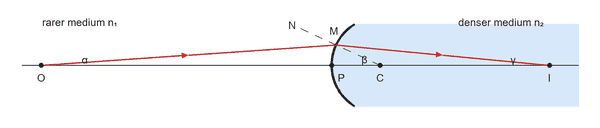
Step 1 — Describe the figure.
In the figure, is a convex spherical surface of radius and centre . It separates a rarer medium of refractive index , on the side of the object, from a denser medium of refractive index , so the convex side faces the rarer medium. The ray along the axis passes undeviated. The ray from the object is refracted at towards the normal and meets the axis at , the real image. Let , and , and let and be the angles of incidence and refraction at .
Step 2 — Write i and r in terms of α, β and γ.
The exterior angle of a triangle equals the sum of the two interior opposite angles. In triangle , the exterior angle at (between and the normal produced to ) is the angle of incidence .
In triangle , the exterior angle at is , and the interior angle at is the angle of refraction .
Step 3 — Apply Snell's law for small angles.
Snell's law at is . For paraxial rays the angles are small, so and (in radians).
Substituting the angles from the previous step gives the next relation.
Step 4 — Write the angles as ratios of lengths.
Draw perpendicular to the axis. For paraxial rays is very close to , so each small angle equals divided by the distance from .
Step 5 — Substitute in (1) and cancel .
Every term now contains , so it cancels.
Step 6 — Apply the New Cartesian signs.
Distances are measured from the pole and are positive in the direction of the incident light. The object is against the light, so . The centre of curvature and the image are along the light, so and .
Step 7 — Rearrange.
Collecting the terms in on the right-hand side gives the result.
Note: This relation holds for any spherical surface (convex or concave, real or virtual image) when the sign convention is used.
Therefore, for refraction at a convex surface facing a rarer medium, .