
Question 635 marksMedium
Define principal focus and focal length of a lens. Explain why a convex lens is called a converging lens and a concave lens is called a diverging lens. State the sign convention used in the case of a lens.
Confirming your payment
Sign up now and get 250 free tokens.
Refraction of Light at Spherical Surfaces - Lenses · Question 63 of 88
Define principal focus and focal length of a lens. Explain why a convex lens is called a converging lens and a concave lens is called a diverging lens. State the sign convention used in the case of a lens.
Solution:
Key idea: A lens bends rays because each part of it acts like a small prism, and a prism bends light towards its base. Whether a lens converges or diverges light depends on which way the bases of these small prisms point.
Step 1 — Define the principal focus.
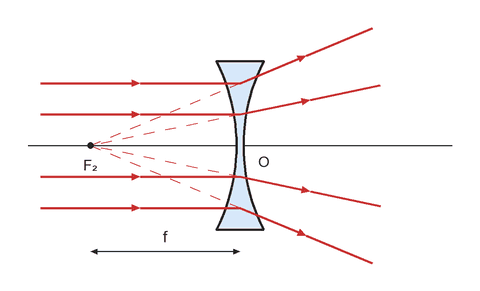
The principal focus of a lens is the point on the principal axis where rays parallel and close to the axis meet after refraction through a convex lens, or from which they appear to diverge after refraction through a concave lens.
Step 2 — Define the focal length.
The focal length of a lens is the distance between its optical centre and its principal focus.
Step 3 — Explain why a convex lens is called converging.
A convex lens is thicker at the middle than at the edges. Each part of it above or below the axis acts like a small prism with its base towards the axis. A prism bends light towards its base, so every ray that does not pass through the optical centre is bent towards the axis. A parallel beam is therefore brought together at the focus , and so a convex lens is called a converging lens.

Step 4 — Explain why a concave lens is called diverging.
A concave lens is thinner at the middle than at the edges. Each part of it acts like a small prism with its base away from the axis, so every ray that does not pass through the optical centre is bent away from the axis. A parallel beam spreads out as if it came from the focus on the incident side, and so a concave lens is called a diverging lens.
Step 5 — State the New Cartesian sign convention for lenses.
The following rules fix the signs of all distances and heights.
With these rules the focal length of a convex lens is positive and that of a concave lens is negative.
Therefore, the principal focus is where parallel rays meet (or appear to come from), the focal length is its distance from the optical centre, a convex lens converges and a concave lens diverges because of the way their prism-like parts bend light, and in the sign convention distances are measured from the optical centre, positive along the incident light.